
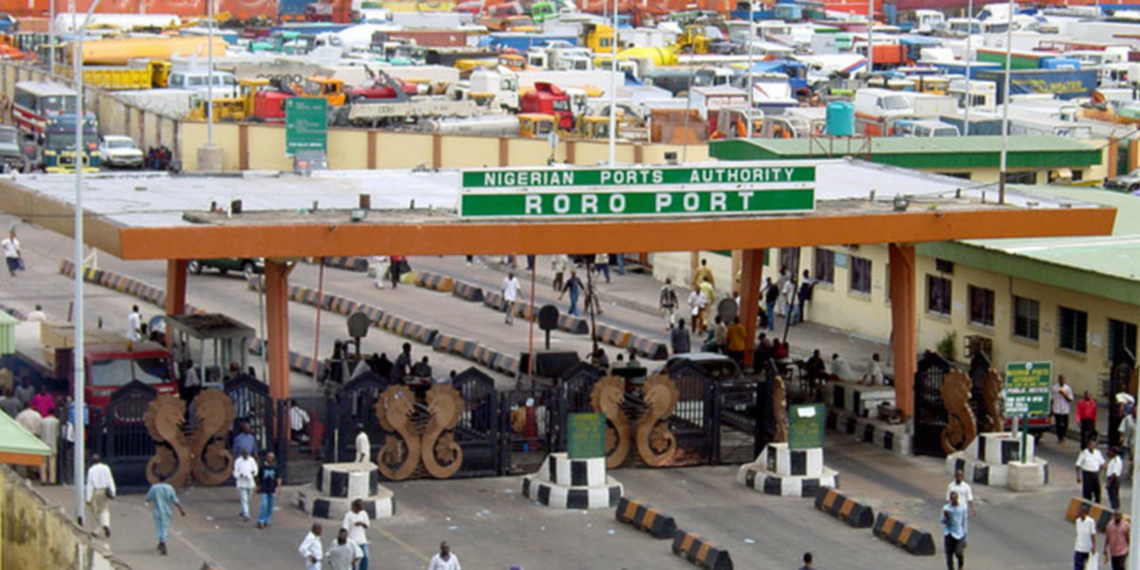
Nigeria’s cargo throughput rose to 32.38 million metric tonnes in the first quarter of 2026, marking an 11.6 per cent year-on-year increase driven by stronger port activity across Nigeria’s maritime sector.
The figure was disclosed by the Nigerian Ports Authority in a statement issued in Lagos and reported by the News Agency of Nigeria.
The performance reflects rising vessel traffic, export growth, and ongoing reforms aimed at improving efficiency across the country’s seaports.
The data also shows a broader expansion in shipping activity, with vessel sizes increasing and container movements strengthening across key terminals, including Lekki Deep Sea Port, Apapa, and Onne.
The Managing Director of the Nigerian Ports Authority, Abubakar Dantsoho, said the sector recorded notable growth in the first quarter of 2026, supported by increased cargo throughput and larger vessel traffic.
Cargo throughput rose by 11.6 per cent year-on-year to 32.38 million metric tonnes in Q1 2026. Ocean-going vessel Gross Registered Tonnage increased by 19.5 per cent to 46.75 million.
“The Managing Director of the Nigerian Ports Authority, Abubakar Dantsoho, says the maritime sector recorded strong growth in the first quarter of 2026, driven by increased cargo throughput, larger vessel traffic and ongoing port reforms,” the NAN report read in part.
It added, “Dantsoho said total cargo throughput rose by 11.6 per cent year-on-year to 32.38 million metric tonnes during the period.”
Outward cargo volumes climbed by 23.7 per cent to 14.13 million tonnes.
Outward laden containers surged by 67.6 per cent to 102,803 TEUs, while vehicle traffic rose 67 per cent to 58,870 units.
Dantsoho attributed the performance to improved cargo efficiency, rising international shipping confidence, and the deployment of larger vessels linked to operations at Lekki Deep Sea Port, as well as expanding regional trade under the African Continental Free Trade Area.
Nigeria’s port system has been undergoing structural changes in recent years, with new deep-sea infrastructure reshaping cargo distribution patterns across the country.
In 2025, total cargo throughput rose by 24.8 per cent to 129.3 million metric tonnes.
Container traffic increased by 25.7 per cent to over 2.1 million TEUs.
Lekki Deep Sea Port accounted for 40.6 per cent of total cargo throughput, emerging as the top-performing terminal.
Onne Port Complex and Apapa Port followed with 19.1 per cent and 16.7 per cent respectively.
The shift has been largely driven by the operational ramp-up of Lekki Deep Sea Port, whose deeper draft and capacity for larger vessels have repositioned Nigeria within regional shipping routes.
Dantsoho noted that reforms under the current administration are focused on modernising infrastructure, expanding digital systems, and restructuring operations to improve competitiveness.
He also disclosed that the $1 billion overhaul of the Lagos Port Complex and Tin Can Island Port is underway following approval of a Memorandum of Understanding.
The Minister of Marine and Blue Economy, Adegboyega Oyetola, added that procurement processes are ongoing for modernisation projects at Warri, Port Harcourt, Onne, and Calabar ports.
Key initiatives include the Port Community System and National Single Window project, both designed to reduce delays, improve transparency, and lower logistics costs.
Investments in rail, inland dry ports, and export corridors are also expected to ease congestion and improve cargo evacuation efficiency.
The latest growth signals strengthening confidence in Nigeria’s maritime infrastructure and its role in regional trade flows.
Dantsoho said Nigeria handles only about 25 per cent of West Africa’s cargo, despite contributing nearly 60 per cent of the region’s GDP, noting that the gap highlights significant untapped potential.
Sustained improvements in port efficiency could position Nigeria as a stronger logistics hub in Africa, particularly as global shipping shifts toward deeper ports and larger vessels.
The continued expansion of export volumes and container traffic also points to improving trade activity, especially under regional integration frameworks such as the AfCFTA.
Nigeria’s port development pipeline is expanding through both private and public sector financing arrangements aimed at boosting capacity and efficiency.
MSC Group signed a 45-year concession with Nigerdock in March to develop a container terminal at Snake Island Port in Lagos.
The project includes a 910-metre quay, deep-sea vessel capacity, and a 30-hectare container yard with expansion options.
A £746 million (about $1 billion) UK-backed financing package will support upgrades at Apapa Port and Tin Can Island Port.
Planned improvements include automation, reduced cargo dwell time, expanded quays, and modern cargo-handling infrastructure.
These developments are expected to reduce vessel turnaround time, improve clearance efficiency, and strengthen Nigeria’s competitiveness in regional and global shipping networks