
The United Nations General Assembly has voted to adopt a new world map that more accurately represents Africa’s true size.
The “Correct the Map” resolution, sponsored by Togo and backed by African Union members, received support from 164 countries, including France and the UK. The United States was the only country to vote against the measure, while six countries abstained.
Although the resolution is non-binding, it is expected to encourage institutions worldwide to use maps that more accurately portray Africa’s actual size.
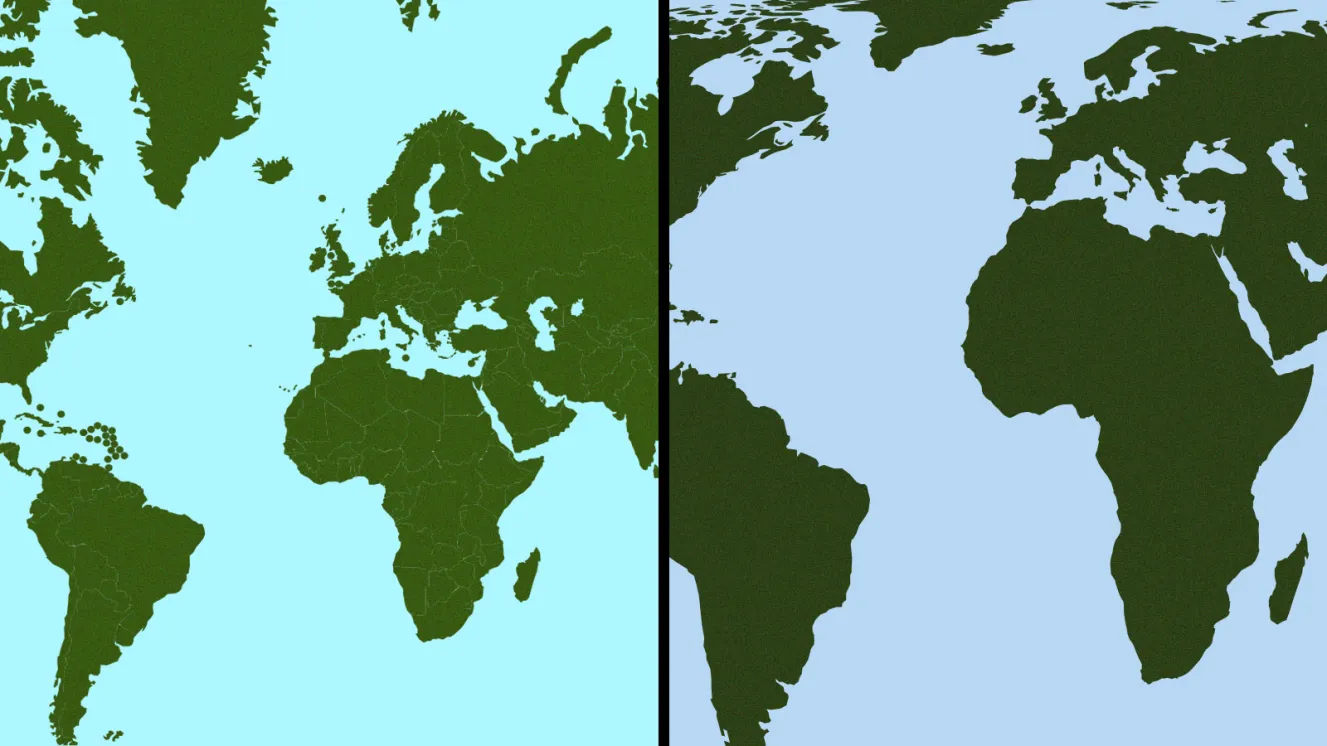
The Mercator projection, which has been widely used since the 16th century, has long been criticised for distorting the size of land masses. It portrays Africa as roughly the same size as Greenland, despite Africa being about 14 times larger.
Critics argue that the distortion has contributed to misconceptions about the scale, development needs and economic potential of countries around the equator.
The Mercator projection was created in 1569 by Flemish cartographer Gerardus Mercator to assist European navigators in plotting routes and travelling across the globe.
The distortion in the Mercator projection stems from the difficulty of accurately depicting the curved surface of the Earth on a two-dimensional map. Any attempt to create a world map therefore involves some degree of compromise.
The Mercator projection represents the Earth’s curvature by exaggerating the size of land masses closer to the poles, while making regions around the equator appear relatively smaller.
To address these distortions, a team of cartographers developed the Equal Earth projection in 2018, an equal-area map designed to provide a more accurate representation of the size of continents.
In February, the African Union’s 54 member states adopted the projection, saying it “more accurately represents the sizes of all continents, particularly Africa.”
Online campaign group #CorrectTheMap said, “You could fit the United States, China, India, Japan, Mexico and much of Europe into Africa and still have land to spare.”
Ahead of Friday’s vote, Togo’s Foreign Minister Robert Dussey told Reuters: “A fair world begins with a fair map.”
Speaking earlier at a UN briefing, Dussey said maps were not neutral because they shape perceptions and influence how people understand the position and significance of different peoples and continents.
Dussey also received support from French Foreign Minister Jean-Noël Barrot, who said France’s foreign ministry would stop using the Mercator projection.
“Changing the map obviously doesn’t change the world. But correcting a representation that distorts it is already an act of truth,” he said.