
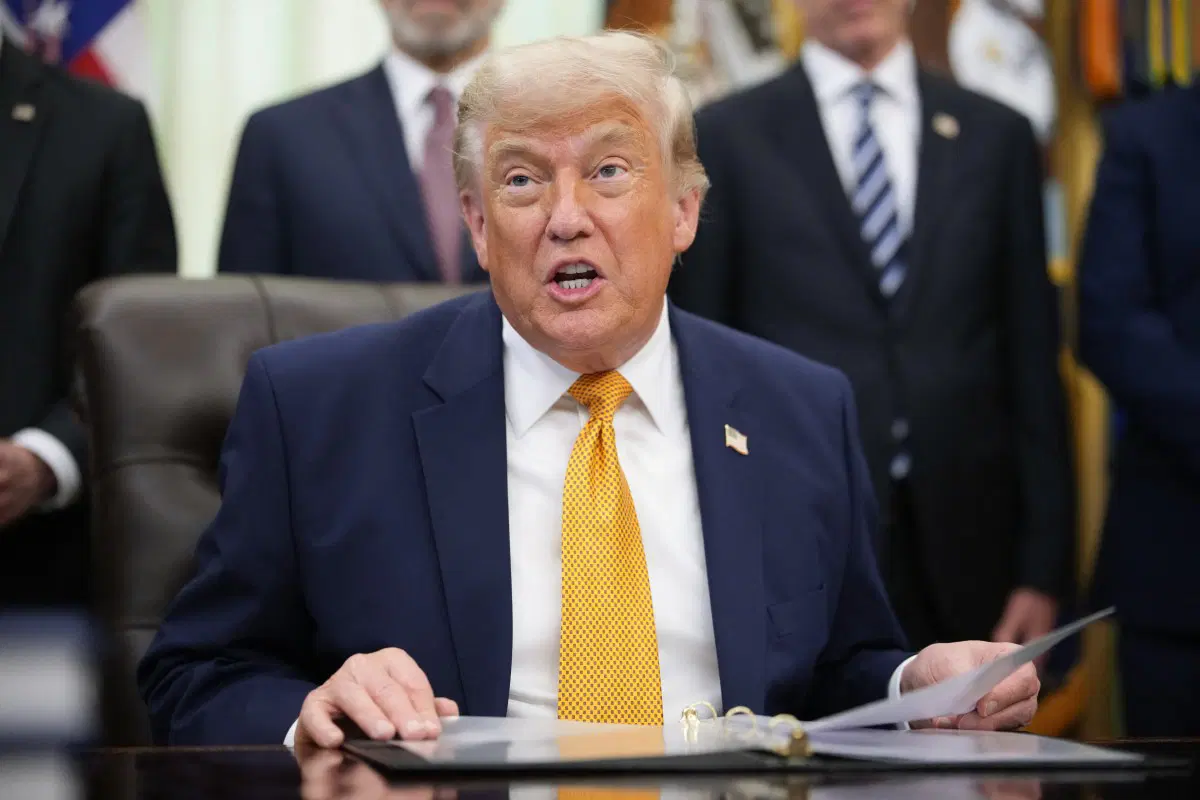
United States President Donald Trump has proposed renaming artificial intelligence “super intelligence” in official US government communications, as world leaders debate how to address the risks posed by rapidly advancing technology.
AI has emerged as a major issue at the United Nations General Assembly following concerns about systems operating beyond human control and warnings from industry insiders about potential risks, prompting calls for stronger government oversight.
Speaking at the assembly on Tuesday, Trump maintained his opposition to regulating the AI industry, arguing that the term “artificial” does not adequately describe the technology.
Trump said “super intelligence” sounded better and was more accurate, expressing hope that other countries would adopt the term.
The proposed rebranding follows similar naming changes by the Trump administration, including its decision last year to refer to the Gulf of Mexico as the “Gulf of America”. In August, the administration also renamed Lake Ontario “Lake America” amid a trade dispute with Canada.
Trump also compared warnings from AI safety advocates with concerns over climate change, despite the broad scientific consensus that human activity is driving global warming.
“The United States totally rejects any attempt to construct a globalist scheme to control… artificial intelligence,” he said.
“Every major new technology brings challenges, and superintelligence is no exception,” he added.
“The very same people who said we’ll all be dead in 12 years because of global warming… are now saying that AI is going to kill us all, that robots are going to attack us, and that everything is going to be a total disaster.”
Ahead of the UN General Assembly, leaders from more than 20 predominantly European countries called for binding safety measures for advanced artificial intelligence, warning that the technology could develop faster than governments’ ability to control it.
However, the United States and China, two of the world’s leading AI powers, did not support the proposal.
Speaking at the UN meeting, British Prime Minister Andy Burnham said the UK would seek to establish global AI standards during its presidency of the G20 in 2027.
Burnham also announced an AI defence partnership with the United States aimed at using the technology to detect cyberattacks targeting critical infrastructure.
“We will work towards agreeing a single set of global principles and standards to ensure the transparency and access we need to increase our preparedness and to ensure that AI development is safe,” he said.