





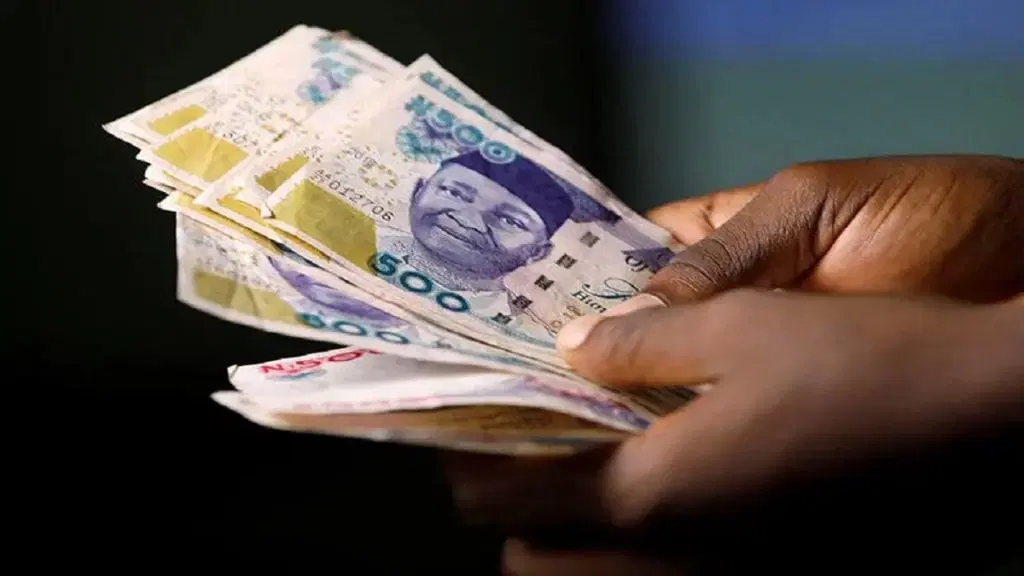
The amount of cash held outside Nigeria’s banking system declined to N4.92 trillion in June 2026, the lowest level in seven months.
This is according to the latest Money and Credit Statistics released by the Central Bank of Nigeria.
The latest figure marks a significant retreat from the elevated cash levels recorded at the end of 2025, suggesting that more physical currency is gradually returning to the banking system amid the CBN’s continued push to deepen digital payments and reduce dependence on cash transactions.
Nairametrics reported that currency outside banks fell from N5.41 trillion in December 2025 to N4.92 trillion in June 2026, representing a decline of N485.80 billion or 8.98 per cent over six months.
The June figure was the lowest since November 2025, when cash outside banks stood at N4.91 trillion.
While currency outside banks fell significantly, the overall stock of currency in circulation recorded a much milder decline.
Total currency in circulation dropped from N5.73 trillion in December 2025 to N5.52 trillion in June 2026, a reduction of N209.56 billion or 3.66 per cent.
The faster decline in cash held outside banks compared with total currency in circulation indicates that a larger proportion of physical cash was deposited back into commercial banks during the period rather than being permanently withdrawn from circulation.
However, the six-month decline was not entirely linear.
Currency outside banks fell from N5.41 trillion in December to N5.25 trillion in January before declining further to N5.19 trillion in February.
Although the CBN dataset does not include the March 2026 figure, the stock reduced further to N5.08 trillion in April.
The downward trend was briefly interrupted in May, when cash outside banks rose to N5.19 trillion, representing an increase of N109.34 billion or 2.15 per cent compared with April.
However, that increase proved temporary.
In June, currency outside banks declined by N270.97 billion month-on-month to N4.92 trillion, representing a 5.22 per cent contraction, the largest monthly decline recorded within the available dataset.
Nairametrics reported that 89.11 per cent of all currency in circulation was outside banks in June 2026, compared with 91.27 per cent in May 2026 and 89.74 per cent in June 2025.
This means that for every N100 in circulation, Nigerians held approximately N89.11 outside banks in June 2026, compared with N91.27 a month earlier.
The month-on-month decline of 2.16 percentage points indicates that a larger share of physical cash returned to the banking system during June.
Compared with June 2025, the ratio also eased by 0.63 percentage points, suggesting a gradual improvement in formal cash intermediation despite the overall increase in currency circulating within the economy.
The contrast becomes even clearer when compared with December 2025.
At the end of last year, approximately 94.33 per cent of all currency in circulation was held outside banks, leaving only 5.67 per cent within the banking system.
By June 2026, the outside-bank share had fallen by more than five percentage points to 89.11 per cent, while the proportion of cash retained within banks nearly doubled to 10.89 per cent.
The figures suggest that although Nigeria remains a predominantly cash-based economy, the balance is gradually shifting.
Nearly nine out of every ten naira in circulation is still held outside banks, highlighting the country’s continued dependence on physical cash, particularly within the informal economy.
Despite the rapid growth of instant payment platforms, mobile banking applications, fintech services and agent banking networks, cash continues to play a central role in retail trade, transportation, informal commerce and rural economic activities.
At the launch of the Nigeria Payment System Vision, PSV, 2028 recently in Abuja, CBN Governor Olayemi Cardoso said the new vision builds on Nigeria’s progress in digital payments and seeks to accelerate the country’s transition towards a more inclusive and technology-driven financial ecosystem.
The apex bank aims to reduce cash circulating outside the banking system to below 40 per cent of total currency in circulation.
More than 10 million QR-code and tap-to-pay acceptance points are expected to be deployed across markets, transport hubs, rural communities, and commercial centres nationwide.