The Federal Government has set a target of generating 70,000 megawatts of electricity by 2030 as it plans to expand power infrastructure to meet growing demand from industries, businesses and households.
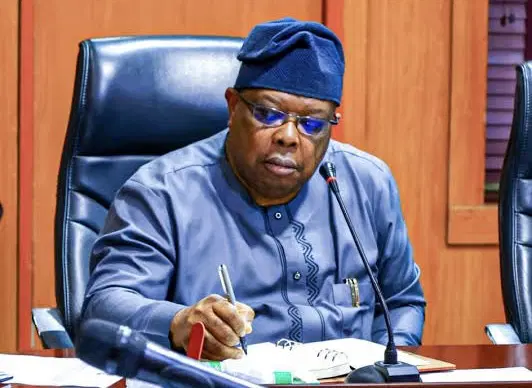
The Minister of Power, Joseph Tegbe, disclosed this on Tuesday at the ongoing 13th Nigeria Energy Leadership Summit in Lagos, where he outlined measures to stabilise the national grid, improve electricity supply and increase generation capacity.
Tegbe acknowledged the significant gap between Nigeria’s current electricity supply and the proposed target but said the country must prepare for rising demand driven by industrialisation, technological advancement and the rapid expansion of data centres.
Despite having an installed generation capacity of more than 13,000MW, Nigeria currently generates less than 5,000MW of electricity.
Tegbe said the target of generating 70,000MW by 2030 should not be constrained by current capacity, noting that the growing number of data centres worldwide was driving up electricity demand.
“Our plan still remains that by 2030, we’re looking at 70 gigawatts for Nigeria. People will ask me question: ‘You’re struggling with 5GW; you’re struggling with 4GW, yet you have an ambition to reach 70GW. The US today has a gap of 357GW just due to AI and data centres alone, not population expansion… Nigeria will not be left behind,” he stated.
The minister said the government’s long-term expansion plans included an East-West Grid programme aimed at strengthening the national transmission network and improving electricity supply across key economic corridors.
Tegbe also announced plans to develop small hydropower projects, noting that 21 dams along the Sokoto-Badagry Expressway had been identified for potential development.
“It will interest you that 21 dams were discovered along the Sokoto–Badagry Express Road, and the President said we should fix and sort out those dams and ensure that those dams actually result into proper hydro project,” he said.
He added that the government would pursue the Mambilla hydropower project alongside smaller schemes to supply electricity to agricultural corridors, processing clusters and local communities.
The minister said the Federal Government would collaborate with state governments, regulators and private operators to coordinate electricity projects and improve supply across the three corridors.
Addressing the sector’s financial challenges, Tegbe disclosed that the government had paid N1.23tn of the N3.3tn legacy debt owed to power generation companies. He said the government was considering structured settlements, payment assurance mechanisms and legally permissible net-off arrangements to clear outstanding obligations and prevent further debt accumulation.