




The President of the Film Educators Guild of Nigeria, Professor Osakue Omoera, has said Nigeria’s creative industry can strengthen its global competitiveness by commercialising indigenous stories, languages and cultural narratives instead of imitating foreign content.
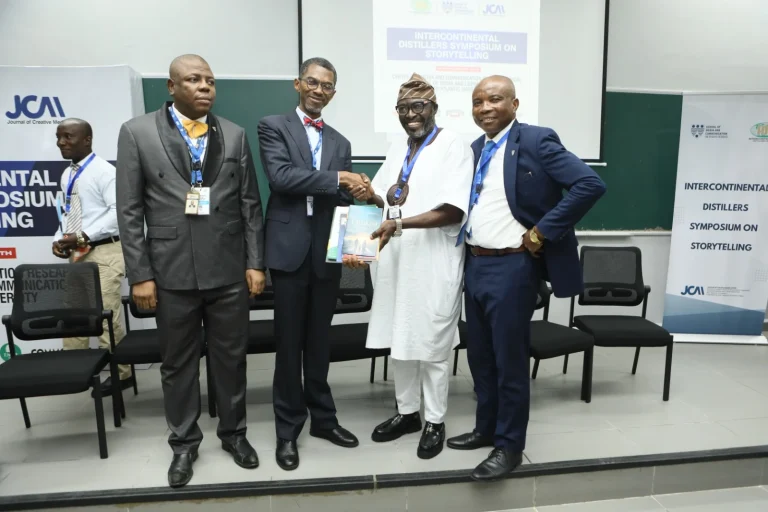
Omoera made this disclosure at the International Distillers Symposium on Storytelling organised by the Centre for Media and Communication Research, Pan-Atlantic University, held recently in Lagos.
Pro. Omoera said that Nigeria possesses one of the world’s richest storytelling ecosystems capable of driving economic value across film, advertising, publishing and digital media.
He said digital platforms have made content creation widely accessible, shifting the focus from simply producing more content to developing stories that engage audiences, shape opinions, and deliver enduring value.
“The challenge is no longer creating content; it is creating content that connects, that endures, of course, that influences,” Omoera said. “Strategic storytelling transforms content into cultural, social and economic value.”
According to the Don, Nigeria’s diverse ethnic groups, languages and traditions provide an enormous competitive advantage that remains underutilised by content creators seeking international audiences.
“Nigeria’s greatest competitive advantage is Nigeria,” he said. “The Nigeria should not de-Africanise itself in an attempt to become international.”
Prof. Omoera, who is also the Dean, Faculty of Humanities, Federal University Otuoke, Bayelsa State, argued that successful global entertainment industries such as those in South Korea, Japan and Latin America achieved international recognition by first telling authentic local stories before exporting them worldwide.
Drawing parallels with Nollywood, he maintained that Nigerian filmmakers, writers and digital creators should prioritise local realities while ensuring global relevance.
“Nollywood achieved international recognition by responding to local realities using local nuances and serving local audiences first,” he said, adding that “universal storytelling begins with African cultural foundations.”
Furthermore, he urged creators to see indigenous languages as valuable commercial assets that can distinguish Nigerian content in global markets, rather than relying solely on English.
“We believe we can focus on our indigenous language in content creation, using even pidgin,” he said. “Every language carries a culture; every culture carries a story.”
While acknowledging the growing influence of artificial intelligence in content production, he stressed that technology cannot replace human creativity and cultural authenticity.
“Human vision gives technology its cycles. AI cannot do everything, even in storytelling,” he said. “The best option… is that there will be a fusion of human and AI.”
The symposium featured panel discussions and interactive sessions examining the intersection of storytelling, culture, development and media innovation.
Participants explored strategies for preserving indigenous narratives, promoting cultural values and leveraging storytelling to address contemporary social and developmental challenges.
The event brought together scholars, researchers, communication professionals, policymakers, students and creative industry practitioners from across Nigeria and beyond.