
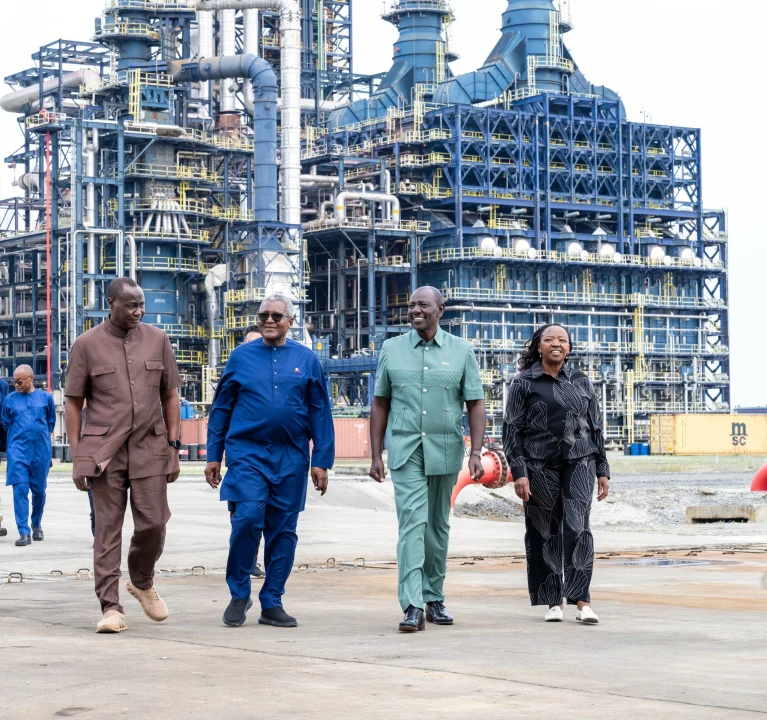
Kenyan President William Ruto has said his government is fast-tracking administrative processes for the proposed Dangote refinery in Lamu, Kenya, as Africa’s richest man, Aliko Dangote, said the planned facility would be larger than the existing refinery in Nigeria.
Ruto made this known on Friday during a tour of the Dangote Industries Limited’s petroleum refinery in Lekki, Lagos, ahead of the September 30 groundbreaking ceremony for the proposed 700,000-barrel-per-day refinery in Lamu.
The Kenyan President said the government had already secured land for the project and was working to meet other requirements to remove bureaucratic bottlenecks and prevent delays in the construction and eventual operation of the refinery.
He described the proposed refinery as a regional project that would drive industrial development across East Africa, create jobs and enhance the technical capacity of the region’s workforce.
“I just want to tell the Dangote family here that the government of Kenya is one hundred per cent behind your project, our project. We have already secured the land that is necessary for this.
“We are working on all the other enablers to make sure that we don’t spend time on doing administrative bureaucratic stuff. We spend time on doing what we must do so that at the earliest opportunity we can refine products out of Lamu in Kenya,” Ruto said during the visit.
The assurance came as Dangote unveiled plans for a larger industrial complex in Kenya, including a 1,000-megawatt power plant with twice the generation capacity of the one at his Lagos refinery.
Dangote said the visit was arranged to give Ruto a firsthand view of the Lagos refinery and the scale of the investment before the Kenyan President embarks on a similar project in Kenya.
He said Ruto’s presence at the facility would provide an opportunity to understand the infrastructure, equipment and technical requirements involved in developing a refinery of such scale.
Dangote described the visit as an important show of support for the proposed Lamu investment, noting that the Kenyan project would have broader economic benefits beyond petroleum refining.
He said the refinery would serve as a catalyst for further investment by attracting businesses and industries that could leverage the infrastructure and petroleum products to be produced at the facility.
Dangote also disclosed that the proposed Kenyan project would include a one-million-tonne polypropylene plant, similar to the petrochemical facility at the Lagos complex, to support the growth of downstream industries.
Polypropylene is used to manufacture a wide range of industrial and consumer products, including plastic pipes, electrical cable coverings and furniture.
Dangote said the Lamu project would also feature additional processing facilities not available at the Lagos refinery, reflecting differences in the crude oil characteristics and product requirements of the two facilities.