
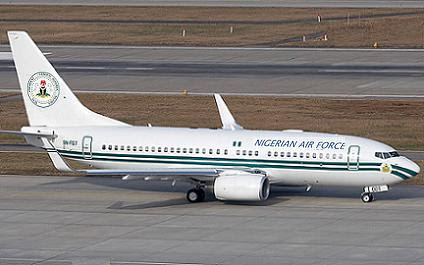
The Presidential Air Fleet received at least N4.24bn in disbursements between June and December 2025, the latest updates on GovSpend, a civic technology platform that tracks and analyses Federal Government spending, have revealed.
Findings by The PUNCH also revealed that the disbursements, made into the Presidential Air Fleet naira transit account operated by the Presidential Air Fleets (State House), were recorded in eight separate transactions across three months of June, July and December 2025, with the bulk of the transfers concentrated in July, when four transactions totalling N2.43bn were made in the space of a week.
A breakdown of the transactions shows that N1.285bn was disbursed on June 12, followed by N430m on July 24, N1.28bn on July 25, N92m on July 29, and N626m on July 31.
In December, three further disbursements were recorded. They include N9m on December 18, described in the GovSpend database as “Presidential Air Fleet forex transit funds,” N343.9m on December 30 and N90.9m on December 31.
Four of the eight transactions carry no accompanying description, listed simply as “None,” a pattern consistent with previous disbursements to the transit account.
Most disbursements to the Presidential Air Fleet transit account are labelled “Forex Transit Funds,” typically funds allocated for foreign exchange requirements to facilitate international transactions, covering expenses related to operations outside the country, including fuel purchases, maintenance or services in foreign currencies.
The new figures add to a growing cumulative spend that has accelerated significantly since Tinubu assumed office.
At least N26.38bn was spent on the operations of the Presidential Air Fleet from July 2023 to December 2024, with N14.15bn disbursed in 2024 alone.
The Presidential Air Fleet’s total budget allocation stood at N17.32bn in 2025, declining to N14.70bn in 2026.
The reduction was driven mainly by decreased capital expenditure.
Engine overhaul projects across the fleet consumed N4.58bn in 2024, N8.65bn in 2025 and N6.05bn in 2026, bringing the three-year aggregate to N19.27bn.
Since 2017, under the Buhari administration, budgetary allocations for the fleet have shown a growing trend, with one exception in 2020, rising from N4.37bn in 2017 to N20.52bn in 2024, a 370 per cent increase in running costs over seven years.
In an interview with our correspondent, the General Secretary of the Aviation Round Table, Olumide Ohunayo, had blamed the meteoric rise on the age of some of the aircraft in the fleet and the declining value of the naira, as well as the “commercial use” of aircraft by the Nigerian Air Force.
Ohunayo explained, “The cost will definitely increase over the years because, for one, this issue of the naira against the dollar.
As the naira keeps falling to the dollar, we will see a rise in cost because most of the costs of training crew and engineers and replacing aircraft parts are all in dollars.
Also, some of these aircraft are not new. The older the aircraft, the higher the cost of maintenance and operation.
Lastly, during these past years, terrorism and insecurity have increased in Nigeria, which has also affected the cost of insuring the aircraft.”
In late April 2024, Tinubu was compelled to charter a private jet to continue his journey to Saudi Arabia after the state-owned Gulfstream 550, which had been assigned to carry him, developed an unspecified technical fault in the Netherlands, forcing him to abandon the aircraft mid-tour.
The episode had prompted the House of Representatives Committee on National Security and Intelligence to recommend the procurement of two new presidential aircraft.
In August 2024, the official Boeing 737 business jet for the President was replaced with an Airbus A330 purchased for $100m through service-wide votes.
The nearly 15-year-old plane, an ACJ330-200, VP-CAC (MSN 1053), is “spacious and furnished with state-of-the-art avionics, customised interior and communications system,” Tinubu’s Special Adviser on Information and Strategy, Mr Bayo Onanuga, said, adding “it will save Nigeria huge maintenance and fuel costs, running into millions of dollars yearly.”
From February through July 2025, the President flew a San Marino-registered BBJ (REG: T7-NAS).
Sources who spoke to one of our correspondents confirmed that the primary aircraft had been flown to South Africa to change its colours to reflect the office of the President. It was flown back in July 2025.
The Presidential Air Fleet comprises a fixed-wing fleet that includes the Airbus ACJ330-200, a Gulfstream G550, a Gulfstream G500, two Falcon 7Xs, a Hawker 4000 and a Challenger 605, three of which are reportedly unserviceable.
The rotor-wing fleet includes two Agusta 139s and two Agusta 101s, operated by the Nigerian Air Force under the supervision of the Office of the National Security Adviser.
The CEO of Centurion Security Limited, John Ojikutu, argued that the disbursements for the air fleet operations were justified considering all related expenses.
“That’s not a big deal. If they are going for repair, particularly for C-checks. It’s always around that range.
They will fly it abroad, buy fuel, catering, and hotel bills are also involved; pilots will fly it back, and the figure likely includes far more than the direct cost of repairing the aircraft,” Ojikutu explained, adding that the figure likely includes far more than the direct cost of operating the aircraft.
The Presidency did not respond to inquiries on the nature of the specific disbursements captured in the recent data.
As of the time of filing this report, calls to the Special Adviser to the President on Information and Strategy, Bayo Onanuga, went unanswered.
In an earlier interview with our correspondent, Onanuga had argued that the costs of maintaining the air fleet are not for the President but in the interest of Nigerians.
“It’s not President Tinubu’s plane; it belongs to the people of Nigeria, it is our property…the President did not buy a new jet; what he has is a refurbished jet, but it is a much newer model than the one President Buhari used.
Nigerians should try to prioritise the safety of the President. I’m not sure anybody wishes our President to go and crash in the air.
We want his safety so that he can hand it over to whoever wants to take over from him,” Onanuga said.