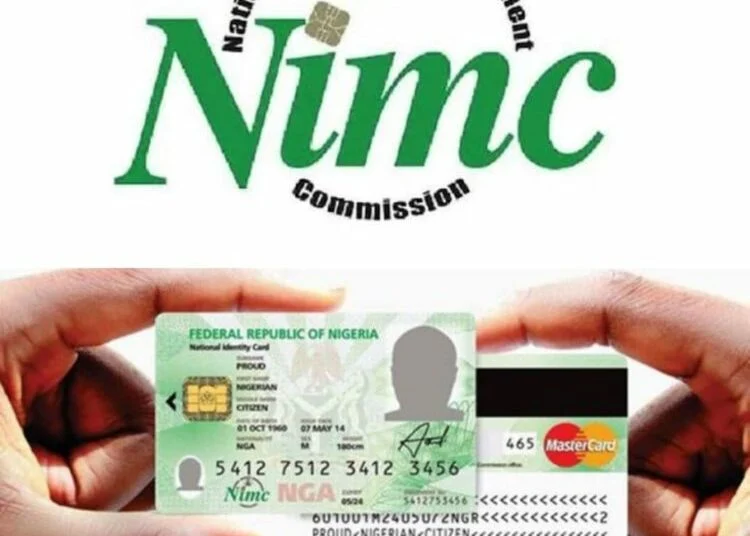


The National Identity Management Commission has dismissed claims suggesting that Nigeria does not have a functional National Identity Database, describing the assertion as misleading and contrary to the realities on the ground.
In a statement signed by the Head of Corporate Communications Unit, Kayode Adegoke, the Commission said the National Identity Database is fully operational, secure, and actively supporting identity verification, authentication, and service delivery across the country.
According to NIMC, the database, established under the NIMC Act No. 23 of 2007, currently contains records of more than 130 million Nigerians, each assigned a unique National Identification Number (NIN).
NIMC’s reaction follows a claim on Saturday by the Minister of Defence, retired Gen. Christopher Musa, that weak national database system has been the major factor undermining efforts to combat insecurity, kidnapping and other crimes in the country.
The Commission said that the system’s storage capacity has also been expanded from 100 million to 250 million records to support broader national coverage and future enrollment growth.
“NIMC is statutorily mandated to establish, own, operate, maintain, and manage the National Identity Database.
“This centralised, biometric-based database is fully functional, secure, and actively supporting identity verification, authentication, and service delivery across Nigeria,” the statement noted.
The agency further highlighted its real-time Verification and Authentication Services, which it said enable seamless identity confirmation for government institutions, financial service providers, and other partner organizations.
It also referenced the launch of NINAuth, a digital identity authentication platform designed to facilitate secure biometric and demographic verification against the central database.
According to the Commission, the National Identity Database is currently being utilized by security agencies, law enforcement bodies, and various Ministries, Departments, and Agencies (MDAs) for identity verification, background checks, and operational efficiency.
NIMC said the database also supports the harmonization of existing government databases while playing a critical role in fraud prevention, public service delivery, and national security operations.
“Several security agencies are utilising the National Identification Number through the National Identity Database to tackle security challenges and eliminate any threat to national security,” the Commission stated.
The agency reiterated its commitment to data security, privacy protection, and continuous improvement in line with global best practices, describing the National Identity Database as a major component of Nigeria’s digital public infrastructure.
Before now, many Nigerians have been questioning the usefulness of the Nigerian identity database and the mandatory linkage of mobile numbers with the NIN, in the face of the rising cases of kidnapping across the country.
Speaking on Saturday at the Nigerian People’s Strategic Conference and Defence Exhibition 2026 in Abuja, the Defence Minister said the absence of a comprehensive and integrated national database has made it difficult for security agencies to effectively identify, track and arrest criminals.
According to him, modern criminal and terrorist networks have become increasingly sophisticated and often exploit weaknesses in identity management and information sharing to evade detection.
“We are struggling because we do not have a proper database. Without accurate information and timely intelligence, it becomes difficult to identify, track and apprehend criminal elements operating within our communities,” Musa stated.
The minister noted that many kidnappers, bandits and criminal groups take advantage of gaps in Nigeria’s data infrastructure, making security operations more challenging.
The last NIN enrollment data published on the NIMC website as of the time of filing this report is for October 2025.
Although the Commission says the database now contains the records of over 130 million Nigerians, the October data shows 123.9 million NINs had been issued at the time.
The NIMC data shows that the highest cumulative enrolment figure of over 13.1 million was recorded in Lagos State.
The State has maintained the top spot since the beginning of the registration exercise alongside Kano State, which occupies the second position with 11.5 million enrolments as of October 2025.