

Nigeria’s headline inflation is forecast to rise to 16.42 per cent year-on-year in April 2026, as sustained pressure from food prices, higher energy costs and elevated global commodity prices continue to shape the domestic price environment.
The projection is contained in the Financial Market Dealers Association Inflation Forecast report for April 2026, released on Wednesday, May 13, 2026, based on data from the National Bureau of Statistics, the World Bank, and the Food and Agriculture Organisation.
On a month-on-month basis, FMDA projects headline inflation at 2.78 per cent in April, moderating from the 4.18 per cent recorded in March — but remaining elevated against the broader disinflation trend that had been building since the second half of 2025.
The forecast marks a reversal of the steady year-on-year deceleration that began in August 2025 and had brought annual inflation down from a peak of 27.35 per cent in March 2025 to a low of 15.06 per cent in February 2026, before it began to creep back up to 15.38 per cent in March 2026.
The FMDA report identifies a confluence of global and domestic factors driving the April inflation forecast, with energy costs and food prices at the centre of the projected pickup.
On a month-on-month basis, April’s projected 2.78 per cent increase compares with 4.18 per cent in March, 2.01 per cent in February and a deflation reading of -2.88 per cent in January 2026.
Year-on-year, inflation is forecast at 16.42 per cent in April, up from 15.38 per cent in March — the first back-to-back monthly acceleration in annual inflation since mid-2025.
Average PMS prices surged to N1,322.50 in April from N1,208.38 in March, a 9.44 per cent increase, though significantly lower than the 37.35 per cent spike recorded in March.
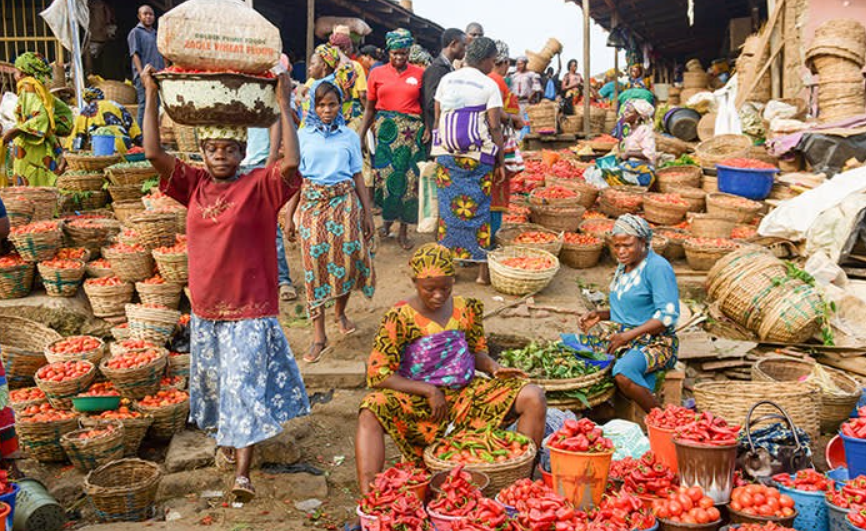
The domestic food price index rose to 3.69 in April from 3.60 in March, driven by increases across major staples, with yam recording the sharpest rise at 3.98 per cent.
Watermelon, maize, millet and sorghum also posted moderate price increases during the month.
The report notes that while energy-related inflationary pressures persist, the moderation in the pace of fuel price increases — combined with naira appreciation — may help partially contain the overall inflation outcome in April.
The naira appreciated 1.36% on average to N1,361.22/$ in April from N1,379.98/$ in March.
The FMDA report highlights a significant tightening in global commodity conditions during April, which is feeding through to Nigeria’s domestic price environment via import costs and energy prices.
Brent crude oil surged sharply to $120.4 per barrel in April from $103.7 per barrel in March, a development the report links to renewed geopolitical tensions in the Middle East and the impact of the Strait of Hormuz crisis on global supply chains.
The World Bank Energy Index rose to 146.4 points in April from 130.6 points in March.
The FAO Food Price Index increased by 1.6 percent to 130.7 points, marking its third consecutive monthly gain, driven by higher cereal, vegetable oil and meat prices.
The World Bank Food Index rose to 118.5 points in April from 116.7 points in March, while wheat prices climbed to $282 per metric tonne from $276 and maize to $214 per metric tonne from $212.7.
Globally, 72% of tracked countries recorded higher inflation in April, up from 67% in March, reflecting broad-based global inflationary pressures.
United States inflation rose to 3.8% in April from 3.3%, while Euro Area inflation increased to 3.0% from 2.6%.
Across Africa, Kenya’s inflation accelerated to 5.6% from 4.4%, while Ghana edged up to 3.4% from 3.2%.
The FMDA notes that the combination of higher global energy and food prices, alongside supply disruptions linked to the Strait of Hormuz crisis, presents a challenging external environment for Nigeria’s import-dependent economy.
The April inflation forecast comes at a sensitive moment for monetary policy, with the Central Bank of Nigeria having spent the better part of 2025 engineering a sustained disinflation through aggressive interest rate tightening and liquidity management.
Nigeria’s year-on-year inflation fell from a record 27.35% in March 2025 to 15.06% in February 2026 — a decline of more than 12 percentage points over eleven months — driven by base effects, naira stabilisation and aggressive CBN monetary tightening.
The projected uptick to 16.42% in April reflects the re-emergence of cost-push pressures rather than a breakdown in monetary policy credibility, with the March fuel price shock now feeding fully into the April price data.
The moderation in month-on-month inflation from 4.18% in March to a projected 2.78% in April suggests that the worst of the fuel price pass-through effect may have already peaked.
Domestic commodity prices for major food staples remain on an upward trend, with the exception of rice, which eased marginally by 0.13% in April — offering limited relief to consumers facing broader food cost pressures.
The persistence of global energy price shocks, particularly if Brent crude remains elevated above $120 per barrel, could sustain upstream cost pressures on domestic transportation, logistics and food production well into the second quarter of 2026.
With the CBN’s Monetary Policy Committee expected to weigh these developments at its next meeting, the FMDA’s April inflation forecast adds to a growing body of evidence that Nigeria’s disinflation journey faces renewed headwinds.