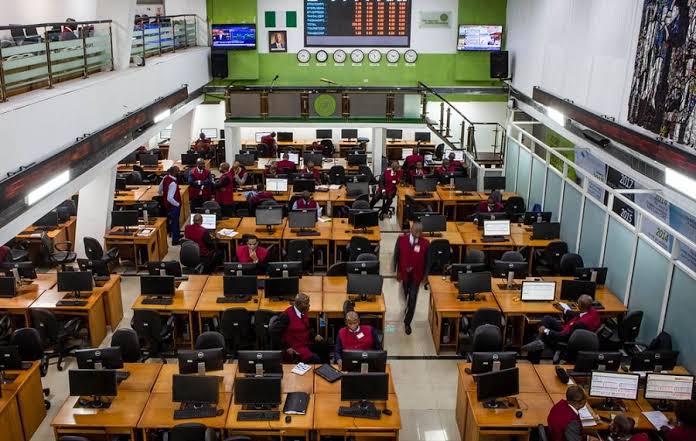


Nigerian stocks have lost more than N5 trillion in value since June 1 as profit-taking activities gathered pace on the Nigerian Exchange, following months of strong gains that pushed the market to unprecedented levels.
The market capitalisation had surged beyond N160 trillion at the end of May, reflecting the remarkable performance recorded by listed equities during the first five months of the year.
At the close of May, investors had gained more than N60 trillion year-to-date, translating to returns exceeding 60 per cent.
Despite the recent decline, the N5 trillion reduction in a market capitalisation valued at over N160 trillion is viewed as a relatively small correction. Market analysts consider it a healthy adjustment after a prolonged period of rapid growth.
The NGX All-Share Index had remained in deeply overbought territory for an extended period, based on the Relative Strength Index. The index frequently traded above 75 and, at times, surpassed 80 following strong rallies in major banking stocks and industrial heavyweights such as Dangote Cement, MTN Nigeria, BUA Group companies and Seplat Energy.
Available NGX data indicate that sudden bouts of panic selling have generally remained under control. These episodes are often linked to sector-specific shocks or short-term profit-taking in blue-chip stocks rather than signs of a broader economic crisis.
Analysts note that several strong macroeconomic factors continue to support the market despite persistent inflationary pressures and the depreciation of the naira. These forces, combined with structural changes in the market, have helped sustain investor confidence.
The local equity market has gained approximately N120 trillion in value under the current administration, while the Nigerian banking industry has witnessed significant liquidity inflows.
One of the key drivers of market activity has been the Central Bank of Nigeria’s recapitalisation directive, which requires banks to raise their minimum capital levels. The policy has triggered a wave of restructuring and capital-raising activities across the banking sector. Investors have responded positively, with fresh funds flowing into major banks and little evidence of widespread panic selling.
Institutional investors, particularly pension fund administrators, have also adjusted their investment strategies. Traditionally attracted to government bonds and other fixed-income instruments, many have shifted their focus to equities as inflation continues to erode real returns on fixed-income investments.
As a result, major local asset managers and pension funds have channelled more than N1.4 trillion into equities in a bid to hedge against the weakening naira.
This steady influx of domestic capital has provided substantial support for the stock market and reduced the likelihood of a prolonged market downturn. Leading companies in the consumer goods, telecommunications and industrial sectors, including Dangote Cement and BUA Cement, have continued to demonstrate resilience and adaptability in the face of economic challenges.
The market is currently trading at a Price-to-Earnings (P/E) ratio of about 13.6 times, significantly above its three-year average of 9.5 times. This suggests that investors remain optimistic about future corporate earnings growth and the long-term prospects of the economy.
However, analysts warn that several risks could challenge the market’s current trajectory.
A more aggressive monetary policy stance by the Central Bank of Nigeria, particularly through further interest rate increases aimed at curbing inflation, could improve returns on fixed-income securities and make them more attractive to investors.
Such a development could encourage a shift of funds from equities back into bonds, potentially reducing liquidity in the stock market and triggering a more pronounced correction.
Another concern is the possibility of share dilution. Should banks and large corporations issue substantial volumes of new shares to meet regulatory capital requirements or strengthen their balance sheets, existing shareholders could see the value of their holdings diluted. Investors are therefore advised to monitor these developments closely.
Market analysts have also identified the 240,000 to 242,000-point range as an important psychological support zone for the All-Share Index.
According to market observers, “The 240,000- 242,000 psychological support: This zone ties directly into the main structural breakdown zone from late April. If the profits take the ASI into this zone, watch volume expansion. A bounce here supports the overall macro uptrend while a clear break under implies the correction has further room to travel.”
They further advised investors to pay close attention to trading volumes during periods of market weakness.
“Monitor volume closely on these days: drops of 1% on falling/waning volume mean sellers are getting fatigued. Consecutive days of multi-trillion Naira declines, accompanied by increasing volume (which we saw on the heavy selling of large-cap industrials) signal that the institutional rotation is incomplete.”