


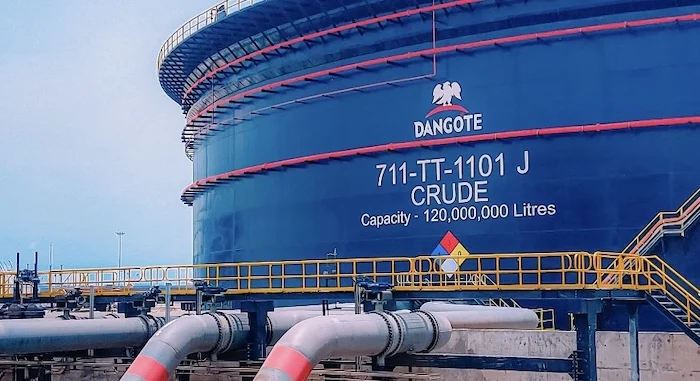
Dangote Petroleum Refinery’s offshore marine terminal has recorded approximately 1,100 tanker calls since commencing operations and currently handles about 75 tanker visits each month.
The company said the number of tanker calls is expected to increase to between 900 and 1,000 annually as the refinery ramps up to full capacity.
The figures highlight the growing scale of marine operations supporting the refinery, which relies on a dedicated offshore terminal to receive crude oil from some of the world’s largest tankers and export refined petroleum products through an extensive subsea pipeline network.
Speaking at the refinery’s Landfall Point, also known as the Trestle, Rana explained that the facility serves as the link between the refinery and its offshore marine infrastructure.
“We are now clocking about 75 tanker calls a month. We are looking to scale to 900 to 1000 tanker calls per year as the refinery is ramped up to full capacity already.“
“Today we have clocked approximately 1100 tanker calls already, changing the energy landscape and maritime economy, bringing Nigeria to the forefront, not only by the refinery but for the maritime trade as well,” Captain Rana stated.
Rana explained that the Landfall Point is the point where pipelines from the refinery’s offshore Single Point Mooring (SPM) terminals come ashore before connecting to the processing facilities.
According to him, crude oil delivered by large tankers is discharged at the offshore SPMs and transported through subsea pipelines to storage tanks. From there, it undergoes crude distillation before moving through secondary and tertiary refining units.
Once refined, finished petroleum products are pumped through separate pipelines back to the offshore terminals for export or domestic distribution.
Rana said the refinery operates five offshore Single Point Mooring terminals, with two dedicated to crude oil imports and three used to load refined petroleum products. The arrangement enables crude imports and product exports to be handled efficiently.
He said the offshore loading system was deliberately adopted because very large crude carriers require natural water depths of about 21 to 22 metres. This allows the refinery to receive some of the world’s largest oil tankers without the significant capital and maintenance costs associated with the dredging required to develop conventional ports.
Rana disclosed that one of the largest vessels to berth at the terminal delivered three million barrels of crude oil, while Very Large Crude Carriers carrying around two million barrels routinely call at the refinery.
The terminal also regularly receives one million-barrel cargoes aboard Suezmax tankers from both local and international sources.
He added that the refinery’s offshore location also provides operational advantages, including the absence of cyclones, typhoons and other severe weather events, enabling marine operations to continue throughout the year.
Nigeria’s Dangote Petroleum Refinery has raised $2.5 billion through a private placement as it prepares for a planned initial public offering later this year, strengthening its financial position ahead of its next phase of expansion.
The fundraising was confirmed by the refinery’s Group Executive Director, Devakumar Edwin, in comments reported by Reuters.
The fresh capital is expected to support the refinery’s expansion plans as it continues to ramp up production and strengthen its presence in Nigeria’s domestic fuel market and export destinations.
The development follows an earlier report by Nairametrics in June that valued the Dangote Petroleum Refinery at $39.1 billion as it sought to raise additional capital through a private placement.