




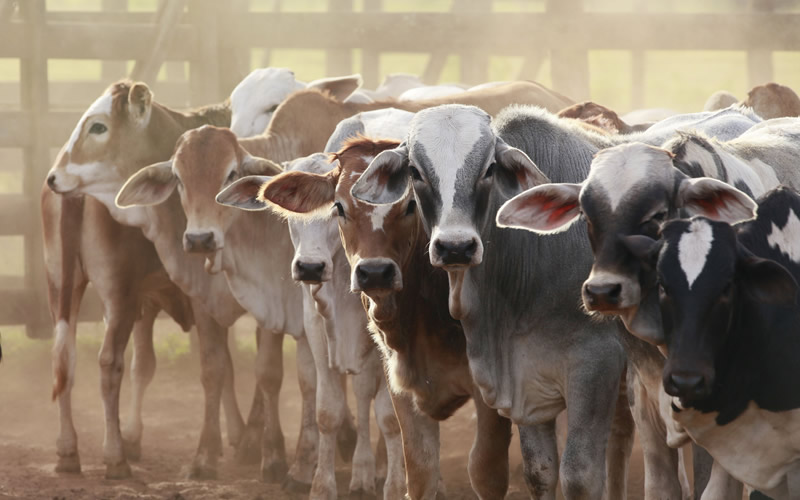
The Federal Government on Monday announced its efforts to transform the livestock sector into a $74 billion industry within five years.
This major objective falls under the National Livestock Growth Acceleration Strategy, to be executed through the Federal Ministry of Livestock Development.
This disclosure was made by the Minister of Livestock Development, Idi Maiha, in a speech delivered at the maiden National Council on Livestock Development. The event, held in Yola, Adamawa State, had the theme ‘Livestock Rebirth: Accelerating Renewed Hope’.
Minister Maiha expressed his delight, describing the NCLD meeting as “historic”. He conveyed his optimism that the livestock sector is being strategically positioned to massively transform the nation’s food system landscape and achieve global competitiveness. He highlighted the huge potential of the sector, which has already attracted global attention and investors within just one year since President Bola Tinubu created the Ministry out of the Federal Ministry of Agriculture and Food Security—a decision long expected by stakeholders and Nigerians.
The Minister detailed the Ministry’s foundational mandate: “Exactly one year ago, our Ministry was established with a clear mandate: to transform the livestock sector from a traditional, often conflict-ridden practice, into a modern, sustainable, and economically vibrant industry. I am proud to report that, in this short period, we have laid a solid foundation for this transformation, guided by the National Livestock Growth Acceleration Strategy, The National Livestock Master Plan and other laudable initiatives. The NL-GAS aims to transform our livestock industry from a $32billion to $74billion industry within the next 5 years. It encompasses increased productivity per head and increases population of our livestock.”
Maiha elaborated on the Ministry’s collaboration efforts: “In line with our strategy, we are actively engaging with countries, community-based organizations, producer associations, indigenous companies, multinational companies and multi/bilateral development partners. These engagements have already begun to yield fruitful outcomes, including bilateral collaborations and strong expressions of interest from foreign direct investors eager to participate in Nigeria’s livestock sector. We are already in discussions with several companies who want to invest in key sectors such as dairy, beef, fodder, small ruminants, animal breeding, poultry, piggery and animal identification, amongst others. We will see the physical manifestation of these engagements in a few months. Development partners are already supporting us in dairy development, peace building and climate smart livestock production- many more are showing strong commitment and are coming as well.”
The Minister further highlighted key achievements under his leadership, which include foundational policy and research like the registration of eight new pasture species and developing the National Strategy and Action Plan on Animal Genetic Resources. Achievements in infrastructure and modernization include veterinary health delivery, L-PRES provision of solar-powered facilities and dips across the country, rehabilitation of the National Veterinary Research Institute (NVRI) Vom, and expanding livestock vaccine production capacity from 120 million to 850 million doses per annum at the NVRI.
Other noted achievements cover the Model Grazing Reserve Rehabilitation, citing the inauguration of the Wase Livestock Village in Plateau State. Partnerships and Investment achievements include the target to double national milk production from 700,000 to 1.4 million metric tonnes annually and aiming to cut the $1.5 billion annual dairy import bill.
In his keynote address, the Special Adviser to the President on Livestock Reforms/Coordinator Livestock Reforms and Co-Chair, Presidential Livestock Reforms Implementation Committee, Prof. Attahiru Jega, urged the NCLD to commence its work by ratifying the NCLD Delivery Compact.
Prof. Jega, whose address was read by the Secretary of PLRIC, Prof. Mohammed Kuta, stated: “Our collective mandate is to midwife a national transition from subsistence-oriented husbandry to a resilient, commercially viable livestock economy capable of driving inclusive growth and rural prosperity. In this regard, I call upon this Council to commence its work with the ratification of an ‘NCLD Delivery Compact.’ This Compact should constitute a binding, intergovernmental covenant, a mutual pledge by federal MDAs, states, and critical stakeholders to implement specific, measurable, and jointly verifiable actions. It shall stand as our public sector scorecard, an instrument of transparency, mutual accountability, and unambiguous commitment to reform. Furthermore, I urge the Council to anchor all deliberations and decisions in evidence, particularly the extensive corpus of empirical analysis already undertaken and catalogued in the bibliography of the Ilorin Paper. These include, inter alia, the National Livestock Transformation Plan (2019), the PLRIC Inception Report (2024), and the seminal findings of the National Livestock Conference Committee (2023).”
In a goodwill message, the Chairman of the House Committee on Livestock Development, Hon. Tasil Raji, assured the audience that his committee members are working diligently on legislations to transform the sector. He emphasized: “As Chairman of the House Committee on Livestock Development, I wish to reaffirm the commitment of the National Assembly to supporting far-reaching reforms that will unlock the full potential of the livestock value chain. The Legislature remains a critical partner in this rebirth agenda, and we are resolute in exercising our constitutional mandate to provide the legislative framework, oversight, and policy direction required to propel the sector forward. In the House of Representatives, we are currently working on several legislative instruments aimed at addressing key challenges within the sector.”


