

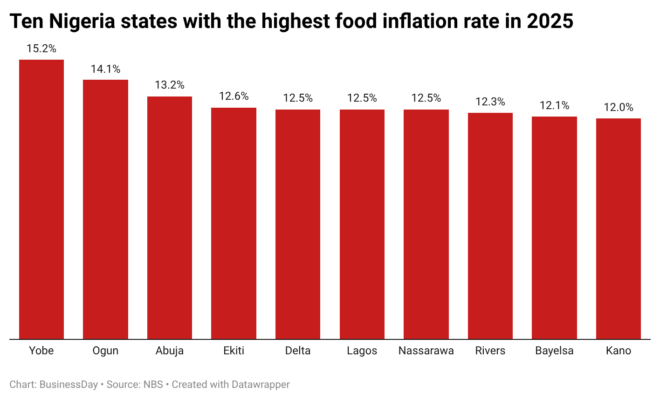
Food inflation remained uneven across Nigeria’s 36 states and the Federal Capital Territory in December 2025, with Yobe State recording the highest year-on-year increase. According to the National Bureau of Statistics, Yobe, described as the pride of the Sahel, posted a food inflation rate of 15.2 per cent year-on-year.
Ogun State followed closely with a food inflation rate of 14.1 per cent, while the Federal Capital Territory, Abuja, recorded 13.2 per cent, placing both among the states with the fastest-rising food prices over the period under review.
In contrast, Akwa Ibom State recorded the slowest year-on-year increase in food inflation at 4.34 per cent. Sokoto followed with 4.62 per cent, while Plateau State posted a comparatively low rate of 6.19 per cent.
On a month-on-month basis, the Consumer Price Index report showed that food inflation was highest in Imo State at 3.19 per cent in December 2025. Nasarawa State followed closely with 3.16 per cent, while Yobe recorded a month-on-month increase of 1.18 per cent.
However, some states recorded a decline in food inflation on a month-on-month basis during the same period. Plateau State led with a decrease of -2.76 per cent, followed by Rivers State at -2.50 per cent and Zamfara State at -1.93 per cent.
Despite the easing observed in some regions, food inflation continued to exert pressure on household incomes nationwide. The NBS noted that the year-on-year national average food inflation rate stood at 10.84 per cent in December 2025, reflecting a technical decline.
On a month-on-month basis, the national food inflation rate dropped to -0.36 per cent in December 2025. This represented a reduction of 1.49 percentage points compared to the 1.13 per cent recorded in November 2025.
According to NBS, the decline in month-on-month food inflation was driven by falling average prices of several key food items. These include tomatoes, garri, eggs, potatoes, carrots, millet, vegetables, plantain, beans, wheat grain, ground pepper, and fresh onions, among others.
The NBS explained that its Consumer Price Index tracks 242 essential food items that are regularly consumed by most households across the country. As a result, food and non-alcoholic beverages contributed 6.06 per cent to overall inflation in December, making it the largest contributor.
Restaurant and accommodation services followed with a contribution of 1.96 per cent, while transport accounted for 1.62 per cent, placing them as the second and third largest contributors to Nigeria’s inflation rate during the month.
Meanwhile, the least contributors to inflation in December were recreation, sport, and culture at 0.05 per cent. Alcoholic beverages, tobacco, and narcotics also contributed 0.05 per cent, while insurance and financial services accounted for 0.07 per cent.
According to NBS, the headline inflation rate stood at 15.15 per cent in December 2025. This figure was calculated using a 12-month index reference period, with 2024 equated to a base index of 100.
The bureau further noted that the December 2025 headline inflation rate was 19.65 percentage points lower than the level recorded in December 2024. It explained that the significant slowdown was partly influenced by the adoption of a revised base year.
On a month-on-month basis, headline inflation moderated to 0.54 per cent in December, down from 1.22 per cent recorded in November. This indicated easing short-term price pressures across the economy.
Reacting to the data, CardinalStone analysts described the trend as constructive for Nigeria’s inflation outlook. In a notice, the firm stated that the pace of price increases is expected to continue moderating as key inflationary pressure points ease.
Headline inflation, according to CardinalStone, is projected to average 14.02 per cent in 2026 and close the year at 12.22 per cent. The firm noted that this trajectory implies a return to Nigeria’s long-run inflation average of about 14 per cent, with inflation dipping below that level between May and December.
The analysts also projected an improvement in exchange rate stability, noting that the naira is expected to appreciate to between N1,350/$ and N1,450/$ in 2026. This outlook is supported by improved foreign exchange liquidity, strong external reserves, a robust current account surplus, and sustained transparency in the foreign exchange market.
“With inflation projected below the Central Bank of Nigeria’s 16 percent target, there will be room for monetary policy rate cuts of 300 to 400 basis points in 2026, likely after the March inflation data. It also expects a gradual easing of other tightening measures, including the cash reserve ratio, from the second half of the year to support credit growth,” the research firm said.