

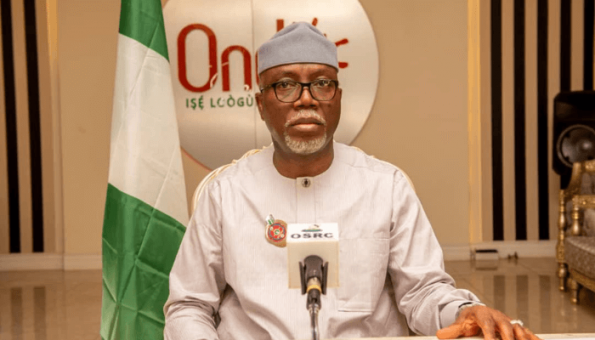
Ondo State Governor Lucky Aiyedatiwa has explained why the state has not yet commenced independent electricity generation, despite the federal government transferring regulatory oversight to it.
The governor stated that his administration is not relenting in seizing the opportunity provided by the federal government to enable the state to generate electricity independently and distribute it for the benefit of residents.
Last year, the Nigerian Electricity Regulatory Commission (NERC) announced the completion of the transfer of regulatory oversight to four states: Enugu, Ekiti, Ondo, and Imo. These states are now fully responsible for regulating their electricity markets.
Speaking to journalists at the event marking the 50th Anniversary of Ondo State, Governor Aiyedatiwa said his administration is currently focusing on strengthening regulation, improving distribution, and partnering with existing power distribution companies to enhance supply to residents.
He explained that although the state does not currently generate its own electricity, it has established structures to oversee and regulate the sector through the Ondo State Electricity Regulatory Commission, which interfaces directly with distribution companies operating within the state.
The governor admitted that the state has not started generating electricity independently but emphasised that his government has been actively engaging the Distribution Companies (DISCOs) to ensure better service delivery and protect consumers from exploitation.
“Yes, we are not generating one for now, but in terms of regulation and distribution, we are very active,” he added.
Aiyedatiwa added, “We have been doing a lot in that sector. You can see that all the DISCOs operating in Ondo State, we are working together with them.
“We have the Ondo State Electricity Regulatory Commission. We regulate and interface with them, so we are in charge of our own electricity.”
Aiyedatiwa highlighted the introduction of the ‘O’ Datiwa Meter’ initiative as one of the key interventions by his administration to address the challenge of estimated billing, popularly known as “crazy bills,” imposed on consumers.
According to him, the state government had to subsidise the distribution of meters to residents to ensure transparency and fairness in electricity charges.
“Don’t forget the O’ Datiwa meter that we took up when they were giving crazy bills to our people. We had to take it upon ourselves to subsidise the distribution of meters to our people,” he said.
He noted that the intervention has helped reduce disputes between consumers and service providers while improving accountability in billing.
The governor also said electricity supply has improved in several parts of the state due to sustained engagement with the distribution companies, stressing that many communities now enjoy more stable and consistent power.
“If you look at it, electricity has been very, very constant in some parts of Ondo state since we came on board. It is because of the engagement we have been having with the distribution company,” he stated.
Aiyedatiwa referenced the band classification system introduced by electricity providers, explaining that customers on higher bands receive longer hours of supply.
“Yes, there is Band A, Band B, and all of that. If you are on Band A, you can be having up to 18 hours in a day out of 24 hours, if I am not mistaken,” he said.
He acknowledged that electricity tariffs remain high for many residents but expressed optimism that costs would reduce over time as the system improves.
“Over time, just like when GSM started, it was expensive, but today it is cheap. It is the same thing. So, with time, we are going to improve on our administration, and then it becomes cheaper for all,” he explained.
The governor further pointed to improved electrification and lighting across parts of Akure and other areas, noting that both solar-powered lights and those connected to the national grid are functioning due to better supply.
Aiyedatiwa reiterated that while independent power generation remains a future goal, the immediate priority is to stabilise distribution, strengthen regulation, and protect consumers from excessive billing.
He, however, assured the residents of the government’s commitment to making power more reliable and affordable.