






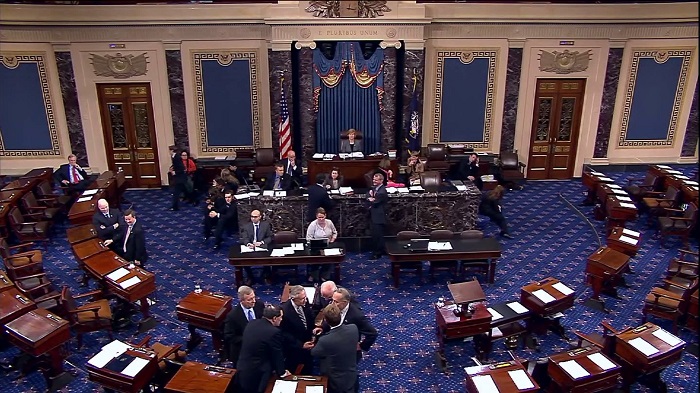
The United States Senate has approved a controversial $9 billion spending cut package proposed by President Donald Trump, targeting foreign aid and public media funding.
The vote, which passed narrowly at 51-48 early Thursday morning, reflects growing Republican momentum behind deep budget reductions inspired by the now-defunct Department of Government Efficiency, formerly led by Elon Musk.
The sweeping cuts include $8 billion slashed from foreign assistance programs—affecting agencies like USAID—and $1 billion withdrawn from the Corporation for Public Broadcasting CPB, which funds NPR, PBS, and more than 1,500 public radio and television stations nationwide.
Originally, the House version of the bill sought to eliminate $400 million from global health initiatives, including the widely praised PEPFAR program, credited with saving over 26 million lives through HIV/AIDS relief. However, opposition from moderate Republicans forced that provision to be dropped.
Support for the measure was not unanimous among Republicans. Senator Lindsey Graham of South Carolina, a known proponent of strong foreign policy, backed the bill but voiced concern over the direction of aid spending. “I’m a big fan of foreign aid and soft power,” he said, “but when the money starts going to junk programs disconnected from our strategic goals, it makes it harder to defend.”
The measure, a rare “rescissions package” that rolls back previously approved funding, must return to the House for final approval before Friday to avoid automatic disbursement. The White House has applied pressure on lawmakers, with Trump reportedly threatening to withhold endorsements from Republican holdouts.
The package follows the fiscal roadmap outlined by Musk’s DOGE initiative before his resignation in May after reported clashes with Trump over the scope and pace of federal cutbacks. While DOGE claimed to identify up to $190 billion in government savings, fact-checkers and nonpartisan analysts have disputed those figures.
Public broadcasting, long a target of conservative criticism for alleged ideological bias, faces deep setbacks under the plan. In May, Trump signed an executive order to defund NPR and PBS, a move reaffirmed by this legislation.
Senate Democrats condemned the vote. Senator Cory Booker of New Jersey called the cuts “a betrayal of constitutional responsibility,” saying, “This is a bunch of my colleagues in thrall to the president, surrendering our power to protect the public good.”
Democrats argue the reductions will disproportionately impact vulnerable global populations and limit access to trusted news sources, while doing little to reduce the national deficit. Nevertheless, the vote highlights Republican plans to push forward with more cost-cutting proposals rooted in the DOGE philosophy, despite lingering disagreements within the party over the strategic value of foreign aid.

