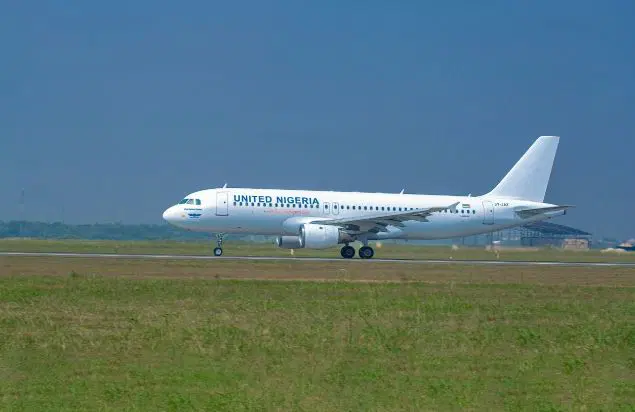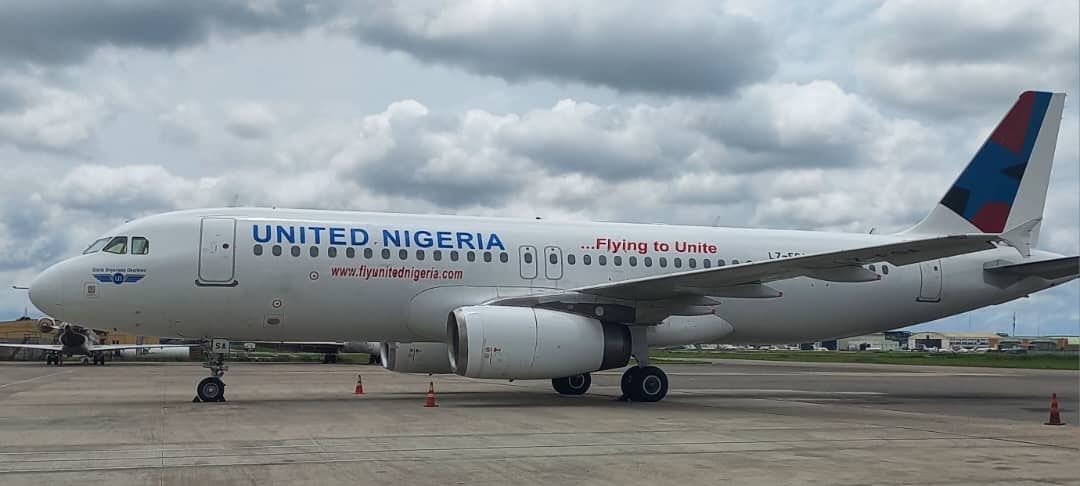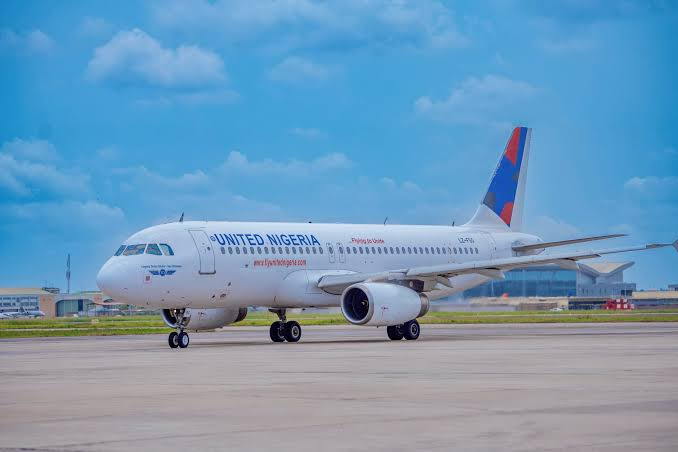
United Nigeria Airlines has raised ₦22 billion through its debut commercial paper issuance, beating its initial target of ₦20 billion on the back of strong investor demand.
According to the airline, the issuance is the first tranche of its ₦100 billion commercial paper programme and marks its entry into Nigeria’s short-term debt market.
The airline accepted an additional 10 per cent above its original target and returned the remaining subscription funds to investors. It is seeking to strengthen its working capital and support fleet expansion.
According to Meristem Capital Limited, demand for the debut issuance exceeded the initial ₦20 billion target by more than ₦5 billion.
The airline, however, limited the additional allotment to ₦2 billion, bringing the total issuance to ₦22 billion.
“The level of demand we received is a clear endorsement of our business model, and financial performance as well as the confidence the market has in our growth plans,” Managing Director Mazi Osita Okonkwo said.
Okonkwo added that the proceeds would support fleet expansion and operations. He also thanked investors for their participation.
Rasaki Salawu, Managing Director of Meristem Capital Limited, which acted as Lead Issuing House, described the transaction as Nigeria’s first commercial paper issuance by an airline.
He said the offer attracted asset managers, insurance companies and high-net-worth individuals. He added that the decision to limit additional allotments reflected financial prudence.
The issuance comprised two series with tenors of 270 and 364 days. Agusto & Co. assigned A3 and BBB- short-term and long-term ratings, respectively, with a stable outlook.
DataPro assigned A1 and BBB ratings for the respective tenors. Cordros Capital and other dealers also participated in the transaction.
The commercial paper issuance follows significant growth in United Nigeria Airlines’ financial performance over the past five years.
Nairametrics had earlier reported that the airline’s revenue rose from ₦10.3 billion in 2021 to ₦90.8 billion in 2025. Profit after tax rose from ₦1.3 billion to ₦23.8 billion over the same period.
Revenue reached ₦95.6 billion in the first half of 2026, exceeding the ₦90.8 billion recorded for the entire 2025 financial year.
August turnover rose to ₦19.4 billion from ₦14.1 billion in July, and the airline recorded a net profit of ₦1.2 billion.
According to Nairametrics Research, Nigerian companies raised ₦1.61 trillion through commercial paper in 2025. This represents a 40 per cent increase from ₦1.15 trillion in 2024.
The average commercial paper discount rate rose to 22.38 per cent in 2025 from 21.69 per cent in 2024, while the average tenor rose to 233 days from 225 days.
The airline’s fundraising forms part of its five-year expansion strategy covering domestic, regional and international operations.
Commercial paper gives companies short-term financing for working capital and operational requirements, although the borrowed funds must be repaid at maturity.
The growing use of commercial paper among Nigerian companies reflects its role as an alternative to conventional bank borrowing. Funding costs and repayment capacity remain important considerations for investors.
United Nigeria Airlines currently operates 10 aircraft, comprising Embraer ERJ-145s, Boeing 737-800s, Embraer E190s and CRJ900s.
The airline plans to take delivery of six additional aircraft before the end of 2026. This could increase its fleet to 16 aircraft if the deliveries are completed as scheduled.
UNA currently serves 14 destinations across Nigeria and Ghana. It also has approvals to operate as a flag carrier to six international destinations.
The airline has secured Global Distribution System agreements with Amadeus and Sabre, allowing travel agents worldwide to access its ticket inventory.
It is an International Air Transport Association (IATA) Operational Safety Audit-certified operator and has been an IATA member since 2022.
In 2026, UNA signed the IATA Multilateral Interline Traffic Agreement, which supports cooperation between airlines on passenger bookings and connections.
The airline is also a full member of the African Airlines Association, which strengthens its participation in regional aviation industry activities.
The planned aircraft deliveries and route expansion are expected to support its broader growth strategy, alongside continued engagement with investors through commercial paper and other capital market programmes.
The ₦22 billion issuance therefore represents an important step in the airline’s access to the capital market. Its ability to manage funding obligations and execute its fleet expansion plans will remain key considerations for investors.