




United States President Donald Trump announced on Monday that his administration would temporarily waive certain oil-related sanctions to boost global oil supply and bring down prices amid disruptions from the ongoing Middle East conflict.
The United States and Israel have conducted strikes on Iran, while Tehran has launched retaliatory attacks across the Gulf region. These developments have rattled global energy and transport markets, severely affecting operations around the strategically vital Strait of Hormuz.
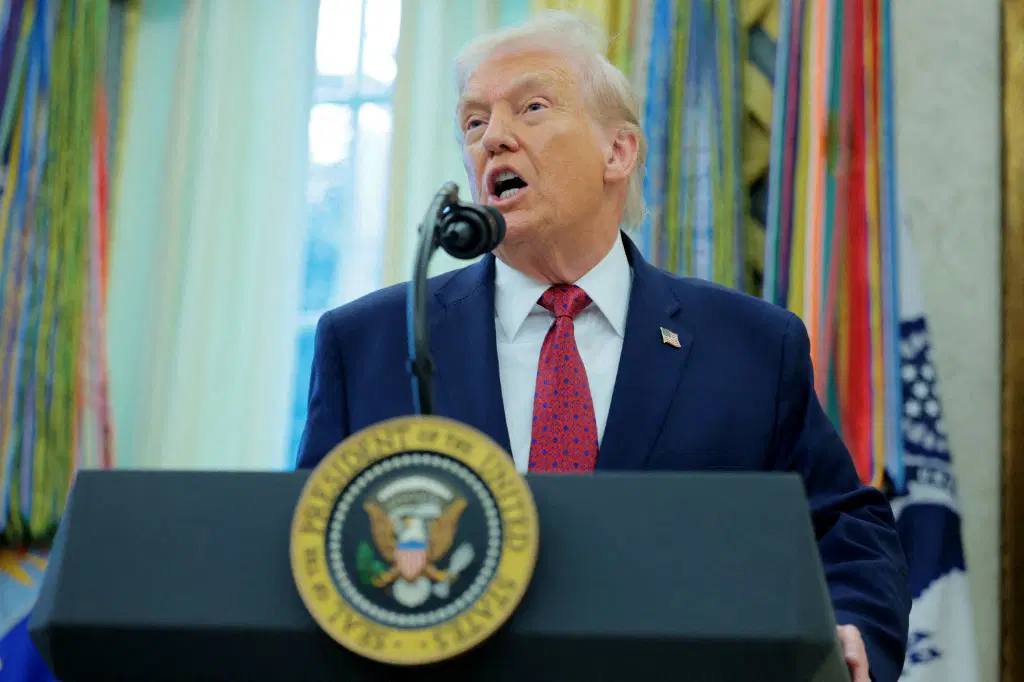
“We’re also waiving certain oil-related sanctions to reduce prices,” Trump told reporters after holding talks with Russian President Vladimir Putin. He also referenced Chinese President Xi Jinping during his remarks.
“We have sanctions on some countries. We’re going to take those sanctions off till this straightens out,” Trump added. The US leader did not identify the countries involved or specify which sanctions would be removed.
Trump made these comments shortly after his discussion with Putin, whose country is one of the world’s largest oil producers and exporters.
China remains a major importer of crude oil and a key trading partner for Russia.
Global oil prices dropped on Tuesday, while equities rebounded following volatile trading the previous day. The market swings came after Trump suggested that the US-Israel conflict with Iran could end sooner than expected.
The president also indicated that the lifted sanctions might stay suspended if the war concludes.
“Then who knows? Maybe we won’t have to put them on. There’ll be so much peace,” he said, reiterating that the United States is prepared to escort oil tankers through the Strait of Hormuz, a critical route through which roughly one-fifth of the world’s oil supply typically passes.
US Treasury Secretary Scott Bessent revealed last week that Washington was weighing the possibility of easing restrictions on additional Russian oil exports.
The comments followed a day after the US temporarily allowed India to purchase oil from Moscow.
Under the temporary measure, the US government eased certain economic sanctions to permit Russian oil currently stranded at sea to be sold to India.
The restriction relief applies to cargoes from vessels previously affected by sanctions and will remain in effect until April 3, 2026.
Trump’s latest statements suggest concerns within his administration about the impact of surging crude prices on American consumers ahead of the crucial midterm elections scheduled for November.
Trump also described his conversation with Putin as “positive” regarding efforts to end the four-year war in Ukraine.
Any relaxation of sanctions on Russia could increase global oil supply. However, it also creates a challenge for Washington as it attempts to limit Moscow’s energy revenues during the prolonged conflict in Ukraine.
Russia’s invasion of Ukraine and the sanctions imposed by Western nations have significantly reduced its oil and gas income. In January, revenue from those sectors dropped to a five-year low.
The Russian economy has struggled under the pressure of the extended war effort and international restrictions, with inflation rising and economic growth slowing.
Oil and gas exports remain the backbone of Russia’s state revenue. However, in October 2025, Washington expanded sanctions by blacklisting two of Russia’s largest oil companies, Lukoil and Rosneft.
The spike in crude prices has also triggered anxiety among oil-importing nations across Asia.
South Korea has activated a $68 billion market stabilisation fund, while Japan is reportedly considering tapping into its national oil reserves.
Long queues have already been reported at petrol stations in countries such as Vietnam, Myanmar and the Philippines.
Analysts say the conflict with Iran and Washington’s earlier move that led to the ousting of Venezuelan leader Nicolás Maduro in January may have unintentionally strengthened Russia’s position in the global oil market.
With supplies from Iran and Venezuela disrupted, many major buyers are now turning to Russian crude as an alternative.
A recent analysis by the Carnegie Russia Eurasia Center noted that Russia could increase oil exports to China as other supply sources become uncertain.
“Now that those supplies are compromised, the primary beneficiary is Russia, which is ready to increase oil exports to China,” the report said.
The analysis added that the current situation allows Moscow to reinforce the argument that maritime supply routes to China could be vulnerable to US control.
“Maritime routes for supplying resources to China could be cut off at any moment by the United States,” it stated.
“So the only reliable option is pipelines and roads from Russia.”