

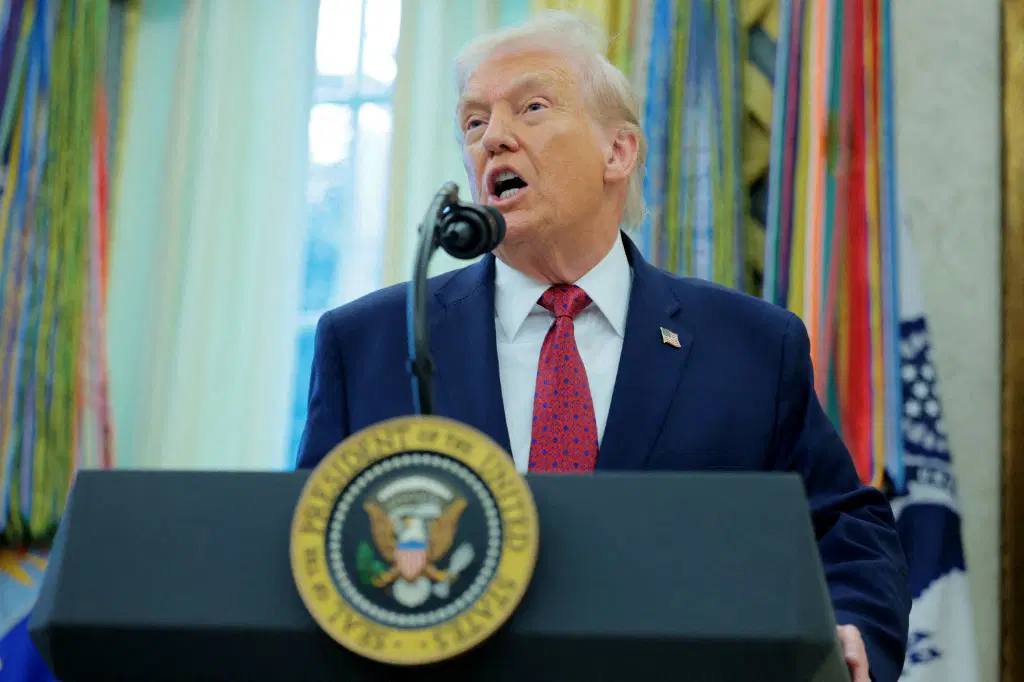
United States President Donald Trump on Friday urged top oil executives to invest in Venezuela’s vast crude oil reserves, but his appeal was received cautiously, with a leading chief executive describing the country as “uninvestable” without sweeping reforms.
During a White House meeting, Trump told industry leaders that his administration, rather than authorities in Caracas, would determine which companies are permitted to operate in Venezuela following the dramatic capture of President Nicolas Maduro by US forces.
“We’re going to be making the decision as to which oil companies are going to go in… (we’re) going to cut a deal with the companies,” Trump said, insisting that foreign firms had lacked meaningful protections under Maduro’s leadership.
“But now you have total security. It’s a whole different Venezuela,” the US president added.
Trump further stated that oil companies would “deal with us directly,” signalling Washington’s intention to sideline Venezuela’s authorities entirely in decisions relating to the exploitation of the country’s oil resources.
Despite these assurances, ExxonMobil Chief Executive Officer Darren Woods expressed strong reservations about returning to the country.
“We’ve had our assets seized there twice and so, you can imagine, to re-enter a third time would require some pretty significant changes,” Woods said.
“If we look at the legal and commercial constructs and frameworks in place today in Venezuela — today, it’s uninvestable.”
The meeting came less than a week after US forces seized Maduro, an operation Trump has openly linked to Washington’s desire to control Venezuela’s oil wealth.
Opening the session, Trump said discussions would centre on how American companies could quickly rehabilitate Venezuela’s decaying oil infrastructure and increase production by millions of barrels per day.
Vice President JD Vance, Secretary of State Marco Rubio and Energy Secretary Chris Wright attended the meeting, alongside senior executives from Chevron, ExxonMobil, ConocoPhillips, Halliburton, Valero, Marathon, Shell, Trafigura, Vitol Americas and Repsol, among others.
A spokesman for ConocoPhillips said the company’s chief executive, Ryan Lance, welcomed the dialogue on “preparing Venezuela to be investment ready.”
Speaking after the meeting, Trump claimed participants had “sort of formed a deal,” though he offered no further details. He also said oil companies were ready to invest “at least 100 Billion Dollars.”
However, analysts told AFP that Trump’s effort to revive Venezuela’s oil sector rests on fragile economic and strategic foundations.
Experts warned that having massive reserves on paper does not guarantee fast or profitable production, citing ageing infrastructure, political instability, the high cost of extracting heavy crude, and growing investor unease as the global economy shifts away from fossil fuels.
“There’s lots of talk about the size of the reserves — 300 billion barrels of proved reserves — but what’s often missing from the conversation is how realistic it is for those to be economically extracted,” said Rich Collett-White, an energy analyst at Carbon Tracker.
After the talks, Energy Secretary Chris Wright, who has previously stated that Washington would control Venezuela’s oil industry “indefinitely,” acknowledged that it would “take time” to rebuild the country’s oil infrastructure.
While Trump continues to promote Venezuela’s oil potential to US firms, interim President Delcy Rodriguez has insisted that her government remains in charge. Venezuela’s state oil company has only confirmed that it is in talks with Washington.
Chevron currently remains the only US company licensed to operate in Venezuela.
ExxonMobil and ConocoPhillips exited the country in 2007 after rejecting demands by then-president Hugo Chavez to hand over majority control to the state.
In a social media post, Trump said he cancelled a second wave of strikes on Venezuela due to what he described as “cooperation” from the country.
Venezuela has been under US sanctions since 2019 and holds roughly a fifth of the world’s oil reserves. It was once a major crude supplier to the United States.
However, according to OPEC, Venezuela accounted for only about one percent of global crude production in 2024, having been crippled by years of underinvestment, sanctions and embargoes.
Trump views Venezuela’s enormous oil reserves as a potential windfall in his campaign to further reduce domestic fuel prices in the United States.

