



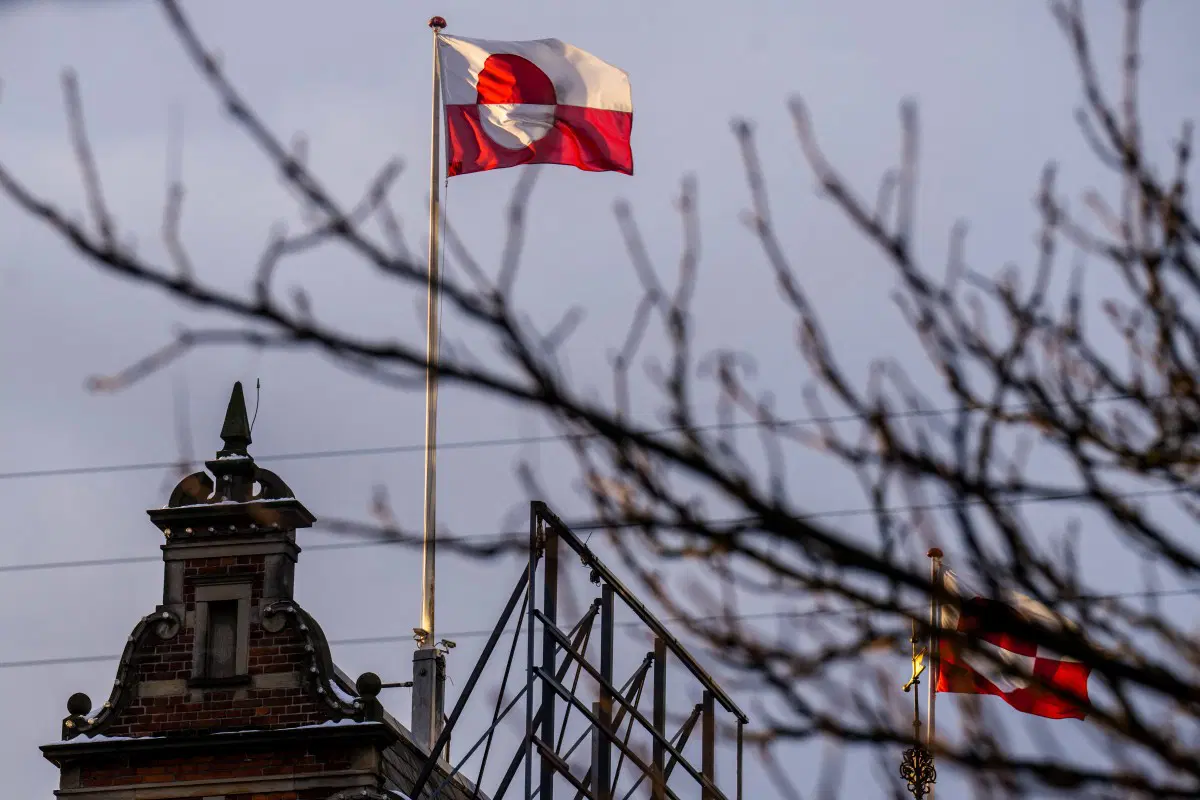
Canada and France will open consulates in Nuuk, the capital of Greenland, on Friday.
The move serves as a strong demonstration of support for the local Greenlandic government amid ongoing pressure from United States President Donald Trump.
Since returning to the White House last year, Trump has repeatedly insisted that Washington needs to control the strategic, mineral-rich Arctic island for security reasons.
Last month, Trump backed off his threats to seize Greenland. He stated that he had struck a “framework” deal with NATO chief Mark Rutte to ensure greater American influence.
A US-Denmark-Greenland working group has been established to discuss ways to address Washington’s security concerns in the Arctic. Details of the talks have not been made public.
Denmark and Greenland have acknowledged sharing Trump’s security concerns. However, both have insisted that sovereignty and territorial integrity remain a “red line” in any discussions.
Jeppe Strandsbjerg, a political scientist at the University of Greenland, described the openings as significant for Greenlanders.
“In a sense, it’s a victory for Greenlanders to see two allies opening diplomatic representations in Nuuk,” said Jeppe Strandsbjerg, a political scientist at the University of Greenland.
“There is great appreciation for the support against what Trump has said.”
French President Emmanuel Macron announced Paris’s plans to open a consulate during a visit to Nuuk in June. During that visit, he expressed Europe’s “solidarity” with Greenland and criticised Trump’s ambitions.
The newly appointed French consul, Jean-Noel Poirier, previously served as ambassador to Vietnam.
Canada announced in late 2024 that it would open a consulate in Greenland to strengthen cooperation.
Ulrik Pram Gad, an Arctic expert at the Danish Institute of International Studies, explained the broader diplomatic message.
The opening of the consulates is “a way of telling Donald Trump that his aggression against Greenland and Denmark is not a question for Greenland and Denmark alone, it’s also a question for European allies and also for Canada as an ally, as a friend of Greenland and the European allies also,” Ulrik Pram Gad, Arctic expert at the Danish Institute of International Studies, told AFP.
Christine Nissen, a security and defence analyst at the Europa think tank, described the step as part of a wider approach.
“It’s a small step, part of a strategy where we are making this problem European,” said Christine Nissen, security and defence analyst at the Europa think tank.
“The consequences are obviously not just Danish. It’s European and global.”
Strandsbjerg noted that the consulates will allow Greenland to gain experience in international relations.
According to Strandsbjerg, the two consulates — which will be attached to the French and Canadian embassies in Copenhagen — will give Greenland an opportunity to “practice” at being independent, as the island has long dreamt of cutting its ties to Denmark one day.
Nissen highlighted the recognition of Greenland’s increasing autonomy under the 2009 Self-Government Act.
The decision to open diplomatic missions is also a recognition of Greenland’s growing autonomy, laid out in its 2009 Self-Government Act, Nissen said.
“In terms of their own quest for sovereignty, the Greenlandic people will think to have more direct contact with other European countries,” she said.
Pram Gad added that diversifying external ties would reduce reliance on Denmark.
That would make it possible to reduce Denmark’s role “by diversifying Greenland’s dependence on the outside world, so that it is not solely dependent on Denmark and can have more ties for its economy, trade, investments, politics and so on”, echoed Pram Gad.
Greenland has maintained diplomatic ties with the European Union since 1992, with Washington since 2014, and with Iceland since 2017.
Iceland opened its consulate in Nuuk in 2013. The United States, which operated a consulate in the Greenlandic capital from 1940 to 1953, reopened its mission in 2020.
The European Commission opened its office in Nuuk in 2024.