






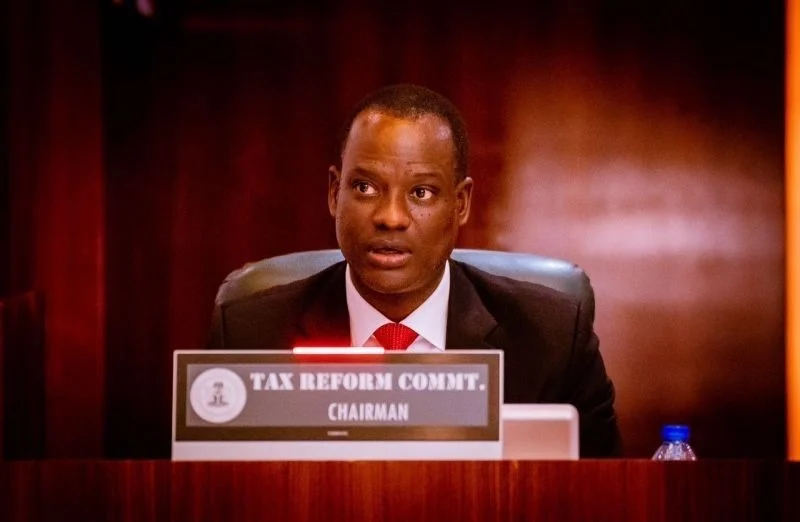
The Chairman of the Presidential Committee on Fiscal Policy and Tax Reforms, Taiwo Oyedele, has stated that President Bola Tinubu lacks the constitutional authority to suspend the recently enacted tax laws.
Oyedele made the clarification amid mounting calls on the Federal Government to pause the implementation of the laws, following controversies surrounding their passage and some of their provisions.
He addressed the issue during an appearance on an Arise Television programme, where he dismissed the calls for suspension and questioned the legality and authority behind such demands.
According to Oyedele, the executive arm of government does not have the power to halt the operation of laws that have already been passed by the National Assembly and duly gazetted.
He said: “Suspending or putting it on hold, what does it mean? Some people calling for the suspension have never asked who is supposed to do the suspension.”
Oyedele explained that once legislation has been validly passed and gazetted, it takes effect in line with its commencement clauses, emphasising that the President cannot unilaterally prevent such laws from coming into force.
He further disclosed that four separate tax laws were enacted, noting that two of them took effect immediately, while the Nigeria Revenue Service has already begun operations under the new legal framework.
Oyedele stated that the new laws repealed the former Federal Inland Revenue Service Act and replaced it with the Nigeria Revenue Service structure, warning that suspending the laws would lead to serious institutional and fiscal disruptions.
He said: “The President has no powers, the executive has no powers to suspend it, that is the first point. The second point is that there are four tax laws, two commenced immediately. The Nigeria Revenue Service, has already commenced. So, these laws repealed the FIRS Act, we no longer have the FIRS Act, we now have the NIRS, so how do you suspend this, does it mean we will no longer have any revenue service?”
Oyedele also raised concerns about the legal and financial implications of suspending the laws, questioning the status of revenues already collected under the new system.
He added: “Is there a way somebody will say that in the last six months, we have had an illegal NIRS? The monies paid to them, we should collect and refund back. I feel if we wait for the outcome of their (House of Reps) review, whatever that is established, if we establish that parts of the alteration were there, we remove them. If you suspend the FIRS for one month, that is crisis.”
Despite Oyedele’s position, some senior members of the Nigerian Bar have opposed the Federal Government’s plan to begin enforcement of the new tax laws from January 1, 2026.
Several Senior Advocates of Nigeria have argued that enforcing the laws would amount to a violation of the rule of law if allegations of post-passage alterations are proven.
They maintain that any legislation found to have been illegally amended after passage should not be implemented, irrespective of its gazette status.
The lawyers have insisted that the integrity of the legislative process must be preserved and that implementation of the laws should be suspended until all issues relating to the alleged alterations are fully resolved.
Meanwhile, the House of Representatives had earlier commenced a review process in response to public backlash against the tax reform laws, as stakeholders continued to raise concerns about transparency, legislative procedures and the potential economic impact of the reforms.

