
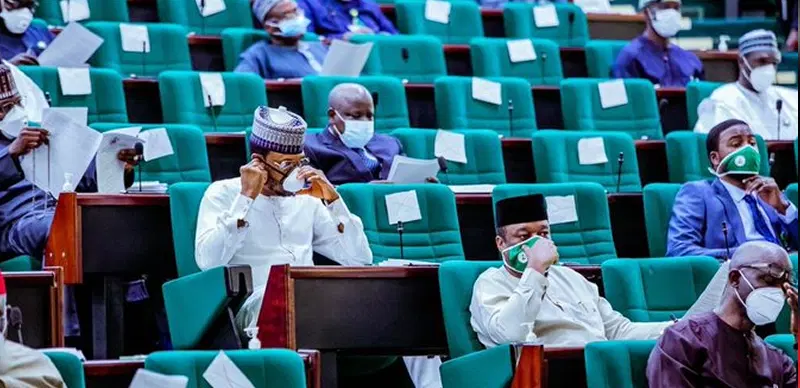
The House of Representatives has commenced an investigation into the alleged non-release of N174.26 billion in agricultural intervention funds.
The probe directs Ministries, Departments and Agencies as well as development partners to fully cooperate with the fact-finding exercise.
The Chairman of the House Committee on Agricultural Production and Services, Bello Ka’oje, made this known in a statement released on Sunday.
He urged all relevant government agencies and stakeholders to provide necessary documents and support to ensure a thorough and transparent investigation.
Recall that the House had, in late January 2026, adopted a motion sponsored by Ka’oje mandating the committee to investigate development partner-funded agricultural projects.
The investigation focuses particularly on those supported by the African Development Bank and the Japan International Cooperation Agency, with a view to ensuring accountability and judicious use of resources.
According to the lawmaker, the committee is specifically mandated to probe the circumstances surrounding the non-release of the N174.26 billion intervention funds.
It will also examine the persistent high cost of fertiliser, which continues to negatively impact farmers and food production nationwide.
He noted that delays in releasing funds secured from international development partners have heightened concerns over food insecurity.
This follows President Bola Tinubu’s declaration of a state of emergency on food security in July 2023, which triggered several donor-backed agricultural interventions.
Providing details, Ka’oje disclosed that Nigeria negotiated a $134m loan with the African Development Bank in February 2023 to support the National Agricultural Growth Scheme–Agro Pocket Project.
Of the amount, $99.67m has been disbursed to the Consolidated Revenue Fund, while a balance of N55.30bn remains outstanding for disbursement to agro-dealers.
The outstanding funds are meant for supplying inputs to 280,000 wheat farmers and supporting 150,000 rice farmers under the 2024/2025 dry season programme.
He further revealed that 15bn Japanese Yen was secured from the Japan International Cooperation Agency in April 2024 as a Food Security Emergency Support Loan.
Although the first tranche of 12bn Yen, equivalent to N118.96bn, was disbursed in March 2025, the funds are yet to be released to the implementing agencies.
The JICA facility, he explained, is designed to support 550,000 smallholder farmers with subsidised inputs for rice, maize, soya beans and cassava production.
This support covers the 2025 wet season and the 2025/2026 dry season farming cycles.
Ka’oje expressed concern that the funds are time-bound and that delayed release has already caused farmers to miss planting seasons.
This has resulted in reduced output in the 2025 harvest and poses significant risks to the 2026 farming season.
He warned that about $200m in additional AfDB funding under a Result-Based Financing arrangement could be jeopardised due to the non-implementation of earlier interventions.
“The seriousness of these issues calls for firm commitment to ensure the implementation of all interventions in order to rescue the nation’s agricultural sector and guarantee food security,” he stated.
The committee, he added, is seeking the full cooperation of all stakeholders and relevant government agencies responsible for fund release and implementation of the interventions.
This is as the parliament moves to clear bottlenecks hindering progress in the sector.