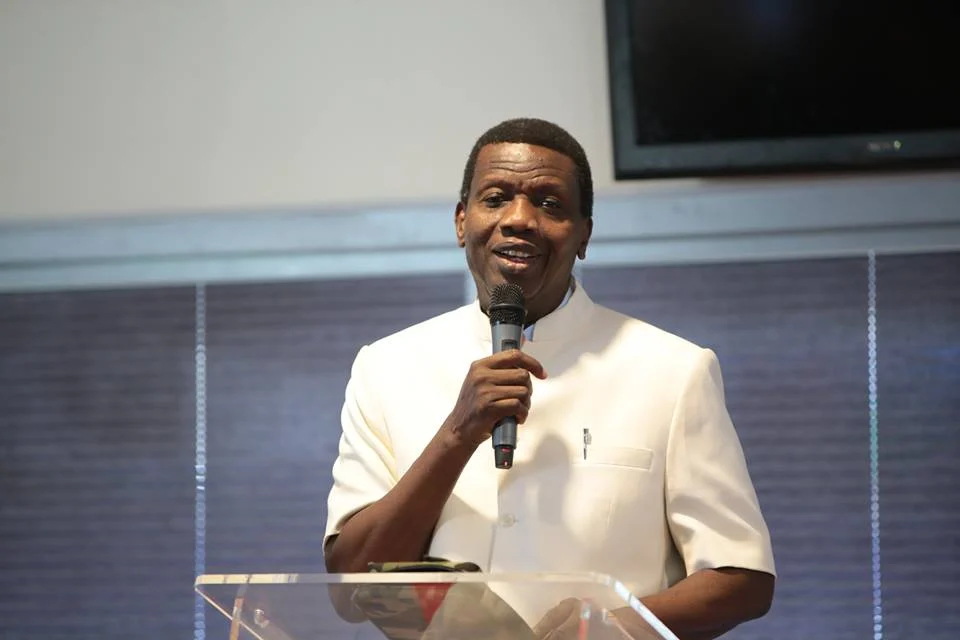
The Continental Overseer (South West, Nigeria and Middle East) of the Redeemed Christian Church of God, Johnson Odesola, has come to the defence of the church’s General Overseer, Pastor Enoch Adeboye.
The defence follows claims that former President Olusegun Obasanjo gave oil wells to some prominent Nigerian pastors while in office.
In an opinion article published on Impact Nigeria on Tuesday, Odesola challenged the founder and president of the Ministers’ Prayer Network, Rev. Mosy Madugba, to back up his claim with evidence.
Madugba had alleged in a sermon circulating on social media that Obasanjo allocated oil wells to Adeboye, the Founder of Living Faith Church Worldwide, Bishop David Oyedepo, and the General Superintendent of Deeper Christian Life Ministry, Pastor William Kumuyi.
He tied the alleged oil interests to the universities, hospitals and schools set up by the religious leaders, as well as the private aircraft acquired by some of them.
Responding, Odesola described the allegation as a serious one that needed verifiable evidence. He listed official government documents, petroleum licensing records and company ownership details as examples.
Odesola, who also oversees Continent 3 of the RCCG, asked Madugba to explain how he got the information. He wanted to know whether Madugba witnessed the alleged allocation or relied on documents or information from credible sources.
He wrote: “A statement made from a pulpit does not automatically become established truth because the speaker is a respected minister of the gospel or holds the title of professor,” Odesola wrote.
He added that reports on the circulating sermon had not offered any documentary evidence that Obasanjo gave an oil well to Adeboye.
He said: “This does not establish that no document could ever exist. It establishes that the allegation remains unsubstantiated in the public domain,” he said.
The RCCG overseer said he was speaking on the allegation against Adeboye because of his long relationship with the cleric and the church.
He said he had been a member of the RCCG for more than five decades and had worked closely with Adeboye for over four decades.
Odesola argued that the growth of the RCCG, including the founding of its university and other institutions, should not be taken as proof that its General Overseer gained from an alleged political allocation.
He noted that the church was founded by Reverend Josiah Akindayomi, and that Adeboye became General Overseer in 1981 after the founder died in 1980.
He also pointed to Adeboye’s academic background, which includes degrees in Mathematics, Hydrodynamics and Applied Mathematics.
According to him, the church’s expansion came from decades of missionary work, evangelism and contributions from members.
On Redeemer’s University, Odesola said the RCCG established the institution and that it received Federal Government approval in January 2005. It began academic activities in October of the same year.
He maintained that the existence of the university and other church institutions did not prove that Adeboye personally received an oil well.
The cleric also questioned the suggestion that private aircraft used by religious leaders showed they owned them personally or got them through alleged oil interests.
He said any investigation into the allegation should establish the name or number of the alleged oil block, the company that received the licence, its shareholders and beneficial owners, the date of allocation and the government authority that approved it.
Odesola further said the RCCG was not obliged to give a detailed response to every allegation circulated on social media. He added that the duty to prove a specific claim rested mainly with the person who made it.
He, however, said the church and the relevant authorities should address legitimate questions if verifiable evidence emerged.
Calling on Madugba to clarify his claims, Odesola urged him to publish any documents that support the allegation or explain the basis of his statement.
He added that if the information was wrong, the cleric should be ready to correct the record.
He wrote: “I do not claim that this personal experience makes the church immune from scrutiny. Neither am I suggesting that Pastor Adeboye or any other religious leader should be above the law,” he wrote.
Odesola said his position was that allegations should not be accepted as established facts without evidence.
He added: “Until such evidence is produced, Nigerians should distinguish between an allegation and a proven fact,” he added.