


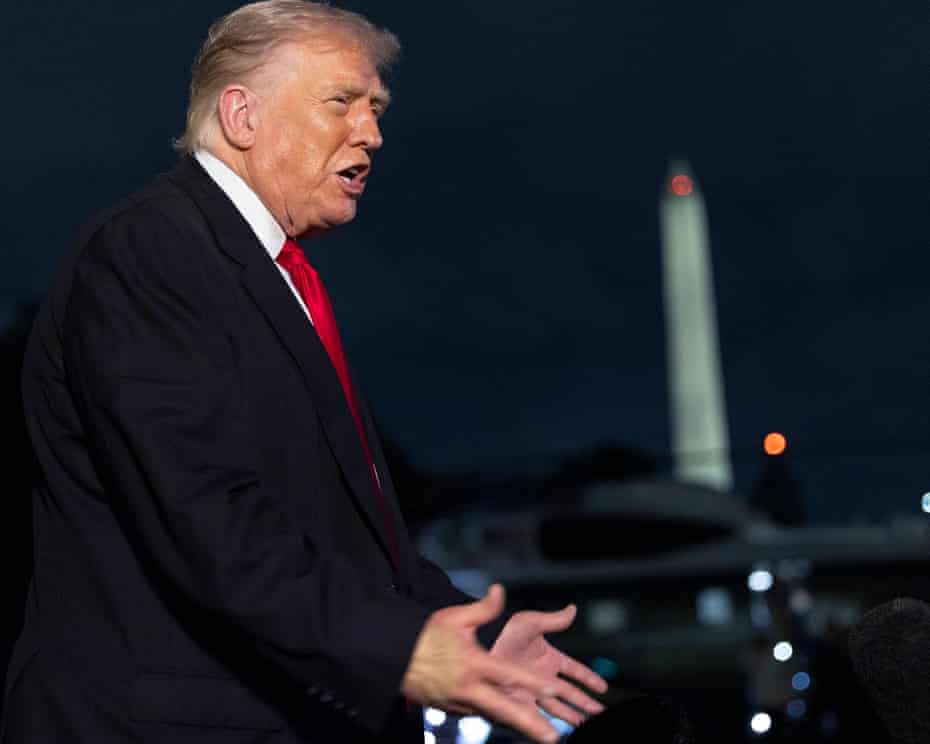
United States President Donald Trump dismissed the recent crude oil price spike, describing it as a “small price to pay” to eliminate Iran’s nuclear threat.
Oil prices surged above $100 a barrel for the first time in nearly four years on Sunday, driven by fears that the escalating war in the Middle East could lead to prolonged disruptions in global oil supply.
Both major crude oil benchmarks, West Texas Intermediate and Brent, rose by more than 15 per cent when markets opened on Sunday evening. These levels had not been seen since the early months of Russia’s 2022 invasion of Ukraine.
Trump maintained the White House position that the increase would be temporary.
“Short term oil prices, which will drop rapidly when the destruction of the Iran nuclear threat is over, is a very small price to pay for U.S.A., and World, Safety and Peace,” he wrote on social media Sunday evening.
“ONLY FOOLS WOULD THINK DIFFERENTLY!” he argued.
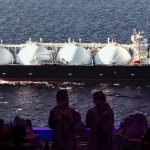
Maritime traffic through the Strait of Hormuz, a critical chokepoint carrying about 20 percent of the world’s crude oil and natural gas, has nearly stopped since the conflict began on February 28.
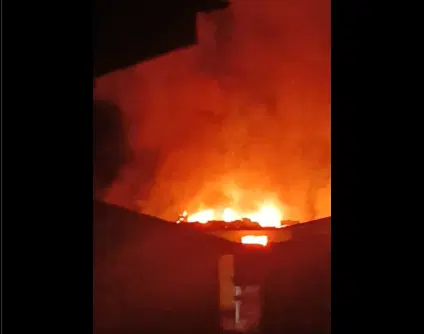
Oil and gas producers in the Gulf region have started reducing output. Israeli strikes on fuel depots in Tehran have heightened concerns about potential retaliatory attacks on energy infrastructure in neighboring countries.
The sharp rise in crude prices has already pushed up fuel costs at American gas pumps, creating a politically sensitive issue ahead of the November midterm elections.
Earlier on Sunday, Trump’s energy secretary, Chris Wright, insisted that any disruptions would be brief.
“Worst case, that’s a few weeks. That’s not months,” the US energy secretary told CNN.
“They shouldn’t go much higher than they are here because the world is very well supplied with oil,” he added to CBS. “There’s no energy shortage in all of the Western hemisphere.”
He noted that the United States was coordinating with shipping companies keen to move their vessels out of the Gulf.
“Early tankers probably will involve some direct protection by the US military” to get through the Strait of Hormuz, he said, adding that he expected traffic to return to normal “relatively soon.”
Iran produces roughly four percent of global oil, according to the US Energy Information Administration.
Despite international sanctions on its oil industry, some Iranian crude continues to be exported, primarily to China, based on industry data.
On Friday, US Treasury Secretary Scott Bessent indicated that the government was considering lifting sanctions on additional Russian oil. This followed a temporary authorization for India to purchase Russian oil the previous day, as global prices climbed.
Also on Friday, the US International Development Finance Corporation announced it was establishing a reinsurance mechanism of up to $20 billion to cover risks linked to transit through the Strait of Hormuz.