



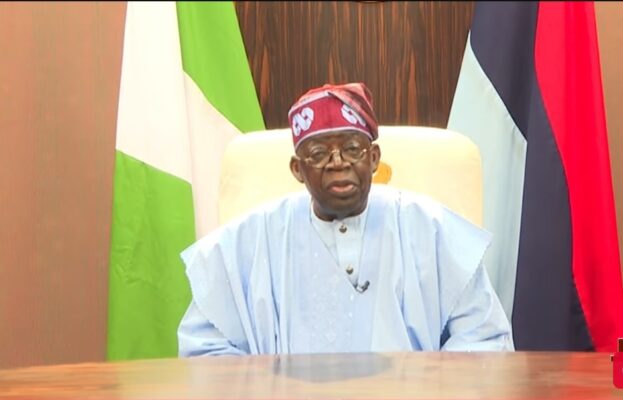
President Bola Ahmed Tinubu has declared that the worst of Nigeria’s economic challenges is over, citing the results of the painful economic reforms introduced under his administration.
In his Independence Day broadcast, Tinubu stated, “I am pleased to report that we have finally turned the corner. The worst is over, I say.
“Yesterday’s pains are giving way to relief. I salute your endurance, support, and understanding.
“I will continue to work for you and justify the confidence you reposed in me to steer the ship of our nation to a safe harbour.”
Tinubu hailed the resilience of Nigerians, saying the country had survived a civil war, military rule and political crises, and is still striving to build “a more perfect union.”
He credited the government’s decision to scrap fuel subsidies and unify exchange rates with stabilizing the economy, boosting revenue, and creating a pathway to sustainable growth.
According to Tinubu, Nigeria’s economy grew by 4.23% in the second quarter of 2025, its fastest pace in four years and above International Monetary Fund projections. Inflation has also eased to 20.12%, the lowest level in three years. The President further cited a record surge in non-oil revenue, improved foreign reserves, and a booming stock market as signs of renewed investor confidence.
While acknowledging the hardships many Nigerians have faced due to rising living costs, Tinubu argued that the reforms were unavoidable. “The alternative of allowing our country to descend into economic chaos or bankruptcy was not an option,” he said.
He pledged that the gains from the reforms would increasingly be felt in households through improved public services, investment in infrastructure, and better support for vulnerable citizens.
Tinubu emphasized that the accurate measure of success would not be limited to economic statistics alone but rather in the tangible improvements in people’s lives.
“The accurate measure of our success will not be limited to economic statistics alone,” he noted, “but rather in the food on our families’ tables, the quality of education our children receive, the electricity in our homes, and the security in our communities.”