



![[ICYMI] Lagos-Calabar highway: Telcos express concerns over threats to cables](https://am-business.s3.eu-west-1.amazonaws.com/wp-content/uploads/2024/05/Lagos-Calabar-Coastal-Highway.jpg)

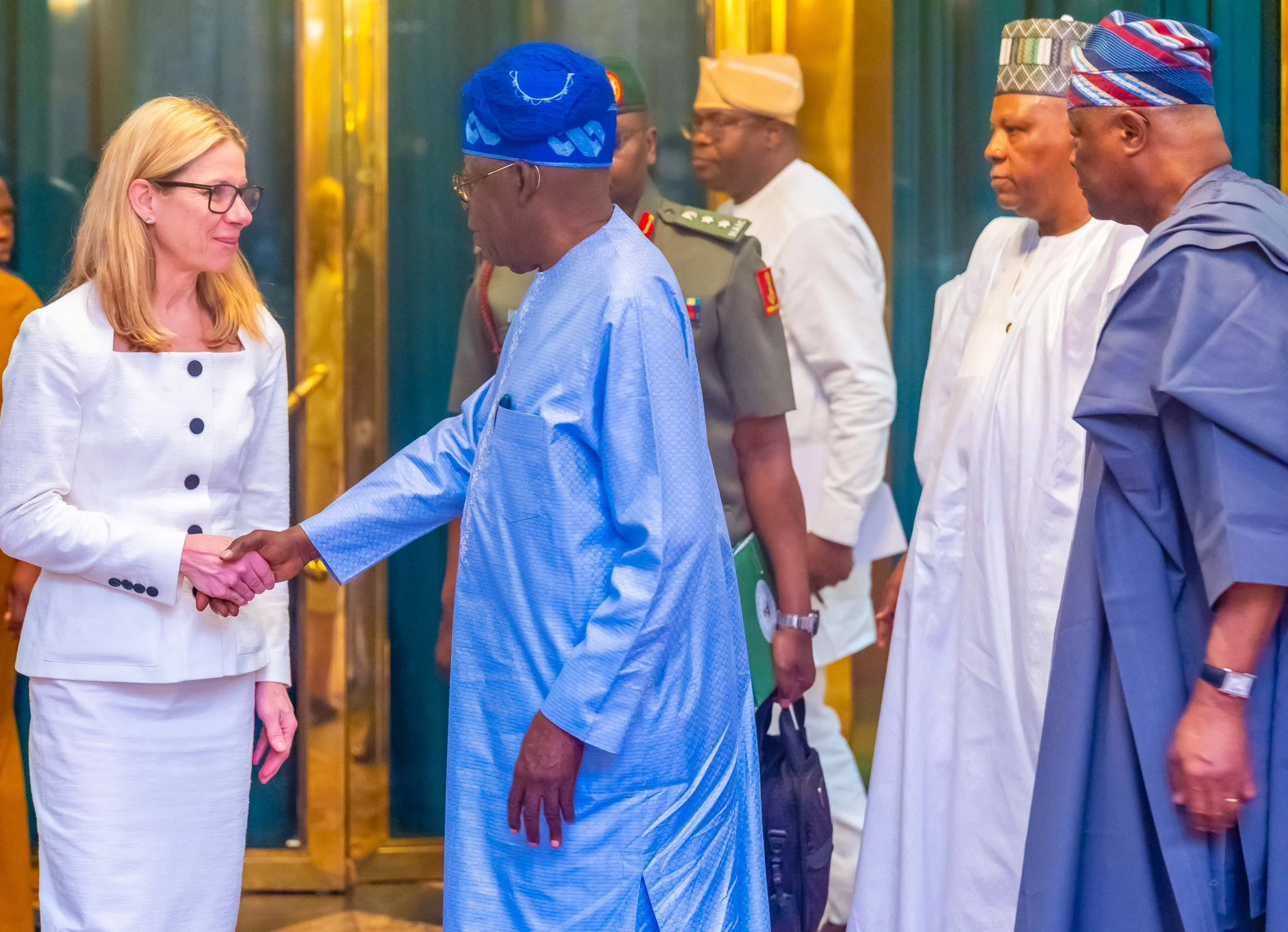
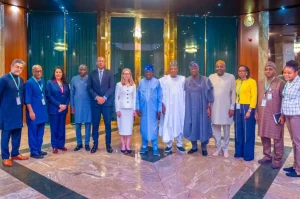
President Bola Tinubu has assured a World Bank delegation, led by Managing Director of Operations Anna Bjerde, that Nigeria’s bold economic reforms are irreversible.
He framed the reforms as essential for harnessing the nation’s vast potential, driven by its youthful population and abundant arable lands.
The meeting took place at the State House following a briefing from the Minister of Finance and Coordinating Minister of the Economy, Wale Edun, and Vice President Senator Kashim Shettima.
President Tinubu expressed delight in the reunion.
He reaffirmed commitment to the reform path.
“since we have gone into this tunnel of reform, we have our hands on the power and we’re never going to look back.”
Tinubu acknowledged the initial hardships but emphasised resilience.
“It is very clear that initially it was painful, difficult, but those who win are not the ones who give up on their way in the difficult times.”
He positioned Nigeria as the heart of the continent that must act decisively.
The President identified agriculture as the key focus, highlighting ongoing mechanisation efforts.
“Looking at faster area of arable lands, how do we employ mechanisation and make agriculture easier? I have embarked on that. There had been mechanisation centres to help the farmers working on the seedings that will enhance their program.”
He invited World Bank support for seedlings.
“whichever way, the World Bank can come in on the seedlings.”
Tinubu linked agriculture to industrial progress, particularly in petrochemicals.
“I know now that our petrochemical industry is getting good output. So how do we help the farmers to convert local market? For fertilisers to improve their yields and move them from ordinary, small scale holders to huge cooperative and confidential farmers that can bring opportunity to Nigerians?’’ Tinubu queried.
He stressed that reforms remain a continuous exercise.
“the renaming assurances is for me to assure you that reform is a continuous exercise.
‘’We’re not looking back…transparency, accountability and change that are dynamics in business orientation and the principle of accountability.”
Tinubu highlighted the rejection of corrupt practices in subsidy and exchange rate regimes.
“It was difficult for a leader to look the other way in any corrupt environment for an opportunity that can give him the fortune of money in a subsidy regime, No. In multiple exchanges, give it up! Let the world and the country benefit from a stable currency.”
He pointed to tangible economic gains.
“Yes, the first reaction was high inflation, but it’s come down dramatically. The naira is stable. Today, we can help various investors with ease of doing business in and out of the country.”
The President called for deeper collaboration and challenged the World Bank to explore innovative financing models suited to Nigeria’s large population.
“Your partnership with us is very important to me, in any way that we can cut bureaucracy and push the risk and develop the skill of our people. It is why I’m seeing you this afternoon to please accelerate that. You are very welcome at any given time,’’ Tinubu said.
Anna Bjerde, Managing Director of Operations at the World Bank, commended Nigeria’s leadership for steadfast reforms over the past two years.
“Nigeria is a frequent example in my discussions with people around the world, presidents around the world, policymakers around the world, investors around the world, because I think in these two years, the results that have been achieved are really commendable,’’ Bjerde said.
She praised the consistent communication of the reforms’ importance.
“You’ve been very steady, and it has been very noted, and from time to time, quoted by myself as well. This resolve, even, amid challenges, has delivered strong results, echoed by private sector feedback in Lagos.”
Bjerde said the World Bank has aligned its Country Partnership Framework with Nigeria’s vision of achieving a $1 trillion GDP and 7 per cent growth under Ajay Banga’s leadership.
She identified job creation as central to harnessing Africa’s demographic boom.
“I’m very bullish on this continent. It’s the only continent in the world that has a rising population. In 2051, 40% of the world will be African, and 40% of those will be young people.”
The World Bank’s strategy focuses on closing infrastructure gaps, scaling agriculture through mechanisation and value chains, improving SME financing, and advancing human development, particularly early childhood development to reduce stunting.
The approach combines public and private sector solutions.
The World Bank’s partnership package includes $17 billion in IDA/IBRD public financing, $5 billion annually from IFC for private sector mobilisation, and expanding MIGA guarantees beyond $500 million.
“What you will see from our side is that it needs to be absolutely resonating with you and the people of Nigeria as the World Bank, being a close partner.” Nigeria is always top of my mind when asked which African country to track,’’ Bjerdi said.

