






The Federal Government has announced that Nigeria’s economy expanded to $372.8 trillion in 2024, up from $309.5 trillion in 2023, reflecting stronger fiscal performance and policy impact.
Total revenue collection also climbed from N19.9 trillion in 2023 to N25.2 trillion in 2024.
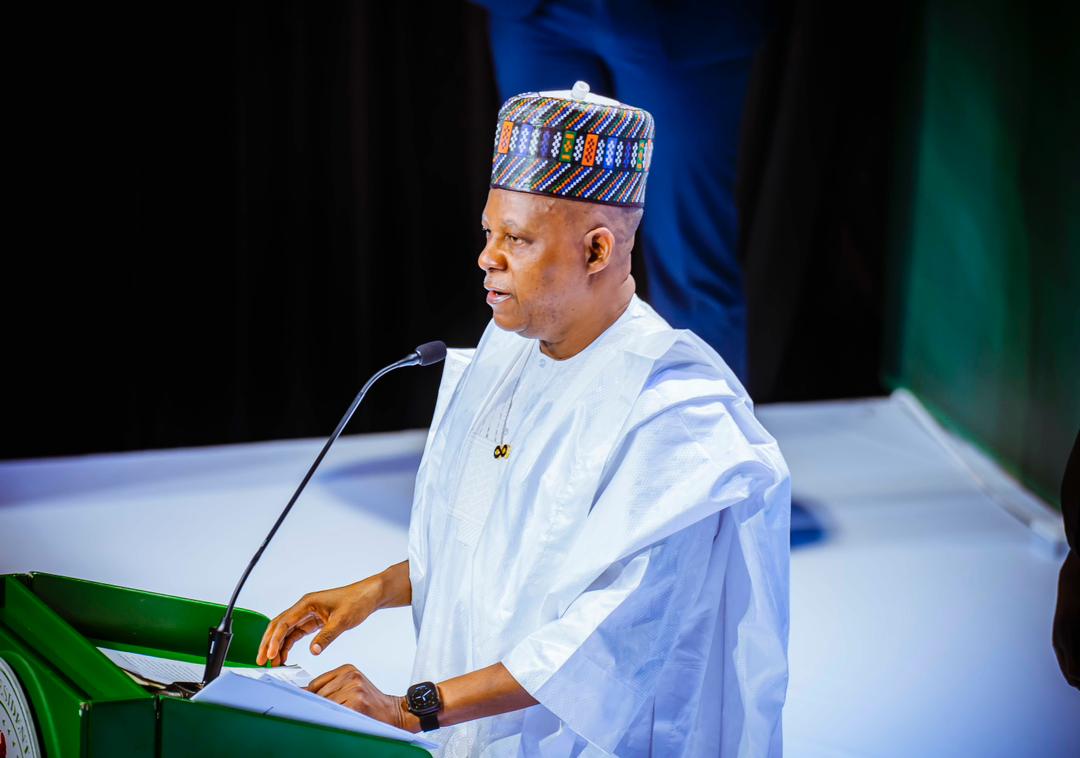
Declaring open the 31st Nigerian Economic Summit in Abuja on Monday, Vice President Kashim Shettima disclosed that as of August 2024, revenue had already hit N27.8 trillion, surpassing the government’s annual target of N18.32 trillion.
The Vice President highlighted key performance indicators, noting that the government’s reforms have begun yielding results beyond the recorded Gross Domestic Product growth of 4.23 per cent in September 2025.
Shettima affirmed the impact of the policy direction, stating: “These triumphs and projections are guided by the promise we have made to the nation, to grow Nigeria’s debt service-to-revenue ratio from 97 per cent to a sustainable level. Aside from the good news that this ratio has now reduced to less than 50 per cent, I am proud to share that this performance in our early days in office inspired Fitch to upgrade Nigeria’s sovereign rating to B with a stable outlook. Our mood is to lift our issuer rating to B3 with a stable outlook. Both place our improved economic process and clear our policy direction as our barometers.”
Shettima further noted that the GDP growth surpasses projections from multilateral agencies and local think tanks.
He provided additional fiscal data, saying: “Non-oil revenues increased by 411 per cent year-on-year in the same month, while the tax-to-GDP ratio now nudges towards 13.5 per cent, up from barely 7.0 per cent a few years ago. Our debt-to-GDP ratio now stands at 38.8 per cent, far below the limits set by the Fiscal Responsibility Act of 60 per cent and those of ECOWAS and the World Bank, which is 70 per cent.”
The Vice President assured Nigerians that promised improvements are visible, adding: “To them, I say, the better days we promised are already within sight.”
He detailed the growth in reserves and trade: “Through these reforms, our external reserves have grown to $43 billion as of September 2025. The figure we had when we assumed the mantle of leadership was so frighteningly low that I can’t even dare to quote it. Our trade balance also improved to N7.46 trillion in the second quarter of 2025, up from N5.17 trillion in the first quarter.”
While acknowledging the persistent employment challenge, the government stated its focus: “I admit that this growth has not yet fully translated into enough jobs for our people, but we are closing that gap. We are giving priority to agriculture and solid minerals—two sectors with great potential to create jobs and strengthen our economy.”
The Vice President outlined the plan for agriculture: “To move faster, we have entered into partnerships with other countries to bring in modern farming equipment, train our farmers, and expand extension services across the nation. Agriculture is the bedrock of our economy, and for us to have enhanced agricultural output, we have to embrace technology. Improved seed is absolutely essential.”
Meanwhile, Minister of Budget and National Planning, Senator Atiku Bagudu, remarked that the economy is showing positive recovery and growth.
He presented the latest GDP figures and their implication, saying: “Quarter-on-quarter, we recorded 3.13 per cent and 4.23 per cent in the 1st and 2nd quarters of 2025. Although it is still early to fully assess the impact of recent reforms, positive macroeconomic trends are beginning to emerge. Real GDP has maintained a steady growth trajectory, with the first quarter of 2024 recording a 2.98 per cent increase, followed by 3.15 per cent in the second, 3.46 per cent in the third, and 3.84 per cent in the fourth. This resulted in an annual growth rate of 3.4 per cent for 2024—a 0.66 percentage point improvement from the 2.74 per cent recorded in the previous year. Quarter-on-quarter, we recorded 3.13 per cent and 4.23 per cent in the 1st and 2nd quarters of 2025. The key economic implication of this result is the stabilisation of the macroeconomic environment occasioned by effective and sustained policy implementation. Higher GDP growth reflects rising domestic demand, increased business confidence, and a more dynamic productive base.”
Despite the positive statistics, Chairman of the Nigerian Economic Summit Group, Mr. Olaniyi Yusuf, called on the government to rely on resilience, reform, and discipline to attract investment and build credibility in view of the global shrinking of development aid.
He advised the government on how to navigate the global shift, stating: “Globally, the economic environment is shifting. Growth is slowing, protectionism is rising, and geopolitical tensions are redrawing trade patterns. Development aid is shrinking as advanced economies battle fiscal pressures and ageing populations. For Nigeria, the message is clear: external support will be limited. We must rely on resilience, reform, and discipline to attract investment and build credibility. If we act decisively, we can turn global turbulence into opportunity.”

