
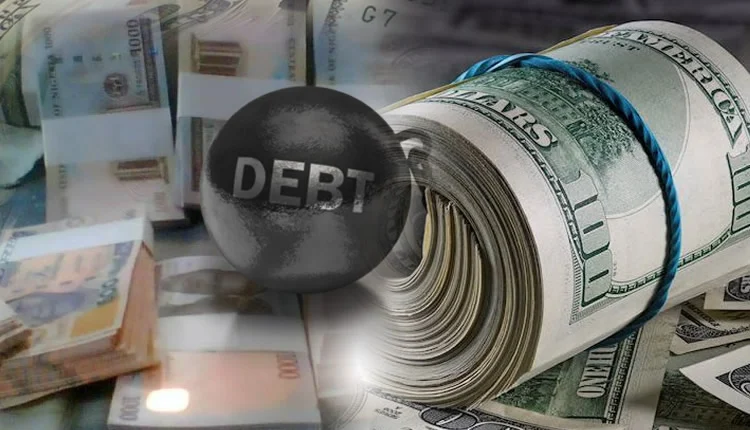
Nigeria’s total debt stock is set to rise to N155.1 trillion, following an additional $6 billion loan request by President Bola Tinubu, approved by the Senate on Tuesday.
The $6 billion loan at an exchange rate of N1,400 per dollar, adds N8.4 trillion to the country’s debt stock which stood at N146.69 trillion at the end of 2025, to N155.1 trillion.
Experts, however, warned that the new borrowing comes with huge foreign exchange risks and will lead to worsening of the federal government’s debt service-to-revenue ratio, which is estimated at 60 per cent by the end of 2025.
The approval for the $6 billion on Tuesday came barely three and half hours after the President of the Senate, Senator Godswill Akpabio, read the letter from the President, seeking the approval. The letter was read the first time, scaled for a second reading, read the third time, and passed the same day by the senators. The Senate approved the loans, following the presentation and consideration of the report by Senator Aliyu Wammakko, Chairman, Senate Committee on Local and Foreign Debts.
Former Vice President, Atiku Abubakar, flayed what he described as lightning-speed approval of a fresh $6 billion external loan request by the National Assembly.
President Tinubu’s request to borrow an additional $6 billion was contained in two separate letters addressed to the President of the Senate, Senator Godswill Akpabio, read at plenary yesterday. In the first letter read by Akpabio, President Tinubu requested the approval to establish a structured total return swap (TRS) external financing programme of up to $5 billion with First Abu Dhabi Bank of United Arab Emirates.
In the letter, President Tinubu, who noted that the facility would be made available to Nigeria in tranches, said: “The purpose of this letter is to request for the approval and resolution of the National Assembly pursuant to the provisions of section 21(1) and 27(1) of the Debt Management Office Establishment Act 2003 to establish a structured total return swap, TRS, derivative external financing programme from First Abu Dhabi Bank of the United Arab Emirates of up to $5 billion which will be made available to the Federal Republic of Nigeria in tranches.”
According to him, the proceeds will be used for budget implementation, development of priority infrastructure projects and repayment of relatively expensive domestic and external debts. He added that the facility would also help the federal government meet urgent financial obligations when necessary. The President said Nigeria’s total public debt currently stood at $110.3 billion, equivalent to about N159.2 trillion as of December 31, 2025. He said the loan would be drawn in phases to reduce pressure on the country’s debt stock and servicing obligations.
In the second letter, Tinubu also asked the Senate to approve the issuance of naira-denominated Federal Government securities as collateral for the facility and the payment of margin obligations in US dollars. In the letter, the President, who sought approval for a $1 billion United Kingdom, UK, export finance loan facility arranged by Citibank, London branch, said the loan would be used for the reconstruction and rehabilitation of Lagos Port complex and Tin Can Island Port.
The letter read: “The rehabilitation of the ports project is a strategic modernisation initiative of the Federal Government of Nigeria, through the Nigerian Ports Authority, to restore and upgrade two of Nigeria’s most vital ports, namely Tin Can Island Port complex and Lagos Port complex, Apapa, which have reached critical engineering failures.”
According to him, the project is aimed at addressing infrastructure deficiencies, improving port efficiency, enhancing safety standards and aligning Nigeria’s port facilities with global best practices. Tinubu added that the rehabilitation would help sustain Nigeria’s competitiveness as a maritime hub and support non-oil trade diversification.