



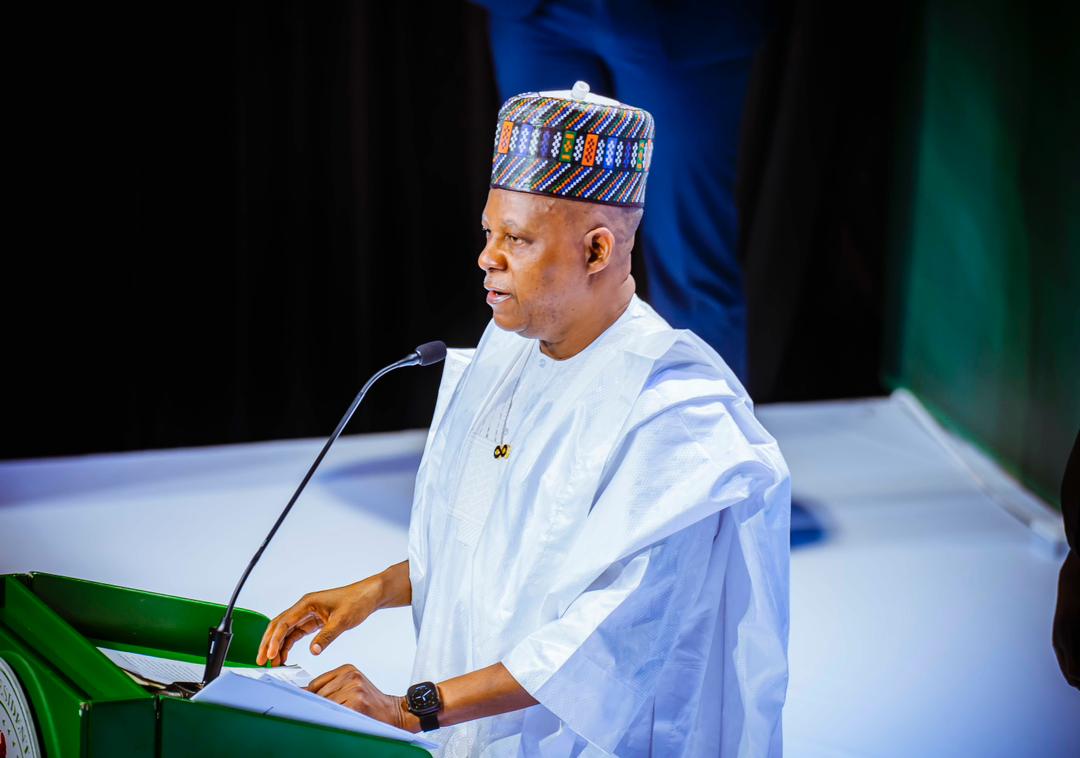
Nigeria has urged African nations to embrace health security sovereignty, shifting away from reliance on foreign aid to building self-sufficient, homegrown health systems.
Vice President Kashim Shettima delivered the call on Friday during a high-level side event titled “Building Africa’s Health Security Sovereignty.” The event took place on the margins of the ongoing 39th Ordinary Session of the Assembly of Heads of State and Government of the African Union (AU) in Addis Ababa, Ethiopia.
Shettima represented President Bola Ahmed Tinubu at the summit. He emphasized that Africa must protect its health systems from the uncertainties of distant supply chains and the shifting priorities of global crises.
“Nigeria stands ready to collaborate with every member state of our Union to make health security sovereignty measurable in factories commissioned, laboratories accredited, health workers trained, counterfeit markets dismantled, and insurance coverage expanded,” he said.
The Vice President highlighted Africa’s vulnerability during the COVID-19 pandemic. The continent faced delays and improvisation due to rationed vaccines and scarce oxygen supplies. He stressed that endurance alone is not a viable strategy and that leadership must actively reduce such vulnerabilities.
“Health security is national security, and in an interconnected continent, national security is continental security. A virus does not carry a passport. A counterfeit medicine does not respect a border. A pandemic does not wait for bureaucracy,” Shettima declared.
Shettima detailed steps Nigeria is taking under President Tinubu’s leadership. These include boosting local pharmaceutical manufacturing, increasing domestic health financing, and strengthening regulatory oversight.
He spotlighted the Nigeria Health Sector Renewal Investment Initiative. Launched in December 2023, it has secured over $2.2 billion in commitments. The initiative aims to renovate more than 17,000 primary healthcare centres, train 120,000 frontline health workers, and expand health insurance coverage within three years.
The Vice President also noted Nigeria’s advancements in epidemic intelligence, genomic surveillance, and emergency preparedness through the Nigeria Centre for Disease Control and Prevention. He added that the National Agency for Food and Drug Administration and Control has intensified regulatory oversight with upgraded quality-control laboratories and stricter enforcement against substandard medicines.
Shettima explained that Nigeria is further unlocking its healthcare value chain. This is being done through the Presidential Initiative to Unlock the Healthcare Value Chain. The initiative targets structural bottlenecks for local pharmaceutical manufacturers, medical device assemblers, and biotechnology innovators.
Coordinating Minister of Health and Social Welfare, Prof. Muhammad Ali Pate, reaffirmed Nigeria’s commitment. He said the country is leading by example in building workforce capacity and strengthening health systems. Pate noted efforts to bridge rural-urban gaps in health worker distribution and to build resilience across the continent.
Africa CDC Director General, Dr. Jean Kaseya, praised Nigeria’s leadership. He emphasized the need for synergy in resources to tackle fragmented investments in health systems.
Health Ministers from Senegal, Malawi, and Ethiopia pledged support for the initiative. They aligned with Nigeria’s call to boost investment in workforce databases and strengthen community health systems.
At the forum’s conclusion, African Union Ministers of Health and Finance urged AU Heads of State and Government to strengthen political commitment. They called for increased sustained investment in human resources for health and community health systems.
The ministers specifically advocated elevating Human Resources for Health and Community Health Workers as strategic pillars of Primary Health Care, Universal Health Coverage, and Pandemic Preparedness, Prevention, and Response.
They set a continental target of two million community health workers by 2030. They also advocated for increased domestic financing and the development of national community health acceleration plans.