




Nigeria’s exports to the United States declined by ₦940.98bn in the first nine months of 2025, even as imports from America more than doubled, reversing the trade balance that had favoured Nigeria in the same period of the previous year, according to findings from foreign trade data released by the National Bureau of Statistics.
An analysis of NBS figures covering Q1 to Q3 2024 and Q1 to Q3 2025 showed that Nigeria exported goods valued at ₦3.65tn to the United States in the first nine months of 2025, compared with ₦4.59tn recorded in the corresponding period of 2024, representing a decline of 20.5 per cent or ₦940.98bn.
Over the same period, Nigeria’s imports from the United States rose sharply to ₦6.80tn from ₦3.01tn, marking an increase of 125.5 per cent or ₦3.78tn, indicating that Nigeria purchased far more goods from the US than it sold to the market in 2025.
This resulted in a trade deficit of about ₦3.15tn with the United States in the first nine months of 2025, compared with a trade surplus of ₦1.57tn recorded in the corresponding period of 2024.
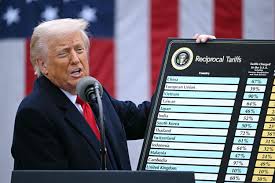
The worsening trade position coincided with the implementation of Washington’s “reciprocal” tariff regime, under which US President Donald Trump signed an executive order increasing Nigeria’s tariff rate from 14 per cent to 15 per cent.
The order, issued in late July, took effect on August 7, 2025. While crude oil exports were exempted in several instances, the higher tariff applied directly to a wide range of Nigeria’s non-oil exports, creating uncertainty for American importers and dampening demand both ahead of and after the effective date.
With crude oil exports largely shielded from the new tariff regime, non-oil exports bore the brunt of the disruption. In the first nine months of 2024, Nigeria’s exports to the US rose steadily quarter-on-quarter, from ₦1.31tn in Q1 to ₦1.59tn in Q2 and ₦1.69tn in Q3.
During the same period in 2024, imports remained relatively moderate at ₦1.01tn in Q1, ₦965.50bn in Q2, and ₦1.04tn in Q3. This resulted in trade surpluses of ₦301.94bn in Q1, ₦620.99bn in Q2, and ₦649.71bn in Q3, culminating in a cumulative surplus of ₦1.57tn over the nine months.
That trend reversed sharply in 2025. Exports opened the year at ₦1.54tn in Q1 but declined to ₦1.36tn in Q2 before plunging to ₦743.63bn in Q3. Imports moved in the opposite direction, rising from ₦1.42tn in Q1 to ₦2.16tn in Q2 and surging further to ₦3.22tn in Q3.
Quarter-on-quarter analysis showed that exports fell by 11.9 per cent between Q1 and Q2 2025, before collapsing by 45.3 per cent between Q2 and Q3. Imports, meanwhile, rose by 51.8 per cent between Q1 and Q2 and by another 49.1 per cent between Q2 and Q3, rapidly widening Nigeria’s trade deficit with the United States.
On a year-on-year basis, exports to the US grew by 17.7 per cent in Q1 2025 compared with Q1 2024, but the trend reversed thereafter. Exports declined by 14.3 per cent in Q2 2025 relative to Q2 2024 and plunged by 56.0 per cent in Q3 2025 compared with Q3 2024.
Imports increased sharply across all quarters, rising by 40.9 per cent in Q1, 123.5 per cent in Q2, and 209.4 per cent in Q3. The contraction in export earnings explains why the United States dropped out of Nigeria’s top five export destinations by Q2 and Q3 2025, despite remaining one of Nigeria’s largest sources of imports.
Product-level data from the NBS highlighted the imbalance. In Q1 2025, Nigeria’s exports to the US were dominated by crude petroleum oils valued at ₦779.38bn, followed by urea at ₦240.17bn and kerosene-type jet fuel at ₦214.30bn. Other exports included petroleum gases in gaseous state worth ₦95.97bn and standard quality cocoa beans valued at ₦58.84bn.
Imports from the US in Q1 2025 were led by crude petroleum oils valued at ₦726.84bn, alongside used diesel vehicles above 2,500cc worth ₦93.51bn, lubricating oil additives at ₦60.12bn, soya beans at ₦45.04bn, and butanes valued at ₦32.85bn.
By Q2 2025, Nigeria’s export basket to the US narrowed significantly, led by cocoa beans valued at ₦37.39bn and urea at ₦106.44bn, alongside technically specified natural rubber worth ₦10.43bn and leather products valued at ₦127.22m.
Imports in Q2 expanded sharply, with crude petroleum oils alone valued at ₦1.34tn, followed by used vehicles, wheat, motor spirit, and denatured alcohol.
In Q3 2025, exports dwindled further to relatively minor items such as soya bean flour valued at ₦23.60bn, cocoa powder preparations worth ₦36.83m, and technically specified natural rubber valued at ₦5.03bn.
Imports from the US continued to surge in Q3, with crude petroleum oils rising to ₦2.31tn, alongside strong inflows of used vehicles, wheat, and industrial plastics.
With the US no longer among Nigeria’s top five export destinations by mid-2025 and imports accelerating rapidly, the figures underscore growing structural weaknesses in Nigeria’s trade position and the vulnerability of its export earnings to external policy shifts.
Earlier in September, President Bola Tinubu said his administration would remain resilient and expressed no fear over the trade policy direction of US President Donald Trump, particularly tariffs targeting Nigerian exports. He cited Nigeria’s improving economic trajectory and growing non-oil revenues as buffers against external shocks.
Tinubu said, “If non-oil revenue is growing, then we have no fear of whatever Trump is doing on the other side.”
Also commenting, Nigeria’s Minister of Industry, Trade and Investment, Jumoke Oduwole, said the country would not be stampeded into retaliatory measures but would stay focused on reform and diversification.
“Nigeria remains responsive; we’re not reacting. We’re focused on the eight-point agenda of President Bola Tinubu. We will continue to support domestic investors and expand market access for Nigerian businesses,” Oduwole said.
She noted that while the United States remains an important trade partner, Nigeria is strengthening its African Continental Free Trade Area strategy and boosting non-oil exports, which grew by 24 per cent year-on-year in the first quarter of 2025.
“It’s mostly an energy trading relationship, but we are waiting to see what happens with AGOA (African Growth and Opportunity Act) in September. We are also growing exports to other African countries and expanding partnerships with Brazil, China, Japan, and the UAE,” she added.
The minister stressed that Nigeria would pursue South–South cooperation, deepen export diversification, and reduce dependence on the American market.
Stakeholders in Nigeria’s export sector had earlier called on the United States to review tariffs on Nigerian products, while also describing the policy shift as an opportunity to expand non-oil exports.
Stakeholders led by the Nigerian-American Chamber of Commerce and the Nigerian Export Promotion Council said the tariffs should not be viewed solely as a challenge but also as a potential window for growth.
A development economist and Chief Executive Officer of CSA Advisory, Dr Aliyu Ilias, said Nigeria should adapt to the changing trade environment. “I think it’s a good time that this is happening to Nigeria. Trump’s tariff is not only for Nigeria. The advantage is that we are now exporting more overall, which is positive for us,” he said.
Ilias argued that Nigeria could leverage its position within BRICS and other international alliances to reduce vulnerability and build resilience, noting that other countries such as India and China are also affected by US tariffs.
“We also have to start being on our own. We can trade with other partners and see, because other partners are also looking for partners. The tariff that is affecting us is also affecting others, so it may be a good opportunity,” he added.
Similarly, economist and Chief Executive Officer of the Centre for the Promotion of Private Enterprise, Dr Muda Yusuf, downplayed the impact of US tariffs on Nigeria.
“Our trade with the US is not that strategic. When anything goes wrong, it is not as if it can have any fundamental effect on our economy. Our trade exposure to them is very limited,” Yusuf said.
He noted that Nigeria’s exports to the US are dominated by crude oil and a small range of other commodities such as fertilisers, making the country’s export base narrow. He added that Nigeria’s tariff exposure is moderate compared with other countries but identified US visa policy as a more significant concern.
“The bigger challenge for Nigeria’s trade relationship with the U.S. is Washington’s visa policy. Barriers to travel limit business interactions and investment inflows. That is more critical than tariffs in the long run,” he said.
Since its inception, the Trump administration has rolled out a series of visa restrictions and travel bans affecting Nigeria and several other countries, citing immigration reform, border security, and improved vetting of foreign nationals.
These measures escalated with a recent proclamation imposing travel restrictions on Nigerians and citizens of 16 other African countries.
According to the White House, holders of B-1, B-2, B-1/B-2, F, M, and J visas will be barred from entering the United States from January 1, 2026.
The visa categories cover business and tourist travel, as well as students and exchange visitors, effectively affecting a broad segment of Nigerians.
Beyond security concerns, the US government also cited what it described as high rates of visa overstays by Nigerian nationals as part of the justification for the restrictions.