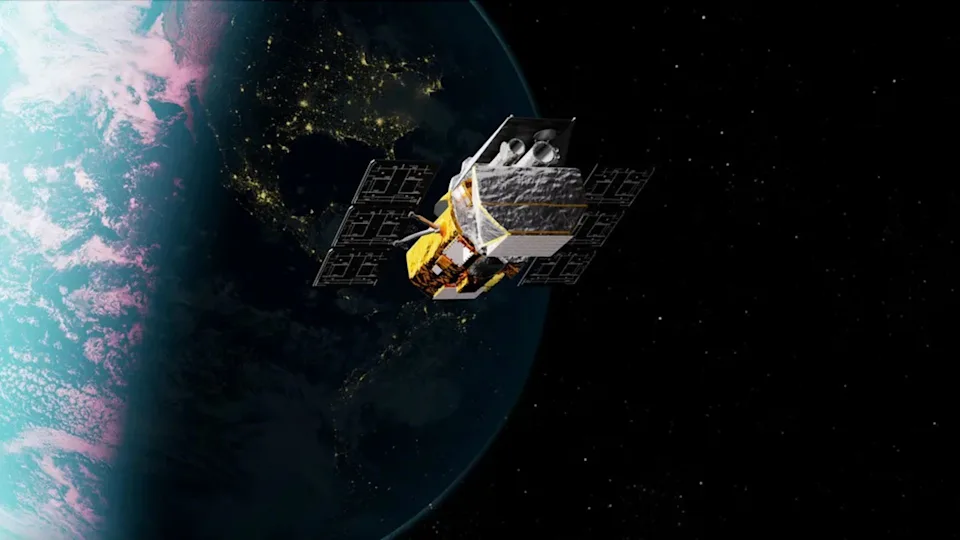
NASA’s Swift space telescope is expected to re-enter Earth’s atmosphere and crash back to the planet within the next few days.
The Neil Gehrels Swift Observatory will make an uncontrolled return after a robotic rescue mission failed to move the spacecraft into a higher orbit to extend its operational life.
Launched in November 2004, Swift spent more than two decades studying gamma-ray bursts, the universe’s most powerful explosions, alongside other cosmic objects and events. It carried three instruments: the Burst Alert Telescope, the X-Ray Telescope and the Ultraviolet/Optical Telescope.
On October 20, NASA reported that Swift’s orbit had dropped to 171 miles (275 kilometres) above Earth. The approximately 3,300-pound (1,500-kilogram) observatory could no longer counter the effects of increased atmospheric drag.
The spacecraft subsequently entered safe mode, prompting its operations team at Pennsylvania State University to send a command that effectively shut down its operations ahead of its expected uncontrolled re-entry into Earth’s atmosphere.
The exact timing and location of Swift’s re-entry remain uncertain, but researchers are closely monitoring its descent.