





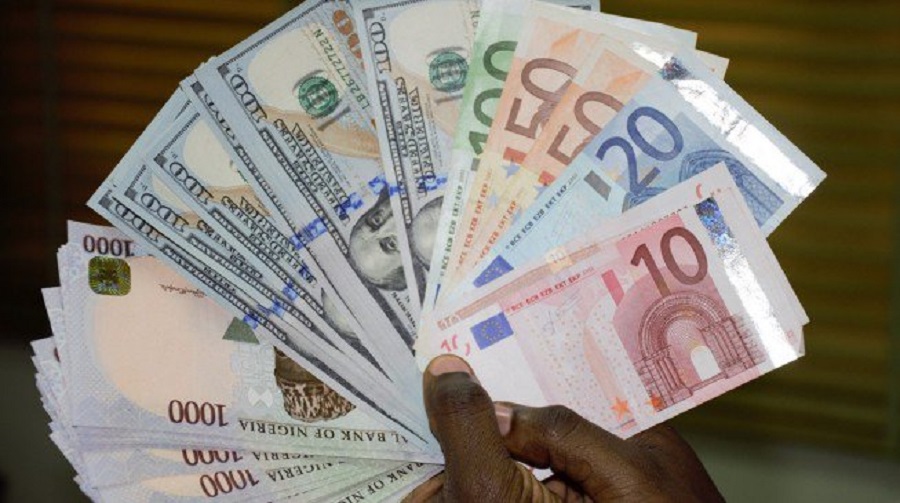
The naira strengthened to N1,337/$ at the Nigerian Foreign Exchange Market on Friday, extending its recent gains as weekly foreign exchange turnover fell sharply to $2.71 billion.
This is according to data from the Central Bank of Nigeria’s website on Friday.
The currency closed at N1,337/$ on August 28, compared with N1,349.99/$ at the previous trading session on August 24, representing a 0.96 per cent appreciation over the week.
Meanwhile, NFEM turnover dropped 48.7 per cent week-on-week to $2.71 billion from approximately $5.28 billion recorded between August 17 and 21, based on data from the CBN.
The naira opened the week at N1,349.99/$ on August 24 before strengthening to N1,343/$ on August 26 and N1,336/$ on August 27.
It closed at N1,337/$ on August 28, trading within a range of N1,335/$ to N1,350/$ during the reported sessions.
The week’s NFEM turnover was concentrated around August 26 and 27, with transactions worth about $913.76 million and $1.06 billion respectively.
Market was closed on Tuesday, 25 August, due to a public holiday.
Turnover on August 24 stood at $731.18 million.
The combined figure amounted to approximately $2.71 billion, compared with $5.28 billion in the previous trading week.
The naira appreciated to N1,403/$ in the parallel market on Friday from N1,407/$ on Thursday.
The naira’s latest appreciation comes amid an improvement in Nigeria’s external reserves.
During the week, Nigeria’s foreign exchange reserves crossed the $53 billion mark for the first time in more than 17 years, reaching $53.11 billion as of August 24, 2026.
Higher reserves provide the Central Bank of Nigeria with a stronger external liquidity position and can improve market confidence in the country’s ability to meet foreign exchange obligations.
Oil prices settled lower on Friday, extending losses for the week as traders weighed signals on the U.S. Federal Reserve’s approach to inflation and reports of a possible agreement to facilitate shipping through the Strait of Hormuz.
Brent crude futures fell 39 cents, or 0.43 per cent, to settle at $89.31 a barrel, while West Texas Intermediate (WTI) crude declined 13 cents, or 0.16 per cent, to $83.40 a barrel.
For the week, Brent crude fell more than 5 per cent, while WTI declined by more than 4 per cent.
Earlier, CBN Governor Olayemi Cardoso dismissed claims that the apex bank is aggressively intervening in the foreign exchange market to defend the naira, saying its interventions now account for only about “1.2% to 1.3% of total FX turnover.”
The CBN governor also linked the improved FX market structure to recent reforms, including the FX Code, electronic trading platform and the revised foreign exchange manual.
The apex bank governor also said Nigeria has built sufficient economic buffers to withstand inflationary pressures arising from the ongoing conflict in the Middle East.