
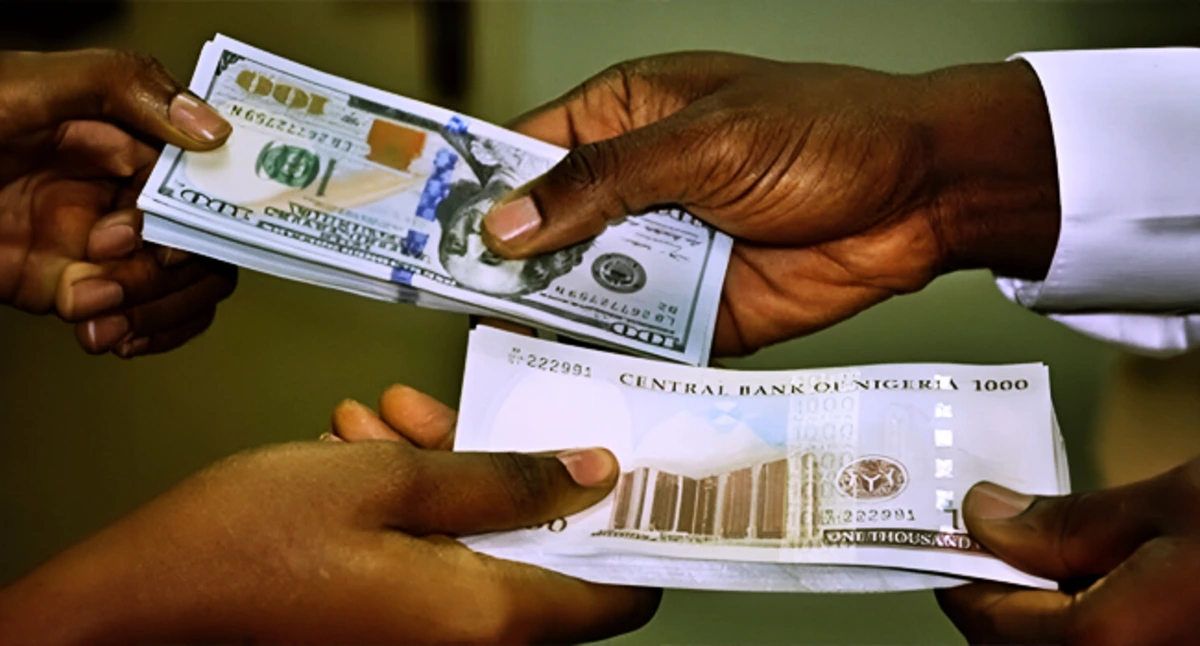
The naira extended its recovery against the United States dollar on Friday, November 27, 2026, closing at ₦1,376/$ for a second consecutive daily gain, while interbank foreign exchange turnover plunged by 54.53 per cent to $106.88 million, its lowest level in the week ended November 27, 2026.
An analysis of Central Bank of Nigeria foreign exchange trading data showed that the local currency gained ₦2 from Thursday’s closing rate of ₦1,378/$.
This brought its cumulative gains over the last two trading sessions to ₦21, or about 1.50 per cent.
Friday’s closing rate was the strongest of the five trading sessions during the week.
The naira traded as strongly as ₦1,350/$ during the session but could not sustain that level.
In the parallel market, however, the exchange rate was unchanged at ₦1,458/$, which points to relative stability in the informal segment following the CBN’s intervention.
Even so, the persistent premium between the official and parallel market rates highlights lingering demand pressures and the importance of sustained foreign exchange supply to achieve greater exchange rate stability.
The latest appreciation extended the recovery that began on Thursday, when the currency recorded its biggest single-session gain in over three months following the CBN’s intervention.
Thursday’s ₦19 single-day gain accounted for about 90.48 per cent of the cumulative two-day improvement, which makes Friday’s ₦2 gain relatively modest.
Compared with the ₦1,394/$ recorded on Friday, November 20, the naira gained ₦18, or 1.29 per cent.
Despite the weekly appreciation, the currency remained ₦16 weaker than its closing rate of ₦1,360/$ on November 16.
The lowest exchange rate improved by ₦25 to ₦1,350/$ from ₦1,375/$ on Thursday.
The highest rate improved by ₦20 to ₦1,377.50/$ from ₦1,397.50/$.
The simple average exchange rate strengthened by ₦19.88, or about 1.43 per cent, to ₦1,367.78/$ from ₦1,387.66/$.
The intraday trading range widened to ₦27.50, its highest level during the week, compared with ₦9 recorded on Tuesday.
Naira rebound spreads to forwards market on CBN intervention
In the forwards market, the naira also appreciated on the 1-month contract (up 1.5 per cent to ₦1,394.21/$).
It rose 1.5 per cent to ₦1,429.83/$ on the 3-month contract and 1.5 per cent to ₦1,473.89/$ on the 6-month contract.
The 1-year contract also gained 1.5 per cent, to ₦1,574.70/$.
Analysts at Cordros Securities Limited said the rebound was supported by $1.40 billion in CBN interventions, increased offshore offers and FX inflows linked to the Dangote IPO.
On Wednesday, November 25, 2026, the CBN intervened to improve dollar supply to the Bureau de Change (BDC) segment.
The intervention followed a weakening of the local currency to its lowest level since March before it stabilised.
The CBN increased weekly dollar allocations to licensed BDC operators from $150,000 to $1.0 million per operator.
The adjustment is a substantial expansion in official dollar supply to the retail foreign exchange market, aimed at improving access to foreign currency, narrowing the gap between official and parallel market rates, and curbing speculative pressures.
Interbank foreign exchange turnover declined for the second consecutive trading session, falling to $106.88 million from $235.04 million on Thursday.
The latest turnover was the lowest since November 16, when interbank dollar transactions stood at $68.66 million.
Friday’s turnover was $595.75 million, or 84.79 per cent, below Wednesday’s $702.63 million.
It was also 88.52 per cent below Monday’s $931.23 million.
Cumulative interbank turnover for the week stood at about $2.14 billion, with a daily average of $428.01 million.
The number of interbank deals fell by 33.89 per cent to 119 from 180 on Thursday, and was 46.64 per cent below Monday’s 223 transactions.
The average transaction value dropped to about $898,124 from $4.18 million on Monday.
Friday’s turnover was about 75 per cent below the week’s daily average, reflecting a significant slowdown in trading activity towards the end of the week.
The decline in interbank turnover therefore reflects both fewer transactions and smaller average transaction sizes, even as the naira recorded consecutive daily gains.
The latest recovery follows a week of sharp swings in interbank foreign exchange turnover and sustained pressure on the naira in the earlier trading sessions.
On Monday, November 23, interbank turnover reached a one-month high as the naira gained marginally to ₦1,393/$ from ₦1,394/$ the previous Friday.
On Tuesday, turnover crashed by 82.36 per cent to $164.28 million as the naira weakened to ₦1,396.50/$.
On Wednesday, turnover rebounded by 327.7 per cent to $702.63 million as the currency weakened further to ₦1,397/$, its lowest closing level since March 6.
Interbank turnover had earlier risen from $68.66 million on November 16 to $800.31 million on November 19, before falling to $106.88 million on Friday.
The naira’s recovery over two consecutive sessions appears to be a direct result of the CBN’s increase in the volume of dollars allocated to BDCs weekly.
The appreciation has not been accompanied by an expansion in dollar transactions, which suggests that the recovery could also reflect reduced dollar demand against improving supply.
However, the wider intraday trading range and the currency’s inability to sustain the ₦1,350/$ level suggest that exchange rate pressures have not fully disappeared.
“In the near term, we expect FX demand pressures to persist through the remainder of the year, reflecting relatively weaker net foreign inflows amid tight global monetary conditions and heightened investor caution ahead of Nigeria’s 2027 general elections. Seasonal import demand ahead of the festive period could further intensify demand-side pressures,” Cowry Asset stated in its weekly financial market review.
“Nonetheless, we believe the CBN’s external reserve buffers remain sufficient to support sustained intervention in the FX market, helping to bridge supply gaps, contain excessive volatility and limit the extent of naira depreciation,” the analysts projected