The Oyo State Government has proposed a ₦1.115 trillion budget for 2027.
The proposal prioritises infrastructure development, job creation, entrepreneurship and the growth of Micro, Small and Medium Enterprises, with the aim of accelerating economic expansion and improving residents’ living standards.
The proposed budget is tagged “Budget of Sustained Progress”.
It is designed to consolidate gains recorded across critical sectors while strengthening the state’s economic competitiveness through investments in infrastructure, agriculture, human capital development and public-private partnerships.
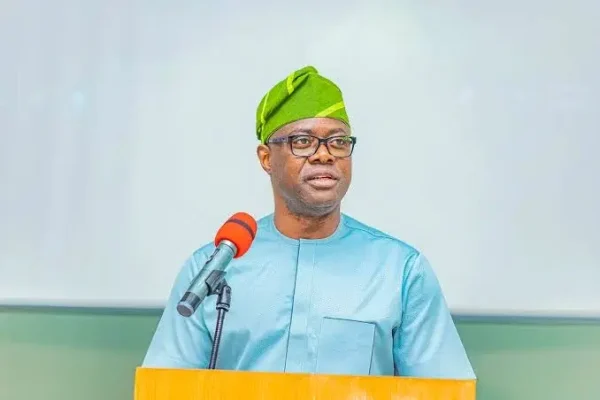
Governor Seyi Makinde presented the proposal to the Oyo State House of Assembly last week.
Capital expenditure accounts for 60.1 per cent of the total spending plan.
The Permanent Secretary, Ministry of Budget and Economic Planning, Julius Ayanleke, spoke on Monday in Ibadan during the presentation of the budget breakdown and analysis at the ministry.
He said the proposal aligned with the administration’s vision of making Oyo State the fastest-growing economy in Nigeria.
He said the government’s spending priorities would focus on completing ongoing projects, strengthening Internally Generated Revenue (IGR) and attracting public and private investments.
The priorities also include supporting MSMEs, expanding infrastructure and ensuring efficient use of resources through Public-Private Partnerships (PPPs).
According to Ayanleke, the proposed budget comprises ₦670.03 billion for capital expenditure, representing 60.1 per cent.
It also comprises ₦445.31 billion for recurrent expenditure, which accounts for the remaining 39.9 per cent.
He explained that the substantial allocation to capital projects was meant to sustain the state’s development drive.
He said this would be done particularly through the completion of ongoing projects and the execution of critical infrastructure programmes.
Among the projects earmarked for priority funding are the Ibadan Circular Road, the Ido-Eruwa Road and several rural road projects.
He said these projects had received adequate provisions to facilitate their timely completion.
Giving an update on the state’s fiscal performance, Ayanleke disclosed that Oyo generated ₦618.72 billion between January and September 2026.
He said the revenue comprised ₦401.44 billion in recurrent revenue and ₦217.28 billion in capital receipts.
The permanent secretary explained that the 2027 budget was developed through the Medium-Term Expenditure Framework (MTEF), sectoral planning processes and consultations with stakeholders across the state’s seven geopolitical zones.
He said this was to ensure that the spending priorities reflected residents’ development needs.
Outlining the government’s fiscal targets, he said the administration would prioritise the completion of ongoing projects.
He said it would also reduce non-essential overhead costs and improve efficiency in personnel and recurrent expenditure.
He added that the government was targeting a minimum annual growth of 10 per cent in IGR between 2027 and 2029.
He said it would also ensure that recurrent expenditure was financed through sustainable revenue sources.
Other priorities, according to him, include diversifying the state’s revenue base and accelerating critical capital projects.
They also include expanding access to grants, development funding and public-private partnership arrangements.
Ayanleke said maintaining the 60:40 capital-to-recurrent expenditure ratio demonstrated the government’s commitment to development-focused investments and long-term economic growth.
He added that the spending approach would enable the state to channel more resources into productive investments.
He said such investments could stimulate economic activities, support businesses, create employment opportunities and improve residents’ welfare.
Also speaking, the Executive Assistant to the Governor on Finance, Budget and Economic Planning, Gafar Bello, commended the state’s budget performance since 2019.
He attributed the progress to transparency, fiscal discipline, efficiency and effective deployment of fiscal management tools.
Bello said the administration’s approach to fiscal management had contributed to improved budget implementation.
He said it had also strengthened the state’s capacity to pursue its development objectives.
The President of the Multi-disciplinary Finance Professionals (MFP), Dr Oyedepo Oyebade, praised the state government and the Ministry of Budget and Economic Planning.
He praised what he described as the transparent presentation of the 2027 budget and impressive implementation of the 2026 fiscal proposal.
Oyebade particularly highlighted the state’s 103 per cent performance on statutory allocation on a pro-rata basis.
He said this reflected the adoption of prudent and realistic revenue projections.
He also commended the government for sustaining transparency, accountability and the January-to-December budget cycle.
He described the consistency as an important feature of sound fiscal management.
According to him, allocating about 60 per cent of the proposed budget to capital projects underscored the administration’s commitment to completing ongoing projects, expanding infrastructure and driving development across the state.