
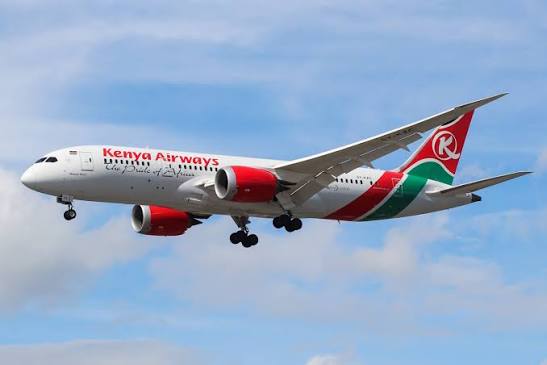
Kenya Airways is targeting $1.5 billion in equity and debt financing from a strategic investor by mid-2027, as it seeks to strengthen its balance sheet and ease mounting financial pressures.
The airline’s Chairman, Kiprono Kittony, disclosed this in an interview with Reuters on Friday, November 27, 2026.
He said the fundraising would combine equity and debt investments.
The proposed capital raise comes as the carrier faces rising operating costs, aircraft maintenance challenges and an expected decline of at least 25 per cent in its 2026 earnings, which makes it more urgent to secure a long-term investment partner.
The airline is now exploring partnerships with investors who can provide patient capital and support its long-term operational and financial stability.
Kittony said the airline’s information memorandum for the fundraising was expected to be ready on November 27, paving the way for talks with interested investors.
The airline has moved away from its initial plan to target another carrier as an investor and is now open to other potential partners, including sovereign wealth funds.
“We would want to have a long-term partner with patient capital,” Kittony said, adding that the airline would adopt a multi-pronged approach involving equity and debt investments.
He also disclosed that the airline had received interest from several potential investors, although he did not name them.
“We have very many parties who are interested. We get calls every day,” he said.
The proposed investment is expected to provide additional capital as the airline works to strengthen its balance sheet and address its financial challenges.
The fundraising comes as Kenya Airways faces higher operating costs, with the airline warning that its 2026 earnings could fall by at least 25 per cent year-on-year.
The airline blamed the expected decline mainly on rising fuel prices and fleet maintenance challenges, which have affected its operations.
Fuel prices reportedly surged by 70 per cent after the start of the war in Iran, while airfares rose by only 20 per cent, leaving the carrier to absorb a significant cost difference.
The disruption also worsened an industry-wide shortage of spare parts, forcing Kenya Airways to ground 11 Boeing and Embraer aircraft.
Kittony said the situation was beginning to improve, with the airline planning to restore five aircraft to its fleet by the end of December 2026.
He added that the carrier expected its entire fleet to be operational by May 2027.
The airline’s financial difficulties have also required government intervention.
At the end of June, its total debt stood at 328 billion Kenyan shillings ($2.52 billion), compared with assets of 180 billion shillings.
The Kenyan government has approved the conversion of 122 billion shillings of the airline’s debt into an equity-qualifying instrument.
It also approved a $350 million cash injection, of which $100 million had been disbursed, Kittony said.
The government considers the support necessary because of the airline’s importance to foreign investment, tourism and Nairobi’s position as a major African aviation hub.
Kenya Airways also faces competition from international carriers such as Emirates and Qatar Airways, as well as African rivals, including Ethiopian Airlines.
Meanwhile, United Nigeria Airlines raised ₦22 billion through its debut commercial paper issuance in November 2026, exceeding its initial ₦20 billion target under its ₦100 billion programme.
The proceeds are expected to support working capital requirements and fleet expansion, as the airline seeks to strengthen its operations and increase capacity.
The fundraising aligns with its five-year growth strategy, which includes acquiring additional aircraft and expanding into regional and international markets.