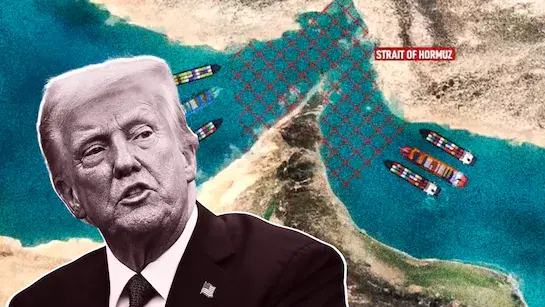

Iran threatened on Monday to deploy naval mines in the Gulf and target power plants across the region in defiance of United States President Donald Trump’s ultimatum demanding that the Islamic republic reopen the Strait of Hormuz.
The escalated rhetoric followed warnings that the world faces an energy crisis more severe than the combined impact of both 1970s oil shocks if the US-Israeli war with Iran continues.
Iran showed no sign of complying with the 2344 GMT deadline to reopen the Strait of Hormuz, or face Trump’s threat to “obliterate” its power plants, as the conflict entered its fourth week.
Instead, Iran warned it would sow “drifting mines” across the Gulf if its coasts or islands are attacked, recalling a tactic used during the 1980s Iran-Iraq war that could further disrupt the vital waterway.
Iran also released maps identifying potential energy targets in the region, including Israel’s two largest power plants and sites in Saudi Arabia, the United Arab Emirates, Qatar, and Kuwait.
“Say goodbye to electricity!” ran the title of one infographic.
“In the event of the slightest attack on the electricity infrastructure of the Islamic republic, the entire region will be plunged into darkness,” said the graphic carried by Mehr news agency.
Israel conducted fresh strikes on Tehran early Monday, with witnesses reporting a thick plume of black smoke rising in the city’s east.
Later in the day, additional blasts were heard in the Iranian capital, though targets remained unclear.
Tehran has retaliated against US-Israeli attacks by restricting traffic through the Strait of Hormuz, a conduit for one-fifth of global crude oil, striking energy sites and US embassies across the Gulf, and targeting locations in Israel.
The head of the International Energy Agency warned that prolonged conflict would lead to daily oil losses creating a crisis worse than both 1970s oil shocks and Russia’s invasion of Ukraine combined.
At least 40 energy assets across the oil- and gas-exporting region are already “severely or very severely damaged”, warned Fatih Birol, with oil prices exceeding $100 a barrel.
“No country will be immune to the effects of this crisis if it continues,” said the IEA boss.
Stocks fell and oil prices rose again on Monday amid exchanged threats between Trump and Iran.
China, the world’s second-largest economy, announced caps on domestic fuel price increases to counter surging oil costs.
Greece allocated relief measures for households and farmers, while a major energy supplier in Cambodia halted liquefied petroleum gas sales due to war-related disruptions.
From Beijing, China’s foreign ministry cautioned against an “uncontrollable situation” if the war expands, while Russia, a key Iran ally, called for renewed diplomacy to ease the “catastrophically tense situation”.
Trump has given varying timelines and goals for the conflict, stating Friday he was considering “winding down” operations before threatening Iran’s power plants.
Iran operates more than 90 power plants, some along the Gulf coast, in a decentralised electricity system with numerous generation sites and hundreds of substations.
Israeli Prime Minister Benjamin Netanyahu described a long-term campaign against Iran’s government, which sponsors Hamas responsible for the October 7, 2023 attack that sparked the Gaza war.
Israel has intensified its ground operations against Iran-backed Hezbollah in Lebanon, anticipating “weeks of fighting”.
The Lebanon conflict has killed over 1,000 people and displaced more than a million, per the health ministry.
Israel highlights its air defences, with Trump and Netanyahu claiming destruction of key Iranian military sites.
However, Iranian missiles penetrated defences over the weekend, striking two southern towns including Dimona near Israel’s suspected nuclear facility, injuring dozens on Saturday.
“We thought we were safe,” Galit Amir, a 50-year-old care provider, told AFP in Dimona.
Rescuers reported a missile landing about five kilometres from what is widely believed to be the Middle East’s only atomic arsenal, though Israel denies possessing nuclear weapons.
On Monday, Israel’s military reported intercepting a new Iranian missile salvo while confirming its artillery had killed an Israeli civilian near the Lebanese border the previous day.
In Iran, at least 3,230 people have died in the war, including 1,406 civilians, according to the US-based Human Rights Activists News Agency.
AFP could not access strike sites or independently verify casualty figures in Iran.