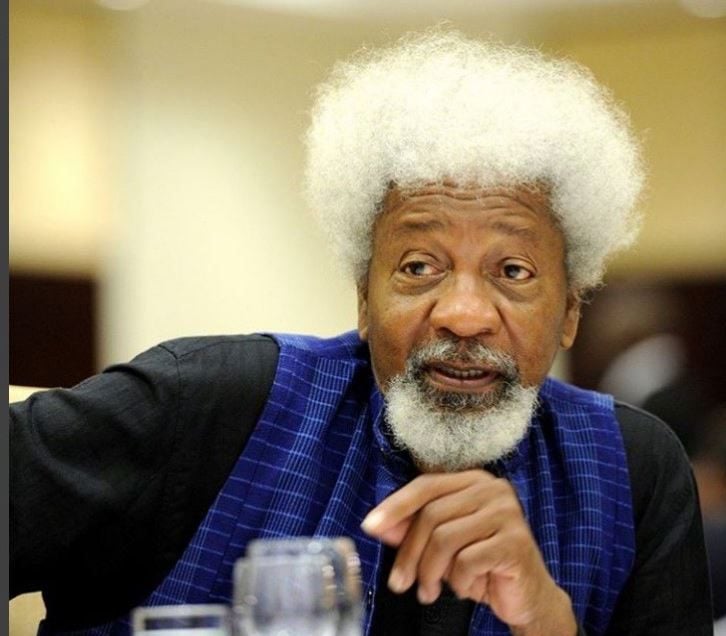
The Nobel laureate, Professor Wole Soyinka, has revealed that he predicted the mass revocation of visas and green cards by the United States Government.
In an interview published by BBC News Pidgin on Facebook on Wednesday, the acclaimed writer, whose visa was recently revoked by the US, said he knew that once Donald Trump got into office as President, “the first thing he will do is cancel even the green cards.”
Soyinka strongly criticized the former President, saying: “This is a petty-minded dictator, you see how he deals with his objects of hate. We saw that dark side of the American side.
There were more killings, extrajudicial killings by the police of black people, of minorities, during that build-up, during the campaign, and on account of hate rhetoric, the hate rhetoric of this individual.”
He affirmed his prophetic insight: “I saw it and I said, listen very carefully — and you can go and check this –I said, ‘When that man comes to power, the first thing he will do is cancel even the green cards’.”
Soyinka’s comments emerged amid rising diplomatic tension between Nigeria and the US, after Trump designated Nigeria a “Country of Particular Concern” over alleged Christian genocide and warned that if the Nigerian government failed to stop the killings, the US would intervene militarily, coming into Nigeria ‘gun-ablazing’, a comment that has generated widespread panic.
Soyinka, a vocal critic of Trump, had famously threatened ahead of Trump’s first inauguration to tear his Green Card once Trump was sworn in, a threat which the Nobel laureate carried out.
Speaking then on the sidelines of an education conference at the University of Johannesburg, the author, who was 82 years old at the time, said: “I have already done it, I have disengaged (from the United States). I have done what I said I would do.” He explained his motivation, adding: “I had a horror of what is to come with Trump… I threw away the (green) card, and I have relocated, and I’m back to where I have always been” – meaning his homeland, Nigeria.
Speaking further in the recent interview, Soyinka said he knew he would not be able to resist making comments on the Trump administration: “I knew I would not be able to resist making comments on what I knew would happen, and sure enough, he did not disappoint me.”
The writer disclosed the recent revocation of his B1/B2 visa by the US Embassy during a media parley last Tuesday in Lagos.
This follows an announcement in July this year by the US Department of State regarding an update to its non-immigrant visa policy for Nigerian citizens, where a press release issued by the U.S. Embassy in Abuja stated that “most non-immigrant and non-diplomatic visas issued to citizens of Nigeria will be single-entry visas with a three-month validity period.”
The US Consulate announced the revocation of Soyinka’s visa in a letter addressed to him dated October 23, 2025, and further requested that he bring his visa to the Lagos Embassy “for physical cancellation,” a request the Nobel laureate described as “a joke.”
The letter also instructed him: “If you have plans to travel to the United States, you must apply again to re-establish your qualifications for a new non-immigrant visa.”
While Soyinka said he did not know the reason for the revocation of his visa, the US Mission in Nigeria clarified last Thursday in response to an inquiry from The PUNCH that visas granted by the country are a privilege, not a right.
The Mission, while noting that it would not discuss details of individual visas, had its spokesperson say: “Visas are a privilege, not a right. Every country, including the United States, can determine who enters its borders. Visas may be revoked at any time, at the discretion of the U.S. government, whenever circumstances warrant.” Soyinka, who had vowed that he would never reapply for a US visa, said in the BBC interview that he had since left the country because he would not allow himself to be “kicked out.”
The 91-year-old author and playwright stated: “I said I’m not going to wait to be told to come for a reinterview or simply told, ‘Get out! The green card is cancelled!’ That’s all. People failed to understand. Even though I said it, people failed to accept it. I said I don’t like to be kicked out; I like to kick myself out, it’s more dignified,” he said.
The Nobel laureate also touched on an incident that happened prior to the revocation of his visa, recalling getting a letter from the US Internal Revenue Service notifying him of a tax audit shortly after Trump took office.
He noted the timing, saying: “After he took office, I got a letter from the IRS telling me to report for an audit. The coincidence for me was very impressive,” he said.
During the earlier Lagos media parley, Soyinka had given an insight into the tax audit, which he said he had no problem with: “I think it’s important for me to begin by reminding us about the history of this visa, which was issued when an accident happened to my Green Card, so it became no longer valid.”
He detailed the letter he received: “Unfortunately, or fortunately, whichever way you want to look at it, not long after that, maybe by accident or maybe it’s related or not, I got a letter from the Internal Revenue Service of the United States of America saying that an audit of my tax return was about to take place, going back about five years.” He noted that audits are done periodically just to make sure one is not cheating, “and that’s okay.”
He explained his visit to the embassy: “So I went to the embassy to say this is the letter I just received from the Internal Revenue Service. My Green Card is no longer usable. I don’t want to be advertised as a tax dodger owing the United States money and being chased all over the world with letters and police, and I said I needed to go in and see the audit, and that’s exactly what happened.”
Soyinka concluded by maintaining that he has no issue with members of the US Embassy or the American people, as he noted he was always treated with courtesy anytime he was at the embassy.