

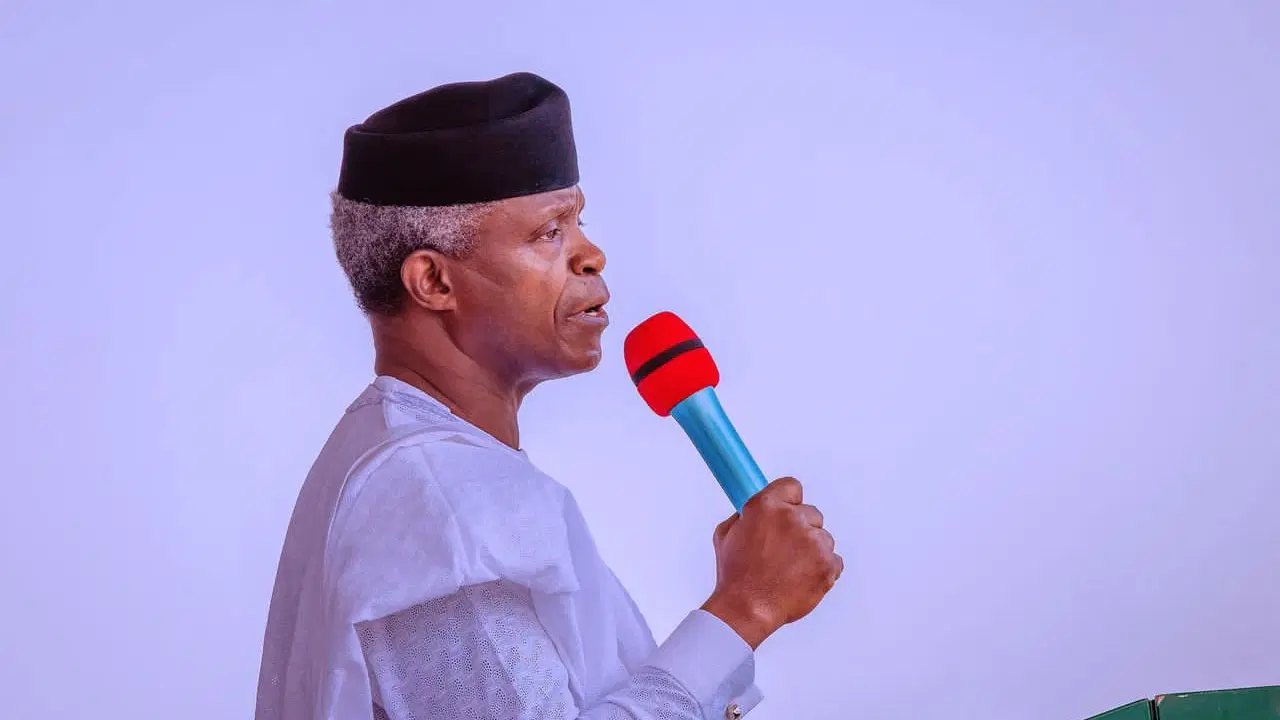
Former Vice President Professor Yemi Osinbajo has called for a paradigm shift in Africa’s development strategy, urging governments and institutions to place social justice at the centre of economic growth.
Osinbajo made the call at the Ford Foundation Office for West Africa high-level anniversary celebration titled “OWA@65: From Nation Building to Social Justice,” held in Abuja.
Speaking on the theme: “Social Justice as an Imperative to Development,” he argued that true progress should be measured not by Gross Domestic Product but by the well-being or quality of life of the citizens.
Reflecting on the current African economic landscape, Osinbajo observed: “Africa is currently the fastest-growing continent in GDP terms. Yet it remains the continent with the lowest overall quality of life. GDP growth does not necessarily translate to jobs or a decent life for citizens.”
He highlighted the disconnect he observed during his tenure as Chair of Nigeria’s Economic Management Team from 2016 to 2019, noting that “When governments talk about growth, citizens wonder what we are talking about. Only big business, banks, and corporates understand those things.”
He stressed the consequence of this failure, adding: “For many, the promise of a better life that democracy offers is simply not there.”
The former Vice President insisted that development should start from the bottom up, not from the top down.
He asserted: “We should not talk about development unless it is tied to the welfare of the majority of our people.” He further explained that “Social justice places the human being not statistics at the centre of development. It produces development that reaches the majority,” stressing that true development must prioritize the welfare of the majority.
He argued that social justice ensures fair access to opportunities, protection of rights, and the resources needed to live a dignified life. He emphasized that inclusion and equality are the drivers of growth that have successfully transformed economies globally.
He concluded his core argument by reiterating that Africa’s greatest wealth lies in its people, stating: “When every policy, every budget, and every reform answers to the needs of the majority, we lay the foundation for genuine progress,” and “Social justice is not charity, it is the bedrock of sustainable development.”
Transitioning to climate justice as a key social issue, Osinbajo warned that climate change is a critical economic issue for Africa, with Nigeria ranking among the 10 most climate-vulnerable countries globally.
He noted the severe future impact, saying: “By 2050, Nigeria could have 9.4 million internal climate migrants, mostly poor rural farmers displaced by floods or desertification. Yet we are not responsible for the crisis—the global north is. Climate justice is therefore a social justice issue,” he said.
He called on global corporations responsible for decades of carbon-intensive activities to fund adaptation and loss-and-damage efforts in vulnerable countries, and stressed that communities affected by environmental degradation, such as in the Niger Delta, should be empowered to negotiate with both the state and resource-extracting companies.
Osinbajo then linked good governance to anti-corruption measures, sharing insights from his co-founding of the anti-corruption organisation Integrity, which was funded by FFOWA in 1994.
He warned that corruption is not just a public sector problem, but a development problem, and “If unchecked, it could cost Nigeria 37 per cent of GDP by 2030,” citing a PricewaterhouseCoopers report. He argued against viewing these efforts narrowly: “Anti-corruption programmes are not just good governance programs. They are social justice programmes. They protect public resources.
They strengthen businesses and create jobs.” He emphasized that when “we build systems of fairness and accountability in government and in the marketplace, we actually unleash increasing economic growth, and we give our people what they deserve, a future that works for everyone,” he said.
In response, the Minister of Budget and National Planning, Sen. Abubakar Bagudu, commended the Ford Foundation for its long-standing partnership, describing the anniversary as timely for deepening collaboration on inclusive development.
Bagudu affirmed the current administration’s commitment, stating: “I have always appreciated the fact that social justice has to do with economic growth and in recognition of that, we are taking on one of the biggest challenges.”
He noted that having stabilized macroeconomic fundamentals and ensured they are facing the right direction, the focus is now on translating that stability into local prosperity: “We are mapping the unique opportunities in the 8,809 wards in the country and that mapping will include how to generate more prosperity in an inclusive manner,” he said.
Dr. ChiChi Aniagolu-Okoye, the Regional Director of FFOWA, recalled that the foundation began operations in Lagos in 1960, supporting initiatives across education, human rights, and environmental justice, among others. She noted that their legacy is not defined solely by numbers, stating: “Our legacy is best reflected in the spirit that underpinned each partnership.”
She asserted the role of Africans in shaping progress: “Progress is not imported, it is imagined, shaped, and owned by West Africans themselves. And social justice is not a luxury; it is the foundation of thriving societies, inclusive growth.”
She added that the foundation “remains steadfast in solidarity” as “young generations demand that democracy delivers not just by allowing to cast a ballot once in a while but through everyday life and opportunities.”
The Senior Vice President of the Foundation, Martín Abregu, noted that while the organization began in the United States, its mission has evolved into a global pursuit of social justice and reduced inequality, working through listening and partnership rather than prescription. He praised West Africa as a source of inspiration for the Foundation, noting the creativity of its youth and the resilience of its civil society.