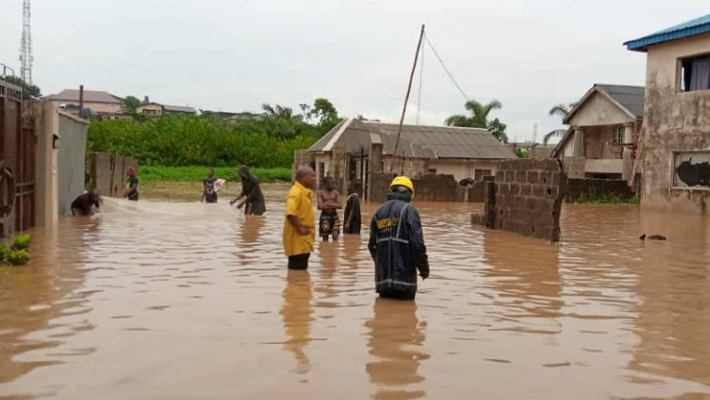

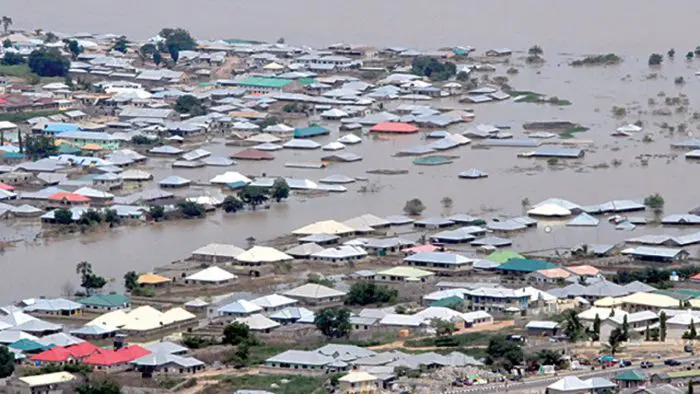
As floods ravage parts of the country, the Nigeria Hydrological Services Agency has predicted that over 18 million Nigerians are exposed to heavy flooding in the 2026 flood forecast.
Speaking exclusively with Vanguard, the Director General, NiHSA, Arc Umar Mohammed, said the predictions were made to ensure state governments do the needful to quickly put in place measures to cushion the impact of the flood.
Speaking through the Head, Geographic Information System, GIS, and Remote Sensing, Emmanuel David Tuna, said the agency’s forecast is for the entire year.
He said: “From our records, we are expecting about 18 million Nigerians to be exposed to flooding in 2026, and until the incident happens before we can tell who is affected because these are all parts of the prediction.
“Over 2,000 hectares of farmlands will be affected. From our forecast, 8,794 educational facilities will be affected, and healthcare centres 3,808.”
Meanwhile, he explained the sources of the 2026 flood, which he said, “We just focused on the rivers connecting to Nigeria. We are expecting intense flooding from Sokoto to Kebbi, and Kebbi will be more intense.
“We are expecting somewhere around Niger after the Kainji Dam. We are expecting intense flooding because we are expecting Kainji Dam to get filled, and with the release of River Niger, Kwara State, some parts of the Federal Capital Territory, FCT, down to Lokoja.
“We are expecting some intense flooding in Lokoja. We are expecting some flooding around Onitsha and Anambra State, and then coming down to Delta and Bayelsa States.
“Adamawa State is the entry point of River Benue. We are expecting flooding right from the border down to Jimeta, spanning down into Taraba State, so we are expecting flooding in Taraba, and all these are heavy flooding from our map.
“We are not expecting Makurdi, the Benue State capital, to be as intense but there is flooding from our forecast in Makurdi this year.”
He also explained that, “We have this flooding in low, medium and high. We also have it in the expected depths of this flood. We have the expected depth.”
However, according to the DG, NiHSA, states had always disregarded their warning and failed to cooperate with his agency when forecasts were made and how to act on their warning and mitigation strategies.
He said, “We have a challenge of cooperation from states, a serious challenge with cooperation from states. Most times, we come before this flood starts because we are not coming when the flood is happening; they are not seeing any impending danger.
“Most times we get disregarded; our warnings are not taken with seriousness or with authority for it to be regulated into the state. We have a program called the National Flood Insurance Programme.
“This programme is to balance the severe effects of flooding so that the impact may not be as intense. We have this document well prepared. What this means is that the flood insurance programme is metric-based.
“We started pitching this to state governments, and at first it looked like engagement but as time went by we started seeing some drawbacks until today as we speak. None of that has been implemented.”
Together with this, he said they also sent letters to some other states, in which they did not get feedback to be invited to present some of their analysis.
“So we have issues with cooperation from the states, each state with its own different situations and the laws guiding that state. It is easier for the states to act on it because they are the point of contact because flooding does not happen at the federal level; it happens at the community level because the states are in charge of this.
“We have all the science regarding this flood. We have channels of communication. We just need engagement from the states to take proper actions before this flood happens. We foresee this flood coming. We want the state to act on it.
“Imagine a situation where we foresee a flood coming but nobody is affected because, at the end of the day, it cannot be entirely eradicated but it can be managed with proper communication. We are expecting the states to engage more. This is one of our biggest challenges.
“We have good coordination at the federal level between all the agencies. The emergency management agency, and this downscaling to the states.”