


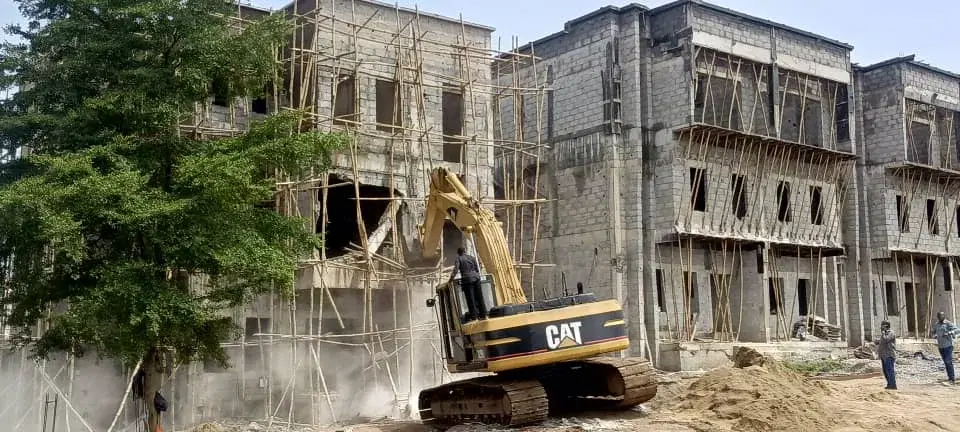
The Federal Capital Territory Administration on Thursday demolished eleven-storey buildings—made up of three and four-bedroom flats—in the Apo-Dutse area.
Mr. Mukhtar Galadima, the Director of the Department of Development Control, FCTA, explained that the demolition was a consequence of the developer’s complete failure to abide by building regulations and their disregard for all official communications and stop-work notices.
Galadima noted that the demolition of the multi-storey apartment buildings was necessary due to the problematic location of the estate. He clarified that the development was not only situated under a significant high-tension line but was also directly obstructing an upcoming bridge planned for the area.
He confirmed that while the developers were initially allocated the plot, the approval for the building plan itself had been specifically declined by his department.
The Director detailed the government’s attempts to halt the illegal construction, stating: “This is a statutorily allocated plot. They requested approval and applied for building plan approval, which we declined because it’s in close proximity to a high-tension line as well as a stream channel.”
He continued, explaining the developer’s non-compliance: “So, we declined to grant approval, but they moved ahead to work.”
Galadima emphasized the long history of official warnings: “We have been serving notices, even from the excavation stage and various stages of development. We even communicated to them in writing that the work should be stopped.”
He expressed disappointment with the developer’s defiant action: “But unfortunately, maybe considering their institution and agency, they moved on.”
Galadima further stressed that the bridge construction plan, communicated by the Engineering Department of the FCDA, made the demolition unavoidable, adding: “So, there’s nothing we can do about this.”
The Director confirmed that the developers had previously been offered an opportunity for an alternative plot allocation, but they had yet to accept it and instead proceeded with the illegal development. Galadima firmly ruled out the possibility of compensation for the demolished buildings.
He explained that compensation is only applicable to property that “has approval and is being cut off by the development process,” adding that in the case of the demolished property, there was no approval.
He concluded by hinting at the possibility of further legal action, including prosecuting defaulting developers and making them bear the penalty, which would include the cost of the demolition.

