





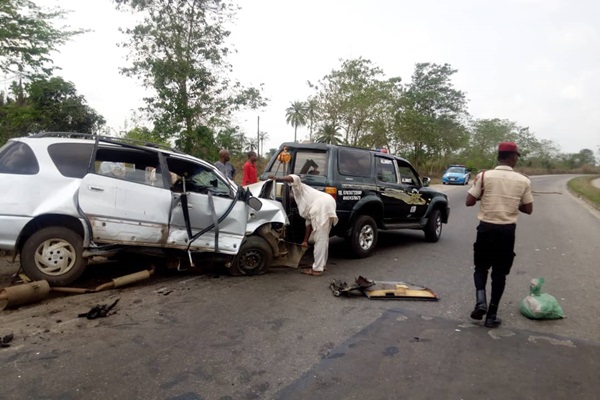
Expert called for a national crash database to combat Nigeria’s high rate of road accidents.
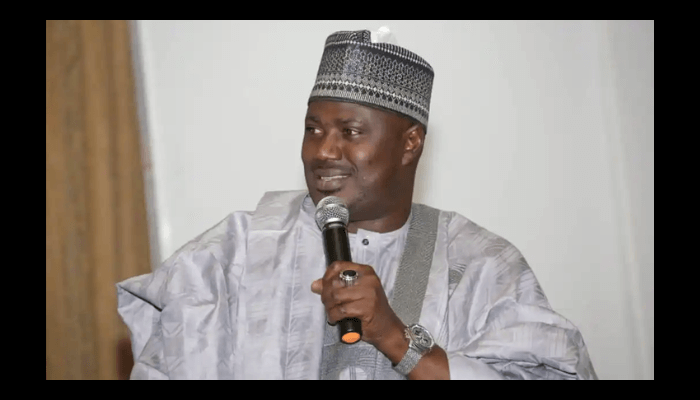
In a statement, Transportation researcher Mujeeb Abdulrazaq warned that Nigeria’s fragmented crash data undermines road safety efforts.
He said that without more accurate and coordinated data, effective policy-making is impossible.
“To address the challenge, there is an urgent need for the establishment of a unified national crash database linking FRSC, police, hospitals, mortuaries, and insurance providers.” He recommended adopting digital reporting tools, GPS-enabled crash logging, and stronger partnerships with academic and research institutions.
“We need to fix the foundation,” he said. “If we can count every crash and every life lost, then we can finally design policies that match the true scale of the problem.”
Abdulrazaq,a specialist in advanced safety analytics, contrasted global best practices—which use data-driven approaches to reduce traffic deaths, with the reality in Nigeria.
He stated that the country’s own crash statistics are too incomplete and inconsistent to support such effective interventions, citing FRSC figures of roughly 10,000 annual incidents resulting in 5,000 to 6,000 fatalities.
He described these official figures as “statistically impossible” for a nation of over 230 million, pointing to independent estimates from international health agencies that place the annual death toll significantly higher.
He stated, “Global modelling suggests Nigeria may be losing close to 40,000 people each year to road traffic crashes. That is an eight- to ten-fold difference. If our official numbers suggest Nigeria has one of the lowest fatality rates in the world, but global indicators show otherwise, then the problem is with the data system, not the analysis.”
Abdulrazaq attributed these discrepancies to structural flaws in Nigeria’s reporting process.
He explained that the FRSC, Police, and hospitals all maintain separate, uncoordinated databases, leading to significant underreporting—especially for rural accidents or cases where victims die after being admitted to the hospital.
To underscore the inadequacy of Nigeria’s data, Abdulrazaq pointed to international comparisons. South Africa, with a population of 60 million, officially records over 12,000 road deaths annually—a rate that makes Nigeria’s official figures seem implausible.
He further noted that the solution lies in emulating countries like Brazil and the UK, which have established unified databases integrating multiple sources like police reports and hospital records.
“Those systems allow officials to know exactly where crashes are happening, why they are happening, and which interventions are working,” he noted.
“That level of visibility is what Nigeria urgently needs.”

