



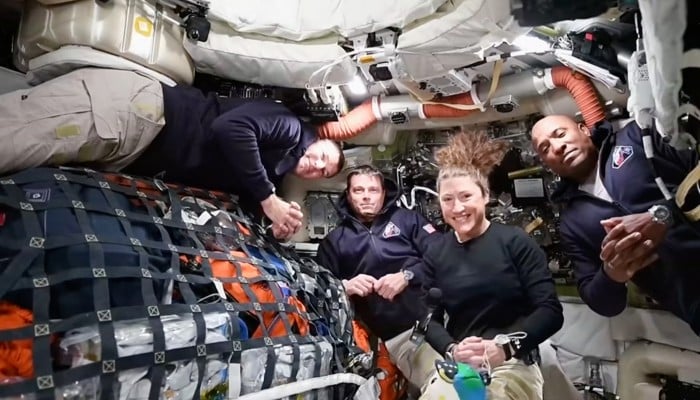
Artemis II and its four-person crew have entered the Moon’s “sphere of influence,” a point where lunar gravity exerts a stronger pull on the spacecraft than Earth’s.
The milestone was reached 39,000 miles from the Moon, four days, six hours, and two minutes into the mission.
The next critical stage comes tomorrow, when the spacecraft swings around the Moon’s far side, carrying humans farther into space than ever before.
At their farthest point from Earth, astronauts Reid Wiseman, Christina Koch, Victor Glover and Canada’s Jeremy Hansen will reach a distance of 252,757 miles, surpassing the Apollo 13 crew’s record by more than 4,000 miles.
They are the first humans to venture beyond the Moon’s threshold since the Apollo 17 landing mission in 1972.
Over the weekend, the crew prepared for their lunar flyby, conducting manual piloting demonstrations, reviewing science objectives for the six-hour observation window, and assessing their space suits, which provide life support in emergencies and for re-entry. Amid the busy schedule, they also made time to admire the breathtaking views from deep space.
In the newest images released by the space agency, the astronauts can be seen looking out at Earth through the Orion spacecraft’s windows.
Orion is set to arrive near the Moon shortly after midnight on Monday, April 6. Later that day, the crew is expected to travel farther from Earth than any humans ever have, breaking the Apollo 13 record of 248,655 miles set in 1970.
The lunar observation period is scheduled to begin at 2:45 PM ET. A few hours later, the crew will pass behind the Moon, temporarily losing communication. Orion’s closest approach is expected at 7:02 PM, coming within 4,066 miles of the lunar surface.
“From that distance, the crew will see the entire disk of the Moon at once, including regions near the north and south poles,” according to NASA.
Later, the crew will witness a solar eclipse, as Orion, the Moon, and the Sun align so that the astronauts will see the Sun vanish behind the Moon for roughly an hour.