The National Agency for Food and Drug Administration and Control on Thursday discovered yet another illegal herbal products factory in Agege, Lagos.
Three unregistered products were allegedly produced there under unhygienic conditions, and one carried a registration number that belongs to a registered cough syrup.
The agency sealed the facility, evacuated the products and arrested the manager, identified as Abulaziz Sayidu, for interrogation. The alleged owner, Ashietu Adams, was said to have fled.
The Deputy Director in charge of the Pharmaceutical Division, Investigation and Enforcement Directorate, NAFDAC, Pharm. Edith Joseph, spoke during an inspection of the facility. She said the agency received intelligence on October 16 about the alleged production of Aishetu Adams Bitters bearing a fake NAFDAC registration number.
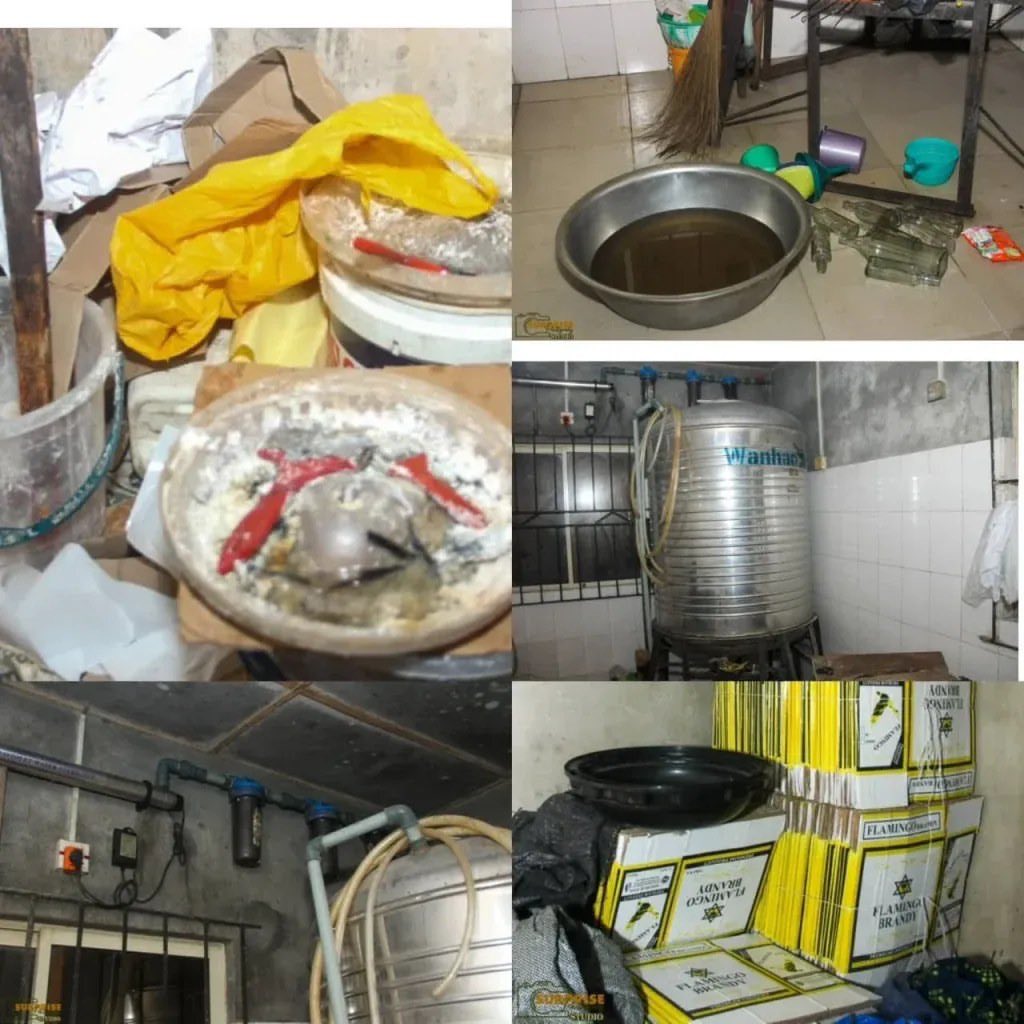
According to her, this prompted surveillance and intelligence gathering, which led to the discovery of the facility hidden inside a residential building.
“What we found was shocking. The facility was in a very poor and unhygienic condition. Look at the water they use for production and the environment where the manufacturing takes place. The products are manufactured outdoors, in the open air. I can tell you that this facility is not approved by NAFDAC,” she said.
The products recovered were identified as Ashietu Adams Herbal Mixture for sexually transmitted diseases, Ashietu Adams Blood Purifier, and another herbal preparation purportedly used for high blood pressure.
Joseph said none of the three products was registered with NAFDAC. She added that the registration number displayed on the blood purifier belonged to a registered cough syrup.
“The number belongs to another registered product, which is a cough syrup. They simply copied the number and placed it on their product to deceive Nigerians,” she said.
She said the products were made without regulatory approval, and their packaging carried neither the manufacturer’s name nor a verifiable address to establish where they came from.
She said the agency had sealed the facility pending further investigation and had taken the recovered products to its office.
Joseph disclosed that Sayidu claimed to have worked with Adams for about a year and to have helped manage the business, especially when she travelled. The manager reportedly told officials that Adams, whom he identified as a Ghanaian woman, had travelled to Ghana.
The agency said investigations were continuing to establish the circumstances of the operation and the whereabouts of the alleged owner.
Joseph cautioned Nigerians against relying solely on NAFDAC registration numbers when buying herbal medicines and other regulated products. She noted that counterfeiters could copy genuine numbers to make unregistered products appear approved.
She advised consumers to confirm product details through NAFDAC’s online verification platforms and the agency’s Greenbook.
“If the name displayed does not match the product being presented, consumers should know that something is wrong,” she said.
She urged consumers, particularly those in rural communities with limited internet access, to visit the nearest NAFDAC office for help in verifying the authenticity of products before buying or consuming them.
The deputy director named the absence of a valid registration number, manufacturer’s name and verifiable address as major warning signs. She added that the agency was stepping up surveillance and enforcement operations against illegal manufacturing outlets.
Also speaking during the inspection, the Deputy Director of Public Relations, NAFDAC, Mrs Christiana Obiazikwor, called for greater public participation in the fight against counterfeit and unregistered products.
Obiazikwor warned landlords and property owners against letting their premises be used for illegal manufacturing. She noted that those found to be aiding criminal operations could face prosecution.
She urged property owners to monitor activities on their premises and report suspicious operations to the appropriate authorities.
“We cannot fight this battle alone. Every Nigerian has a role to play in identifying and reporting places where illegal manufacturing activities are taking place,” she said.
Obiazikwor said NAFDAC was widening public awareness through radio programmes, multilingual jingles and community sensitisation campaigns, including its “NAFDAC and Your Health” programme.
She said the agency also ran awareness campaigns in local government areas, churches and schools to teach Nigerians how to identify suspicious products and report illegal manufacturing activities.
Stressing the importance of product traceability, she said consumers should check details such as the manufacturer’s address and batch number instead of relying solely on a registration number.
“These products do not have batch numbers or the manufacturer’s address. These are important details that help establish the identity and traceability of a product,” she said.
She added that the agency was working towards stiffer penalties for offences involving the manufacture and distribution of counterfeit and unregistered products.
NAFDAC urged members of the public to report suspected illegal manufacturing activities, assuring them that reports would be handled discreetly.
The report spells the owner’s name both as “Ashietu” and “Aishetu”, so please confirm the correct spelling against the original.