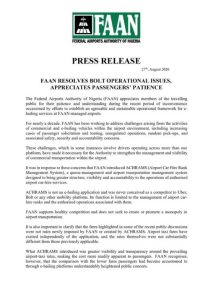





The Federal Airports Authority of Nigeria has cleared ride-hailing company Bolt to immediately resume services at all FAAN-managed airports after the two sides reached an “agreeable operational framework.”
The announcement, contained in a press release dated 27 August 2026 and signed by Henry Agbebire, Director of Public Affairs and Consumer Protection, ends a brief but highly publicised disruption that left many passengers facing higher fares and fewer transport options.
The move follows constructive engagements between FAAN and Bolt. In the statement, FAAN said: “The Authority is therefore pleased to announce that, following constructive engagements, FAAN and Bolt have reached an agreeable operational framework and Bolt is cleared to commence its services at FAAN-managed airports immediately.”
FAAN apologised for the inconvenience caused during the temporary interruption of e-hailing services, acknowledging that passengers experienced increased costs and disruption. The authority stressed that its earlier actions were driven by regulatory, safety and security considerations rather than economic interests, while conceding that “the immediate impact on passengers was significant.” It added: “We have listened, reflected and made the necessary adjustments.”
Decade-long Dispute
For nearly a decade, FAAN has sought to address longstanding challenges associated with commercial and e-hailing vehicles operating inside airport environments. These included passenger solicitation and touting, unregulated operations, random pick-ups, and related safety, security and accountability concerns. In some cases, drivers operated across multiple platforms, complicating oversight.
In response, FAAN introduced the Airport Car Hire Rank Management System, described as a queue-management and transportation management tool intended to bring greater structure, visibility and accountability to authorised airport car-hire ranks. FAAN was explicit that ACHRAMS is not an e-hailing application and was never designed as a competitor to platforms such as Bolt, Uber or others:
“ACHRAMS is not an e-hailing application and was never conceived as a competitor to Uber, Bolt or any other mobility platform. Its function is limited to the management of airport car-hire ranks and the authorised operations associated with them.”
The authority also clarified that the fares highlighted in recent public discussions were not newly imposed by FAAN or created by ACHRAMS. Airport taxi rates, it said, had existed independently and were not substantially different from previous levels. What ACHRAMS did was make those prevailing rates more visible to passengers. FAAN recognised that the contrast with the lower fares many travellers had become used to on e-hailing apps “understandably heightened public concern.”
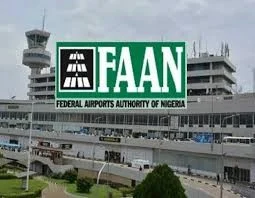
The temporary restriction on e-hailing pick-ups, which affected operations at major hubs including Murtala Muhammed International Airport in Lagos and Nnamdi Azikiwe International Airport in Abuja, triggered widespread passenger complaints and online criticism. Reports and viral posts highlighted cases where traditional airport taxis were quoted at significantly higher rates (in one widely circulated example, around ₦30,000 for trips that e-hailing services had previously offered for far less). Public pressure mounted quickly, prompting the rapid negotiations that produced the Bolt agreement.
FAAN has repeatedly stated that it supports healthy competition and does not seek to create or promote a monopoly in airport transportation. Discussions with other e-hailing operators remain ongoing, with the authority expressing confidence that outstanding issues will be resolved “in the coming days.”
Passenger Choice and Ongoing Assurances
In the release, FAAN reiterated that passengers remain free to choose from available authorised transportation options that best meet their needs. Its responsibility, it said, is to ensure that whichever service they select operates within a safe, secure, orderly and accountable airport environment. The resolution with Bolt, according to the authority, “demonstrates that it is possible to protect the integrity and security of the airport environment while preserving the convenience and freedom of choice that e-hailing services provide to passengers.”
The statement closed by thanking the travelling public for its patience and understanding, and by assuring passengers that “their safety, security, convenience and overall airport experience remain at the centre of FAAN’s decisions.”