
State governments are receiving billions of naira through a relatively new Federation Account Allocation Committee intervention for infrastructure and security, with available half-year budget implementation reports showing that at least N435bn in revenue was recorded under the funding window by 29 states between January and June 2026.
The intervention, classified in state financial records as “State Infrastructure and Security” under the National Chart of Accounts code 11010313, is distinct from the FAAC conventional statutory allocations but distributed as regular FAAC revenue. No amount was disbursed for this purpose in the corresponding period of 2025.
The data was obtained from the fiscal performance of each state, utilising data from the Q1 to Q2 budget performance reports from January to June 2026 obtained from Open Nigerian States, a BudgIT-backed website that serves as a repository of government budget data.
The intervention comes as Nigeria battles worsening insecurity and a huge infrastructure deficit, with banditry, kidnappings, attacks on schools and communities, poor roads and other infrastructure gaps placing increasing pressure on state governments.
Between March 2024 and May 2026, no fewer than 603 pupils, students and teachers were abducted in seven mass school abductions, despite the government’s N145bn Safe Schools Initiative.
The government recently intensified efforts to address the security crisis, including the expansion of the Nigerian Army from eight to 12 divisions and the approval for the recruitment of 28,000 additional soldiers.
However, the scale of insecurity has increased pressure on state governments to also invest more in security and critical infrastructure.
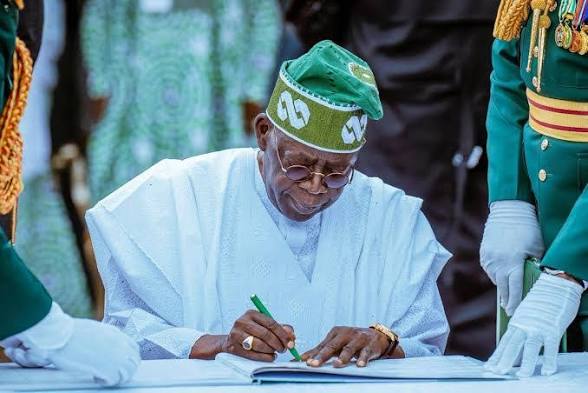
It was against this backdrop, and following the removal of petrol subsidy, that President Bola Tinubu approved the Infrastructure Support Fund for the 36 states in July 2023 to strengthen their capacity to invest in roads, agriculture, health, education, power, water and other critical areas.
A June 2025 publication disclosed that between March 2024 and May 2025, state governments and the Federal Capital Territory received a total sum of N1.6tn for infrastructure and security projects. Three years after the pronouncement, this funding has now emerged as another revenue source for meeting government obligations by sub-nationals.
The review covered 32 states for which information was available. Of the 32 states reviewed, 16 specifically reported a combined N265.50bn under the dedicated State Infrastructure and Security revenue line.
Another 13 states reported a combined N169.75bn as other separately disclosed FAAC-related revenue, although their reports did not classify the money directly as infrastructure and security funding.
The combined amount from the 29 states with identifiable receipts therefore stood at N435.25bn.
Three states, Adamawa, Anambra and Oyo, recorded zero actual receipts under the infrastructure and security line during the period, despite Adamawa and Anambra making budgetary provisions for the item and Oyo expecting an N8bn allocation.
Akwa Ibom was included among the 32 states reviewed, but its available half-year report did not disclose a figure for the infrastructure and security revenue component.
Four states, Bayelsa, Edo, Osun and Rivers, were not covered by the available dataset and were therefore excluded from the calculation.
While Bauchi, Borno, Cross River, Ebonyi, Enugu, Gombe, Imo, Jigawa, Kano, Katsina, Kogi, Kwara, Ogun, Sokoto, Taraba and Yobe clearly reported the dedicated infrastructure and security revenue, several other states recorded substantial sums simply as other revenue distributions from FAAC.
This suggests that the total amount flowing to states through the special revenue window may be larger than the N435.25bn identified in the available accounts.
A state-by-state analysis showed that Enugu recorded the highest cumulative receipt of N27.02bn among states that separately reported a dedicated infrastructure and security revenue line, followed by Gombe with N24.50bn.
Jigawa, Katsina and Ogun each received N19.50bn, while Cross River and Yobe recorded N17.50bn apiece.
Borno received N16.41bn, Bauchi got N14.58bn, while Ebonyi, Imo, Kano, Kwara and Taraba each reported N14bn.
Sokoto received N12.50bn, and Kogi recorded the lowest amount among the 16 states with actual dedicated receipts at N7bn.
However, when states that classified the money under other FAAC-related revenue heads were included, Ondo emerged as one of the biggest beneficiaries, reporting N31.86bn, while Lagos received N30.30bn.
Abia reported N24.50bn, Nasarawa N21.24bn, Niger N15.50bn, while Benue and Plateau each recorded N14bn.
Delta received N5.50bn, Ekiti reported N5.38bn, Kaduna N3.83bn, Kebbi N1.95bn and Zamfara N1.71bn.
The breakdown showed that the 16 states with clearly identified infrastructure and security revenue accounted for about 61 per cent of the N435.25bn total, while the 13 states that reported other separately disclosed FAAC-related revenue accounted for approximately 39 per cent.
The total amount is equivalent to nearly 10 per cent of the N4.55tn federation allocation received by states with available half-year records. It was also equivalent to 20.71 per cent of the N2.10tn generated internally by the same states during the period.
When compared with the combined N6.65tn FAAC and independent revenue, the N435.25bn represented 6.55 per cent.
Further analysis of the “State Infrastructure and Security” revenue line revealed that Gombe State has received N24.50bn against a full-year budget provision of N5bn, representing 490 per cent of its annual estimate within the first six months.
Bauchi recorded N14.58bn, equivalent to 86.6 per cent of its N16.84bn annual budget for the item.
Jigawa received 65 per cent of its N30bn annual provision, while Yobe recorded N17.50bn against a N36.49bn budget, achieving 48 per cent of its annual projection. The state was therefore N18.99bn, or 52 per cent, short of its full-year estimate.
Ogun received N19.50bn compared with its N51.28bn budget, representing 38 per cent performance. This left the state with a funding gap of N31.78bn, or 62 per cent of its annual projection.
Enugu recorded N27.02bn against a N80bn budget, achieving 33.8 per cent of its full-year estimate. The state’s receipts were therefore N52.98bn, or 66.2 per cent, below the amount budgeted.
Similarly, Borno received N16.41bn out of its N49.44bn budget, representing 33.2 per cent performance and a shortfall of N33.03bn, or 66.8 per cent.
Katsina received N19.50bn against a budget of N60.27bn, achieving 32.4 per cent of its annual estimate. The state was N40.77bn, or 67.6 per cent, below its budget projection.
Kwara received N14bn out of N49.62bn, representing 28.2 per cent performance, while Kano recorded N14bn against a budget of N61.07bn, equivalent to 22.9 per cent.
The figures left Kwara with a N35.62bn gap, representing 71.8 per cent of its annual estimate, while Kano was N47.07bn, or 77.1 per cent, below its projection.
Kogi received N7bn against a N39.19bn budget, representing 17.9 per cent performance and leaving a gap of N32.19bn, or 82.1 per cent.
Taraba recorded N14bn compared with its N80.70bn annual budget, representing 17.3 per cent performance. The state was therefore N66.70bn, or 82.7 per cent, short of its annual estimate.
Ebonyi received N14bn against a budget of N88.41bn, achieving just 15.8 per cent. This left an outstanding balance of N74.41bn, representing 84.2 per cent of the state’s projection.
Sokoto recorded one of the widest gaps, receiving N12.50bn against its revised N90bn budget. The amount represented 13.9 per cent performance, leaving a balance of N77.50bn, or 86.1 per cent.
Adamawa and Anambra recorded the biggest percentage shortfalls after receiving no money under the dedicated revenue line by the end of June. Adamawa had budgeted about N35.23bn, based on its revised estimate, while Anambra projected N10bn. Both states therefore recorded a 100 per cent funding gap.
Cross River and Imo received N17.50bn and N14bn, respectively, but the available data did not provide corresponding budget figures for the infrastructure and security revenue line. Their budget performance could therefore not be calculated.