

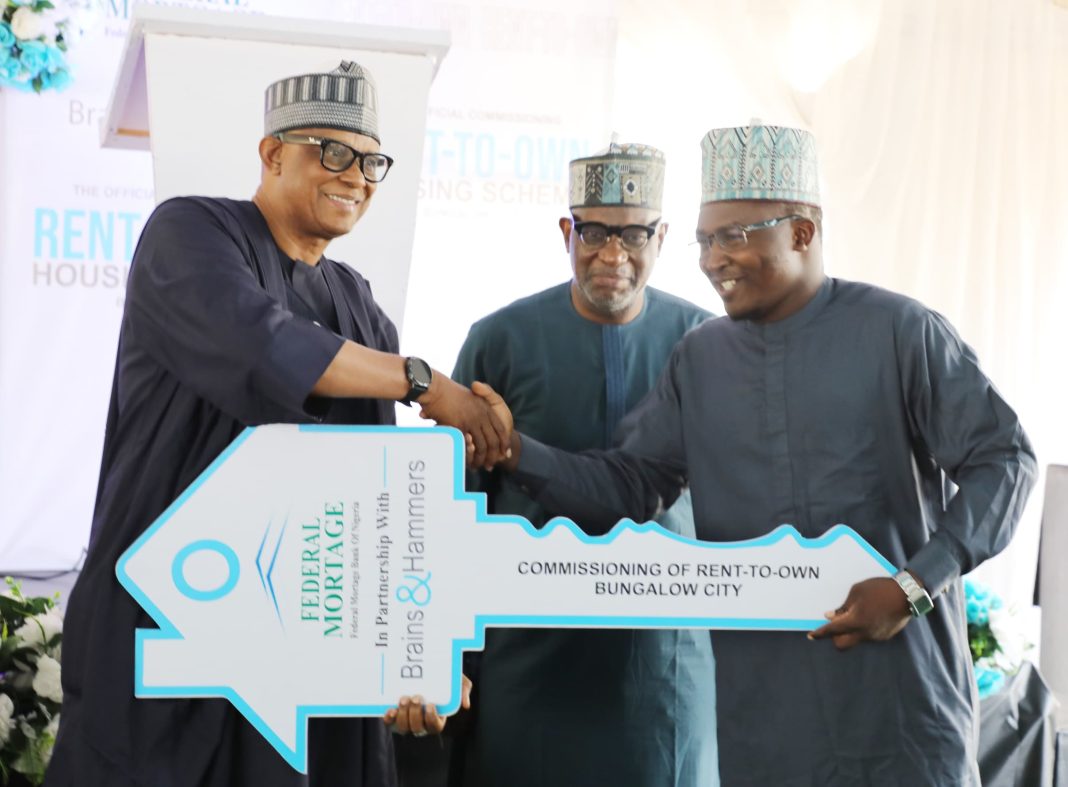
The Federal Government has handed over rent-to-own housing units to beneficiaries in Abuja, marking another step in its efforts to expand access to affordable homeownership for Nigerians.
The handover took place on Tuesday, June 23, during a ceremony held in the Federal Capital Territory, where officials of the Federal Ministry of Housing and Urban Development and the Federal Mortgage Bank of Nigeria formally presented the houses to beneficiaries under the rent-to-own housing scheme.
The rent-to-own initiative is designed to enable eligible Nigerians, particularly contributors to the National Housing Fund (NHF), to move into completed homes and gradually pay for them over an extended period, eventually becoming homeowners without the burden of raising large upfront payments.
Speaking at the event, the Permanent Secretary of the Ministry of Housing and Urban Development, Dr. Shuaib Belgore, who was represented by a ministry official, commended the beneficiaries and reaffirmed the Federal Government’s commitment to making decent and affordable housing accessible to Nigerians.
Darma described the handover as evidence of the government’s determination to bridge the country’s housing gap and improve the welfare of citizens through innovative housing finance solutions.
“This initiative is a practical demonstration of the government’s commitment to ensuring that Nigerians have access to affordable housing and a clear pathway to homeownership,” he said.
Also speaking, the Managing Director and Chief Executive Officer of the Federal Mortgage Bank of Nigeria (FMBN), Shehu Usman Osidi, said the bank remains committed to supporting affordable housing programmes that enable workers to own homes through flexible payment arrangements.
Osidi noted that the rent-to-own scheme removes many of the barriers that have traditionally prevented Nigerians from becoming homeowners, particularly the challenge of sourcing large lump-sum payments.
Beneficiaries who received the housing units expressed appreciation to the Federal Government and FMBN, describing the programme as a life-changing opportunity that has brought them closer to realizing their dream of owning a home. They said the flexible repayment structure makes the homes affordable and sustainable for working Nigerians.
The FMBN Rent-to-Own Scheme was launched in 2018 as part of efforts to make homeownership more accessible and affordable for Nigerian workers.
The initiative was designed to be implemented in phases, with about 3,000 housing units targeted in the pilot phase across the country. The programme aims to address housing finance challenges by eliminating the need for large initial deposits while providing a structured pathway to homeownership.
However, the initiative may not be sufficient to address Nigeria’s housing deficit. The country is facing a housing crisis, with the Federal Government estimating a housing shortfall of about 14.9 million units, according to data from the National Housing Data Technical Committee, underscoring the depth of the challenge.
To tackle this deficit, it is estimated that about 550,000 housing units need to be built annually at a cost of N5.5 trillion over the next 10 years.
Although the initiative might not be able to address the country’s housing deficit, Federal, State, and private firms, have leverage on it as part of efforts to reduce Nigeria’s housing deficit and expand access to homeownership.
In November 2024, the Minister of Housing and Urban Development, Musa Dangiwa, disclosed that government-funded one-bedroom apartments developed under the Renewed Hope Estates Programme were priced between N8 million and N9 million.
He added that similar housing units developed through Public-Private Partnership arrangements under the Renewed Hope Cities programme were priced at about N22 million.
Since the launch of the rent-to-own initiative, both federal and state governments have introduced various housing programmes and financing models aimed at improving housing affordability and increasing access to decent accommodation for low- and middle-income Nigerians.
At the state level, the Lagos State Government announced in July 2025 that it planned to complete more than 14,000 housing units by 2026 as part of efforts to address the state’s housing shortage and expand access to affordable homes.
Earlier in May 2025, the Lagos State Government revealed that it had delivered 9,970 housing units across the state over the previous six years, underscoring ongoing efforts to boost housing supply and homeownership opportunities.