
Lagos State Governor Babajide Sanwo-Olu has revealed that talks are in progress to extend the Red Line rail into Ogun State as part of efforts to ease congestion through an integrated transport system.
Nairametrics reported that the disclosure was made in a statement issued on Wednesday by Gboyega Akosile, Special Adviser on Media and Publicity to the Governor.
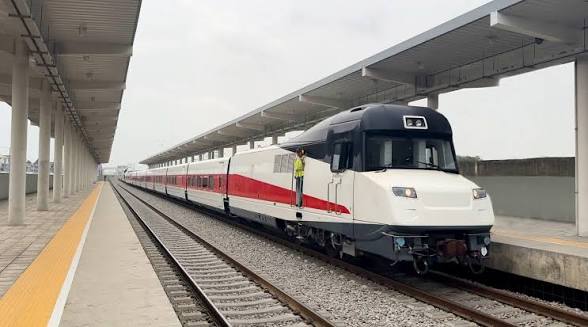
Currently, Phase 1 of the Red Line, which is already in operation, runs from Oyingbo to Agbado, while the second phase, which is under construction, is expected to terminate at Marina, where it will connect with the Blue Line, whose Phase 1 operates from Marina to Mile 2.
Governor Babajide Sanwo-Olu said the planned extension into Ogun State is part of Lagos’ broader transport strategy that integrates rail, road, and water transport systems to improve mobility and reduce congestion.
He explained that the Red Line was designed as a high-capacity corridor to serve both intra-city movement and the large number of commuters traveling daily between Lagos and neighbouring Ogun communities.
According to him, the expansion is intended to strengthen connectivity and improve travel efficiency along the Lagos–Ogun corridor.
“The beauty of the Red Line is that it is twice as large as the Blue Line. While the Blue Line operates four-car trains, the Red Line will run eight-car trains. At full capacity, it will be able to move up to 500,000 passengers daily along the corridor from Agbado to Oyingbo.”
“Discussions are ongoing to extend the rail service further into neighbouring Ogun State to accommodate more commuters.”
He added that Lagos continues to invest in expanding rail infrastructure, including additional rolling stock for the Red Line, which is expected to significantly increase capacity when fully deployed.
He also noted that integration with other transport systems, including the Omi-Eko water transport project, will further strengthen the state’s overall mobility network.
The Lagos State Government recently received 24-car train sets for the Red Line to boost capacity along the Oyingbo–Agbado corridor.
The Red Line is one of Lagos’ key rail projects aimed at reducing traffic congestion and improving connectivity across major transport corridors. It spans 37 kilometres in total, with Phase 1 covering 27 kilometres from Agbado to Oyingbo.
Full passenger operations began on October 15, 2024, after earlier trial runs. The corridor includes eight stations: Agbado, Iju, Agege, Ikeja, Oshodi, Mushin, Yaba, and Oyingbo.
Construction began in April 2021, and the first phase was inaugurated in February 2024. The rail line operates under a track-sharing agreement with the Nigerian Railway Corporation along the Lagos–Ibadan corridor.
The project is part of the Lagos Strategic Transport Master Plan, which provides for six rail lines, with the Blue and Red Lines currently operational.
The second phase of the Red Line is expected to extend from Oyingbo to Marina, linking directly with the Blue Line’s Phase 1 corridor from Marina to Mile 2.
The Red Line is part of a wider Lagos rail expansion strategy under the Lagos Strategic Transport Master Plan, which envisions a multi-line metro system across the state.
The plan is being implemented in phases to improve connectivity across densely populated and high-traffic corridors.
The master plan outlines six Light Rail Transit (LRT) lines, with Phase 1 of both the Blue and Red Lines currently operational under the Lagos Metropolitan Area Transport Authority.
Lagos State has partnered with the Ministry of Finance Incorporated (MOFI) and China Harbour Engineering Company (CHEC) to develop the 68-kilometre Green Line.
The Green Line will run from the Lekki Free Zone to Marina, linking major areas including Victoria Island, Lekki, and Ajah.
The 2025 federal budget provides N146.14 billion in counterpart funding, while the proposed 2026 budget includes N102.3 billion for the project.
However, work is yet to start on the Green Line, which the Lagos State Government valued at $3 billion.