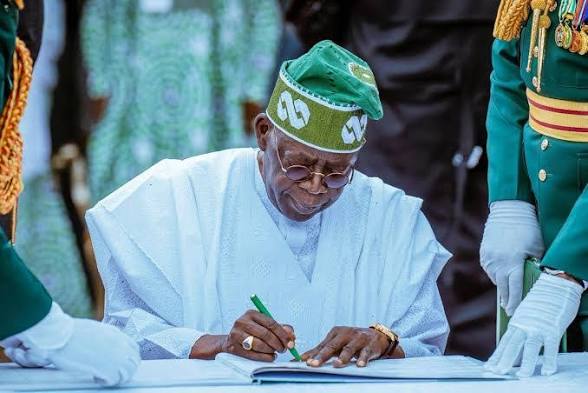

The leadership of the Petroleum and Natural Gas Senior Staff Association of Nigeria has announced plans to meet with the Presidential Implementation Committee on Executive Order 9, which was recently signed by President Bola Tinubu.
PENGASSAN has warned that the executive order poses a serious threat to the stability of the oil and gas industry, describing it as a “direct attack” on the Petroleum Industry Act.
Speaking at the union’s National Executive Council meeting in Abuja on Tuesday, PENGASSAN President Comrade Festus Osifo stated that provisions of the order—particularly the directive to remit 30 per cent of profit oil from Production Sharing Contracts directly to the Federation Account—could destabilise operations at the Nigerian National Petroleum Company Limited and endanger workers’ welfare.
Osifo firmly dispelled rumours of imminent protests by the union, despite widespread claims that the controversial executive order threatens the livelihoods of 10,000 senior staff workers at NNPC.
He noted, however, that the union had begun engagements with government officials, including the Presidential Implementation Committee, and expressed optimism that common ground would be reached.
Osifo, who also serves as President of the Trade Union Congress (TUC), said, “We are a senior staff association, and we are a very reasonable group. Normally, when such issues arise, we hold a press conference to draw the government’s attention, followed by engagements.
“That is exactly what we have been doing. We engaged on Sunday and yesterday (Monday). We will continue with a meeting of the Presidential Implementation Committee on Executive Order 9 on Wednesday to raise our concerns.
“For us, there is no hidden agenda. We don’t politicise issues. We focus first on how they affect our members, then the industry, and Nigerians at large. From the engagements so far, there are green lights, and we believe we can close the gap.”
He added, “From our assessment, the provisions of this order are a direct attack on the PIA. If the government wants to amend laws, it should send them to the National Assembly for stakeholders to debate. The way this executive order was issued could undermine the stability we currently enjoy in the oil and gas industry.”
Osifo expressed concern that diverting the 30 per cent profit oil allocation to the Federation Account Allocation Committee—without clearly defining how the statutory management fee would be refunded to NNPC Ltd.—could affect the salaries of hundreds of PENGASSAN members.
“That 30 per cent of profit oil amounts to between 1.5 and 2.5 per cent of total revenue. It funds the management fee used to pay salaries for those administering the PSCs.
“There are comrades interfacing daily with Shell, TotalEnergies, ExxonMobil, and other operators to ensure Nigeria is not shortchanged. How will their salaries be paid?”
The labour leader also painted a grim picture of the broader economy, arguing that recent claims of declining inflation do not reflect Nigerians’ harsh reality.
“When they say inflation is reducing, it’s a year-on-year comparison. If a product moves from N5,000 to N10,000, and the next year it rises to N10,200, they celebrate that inflation has dropped. But the real issue is that prices have already doubled. Nigerians are still feeling the heat in their pockets. How have rising foreign reserves put food on the table? How has exchange rate stability improved the disposable income of the average worker?”
Osifo noted that oil and gas workers bear heavy social responsibilities beyond their nuclear families.
“We are responsible for our communities and villages. When anything goes wrong, we are the first point of call. So when the economy works, it must work for every individual,” he said.
On insecurity, the PENGASSAN president declared that the government must prioritise technology and adequate funding to curb violence across the country.
“We are in a state of emergency in terms of insecurity. Reduce the plenty of talk and focus on solutions. Devote more funds to security. Nigerian lives must count.”
He urged federal and state governments to invest heavily in infrastructure and electricity, describing power supply as “the backbone of development”.
He added, “Now that power generation has been decentralised and moved to the concurrent list, state governments have no excuses. Electricity must be resolved if Nigeria wants to grow in leaps and bounds.”
Osifo also disclosed that unresolved labour issues persist at the Dangote Group refinery, urging swift intervention by the Federal Ministry of Labour and security agencies.
“We felt by now the issues should have been resolved, but they are still lingering. Efforts must be intensified as soon as possible.”
The labour leader welcomed the growing rig count and improved security along crude oil pipelines, which have boosted production and government revenue.
“When you take your eyes off the ball, things can go wrong immediately. Government must sustain pipeline security because, beyond revenue, it secures our members’ jobs,” he said.
The union renewed its long-standing advocacy for adopting the Nigeria LNG Limited model in managing state-owned refineries, calling for majority private sector ownership to ensure efficiency and shield operations from political interference.
“What we have advocated for over 20 years is the NLNG model: 51 per cent private ownership and 49 per cent government to maintain energy security. When refineries are working before privatisation, their valuation will be much higher.”
Osifo called for sustained dialogue with the Federal Government to safeguard jobs and ensure stability in Nigeria’s oil and gas sector.