
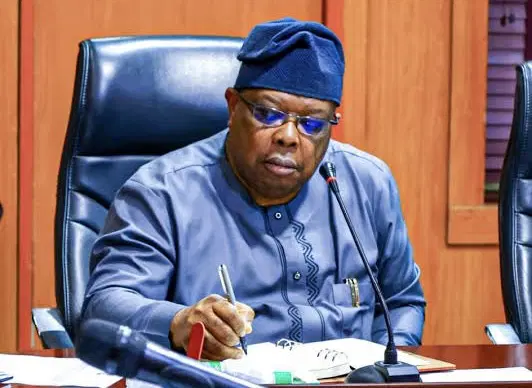



The Minister of Finance and Coordinating Minister of the Economy, Mr. Wale Edun, stated that sustained economic reforms and increased private sector participation are key to Nigeria’s goal of achieving at least seven per cent GDP growth by 2027–2028.
Speaking on Tuesday at the African Business Convention in Lagos, Edun emphasized that Nigeria remains on track for accelerated growth, despite challenging global financial conditions and rising geopolitical uncertainties.
Edun, represented by the Permanent Secretary of the Federal Ministry of Finance, Mr. Raymond Omachi, said the government’s economic strategy prioritizes restoring macroeconomic stability, enhancing productivity, and deepening inclusion, rather than depending on oil-driven growth.
He said, “Nigeria must return to a path of growth of at least seven per cent, that is what we are working on every day. Not oil-driven growth but sustained, inclusive and productivity-led growth. The global economic environment is challenging, but Nigeria’s direction is clear, and we are following it consistently. The foundation is being laid, the reforms are taking hold, and the ambition is unwavering. Seven per cent growth, millions lifted out of poverty in Nigeria, is not a distant dream and aspiration; it is already here. It is a shared project; we need to work together.”
The minister also highlighted the crucial role of the private sector in driving economic growth.
“For Africa, growth must be domestically driven, private-sector led and productivity-focused. We must mobilise our own resources, use technology to overcome constraints, and convert our greatest asset, our people, into skilled, productive participants in the global economy. Nigeria, as Africa’s largest economy and most populous nation, has both a responsibility and an opportunity to lead.
“Since May 2023, Nigeria has embarked on a coherent, disciplined, reform-oriented economic programme built on two core goals. First, to restore macroeconomic stability and credibility so private investment can thrive. Second, to rebuild government capacity so the state can invest strategically in the foundations of long-term growth: education, healthcare, infrastructure and human capital. To achieve this, the government has taken bold and sometimes difficult decisions. Reforms are often painful. They affect people in the short term, but they are necessary for long-term improvement,” he said.
Highlighting the pivotal role of the private sector, Edun noted that the government must provide macroeconomic stability, robust infrastructure, consistent policies, and a transparent, business-friendly environment.
“The private sector is the engine of Nigeria’s goal. The government’s role is to provide stability, infrastructure, policy consistency and a transparent, business-friendly environment. We are seeking investment that builds factories, investment that builds skills, technology and a regional value chain. Nigeria is not just open for business, Nigeria is reforming to accelerate business,” he said.
In his address, the Chairman of the Nigerian Exchange Group, Umaru Kwairanga, said the exchange is committed to supporting Nigeria’s $1 trillion economic growth agenda.
Kwairanga emphasized that platforms like the African Business Convention play a vital role in turning dialogue into tangible partnerships, enhancing investor participation, and building resilient financial ecosystems that foster inclusive growth.
The event’s convener, Dr. Ogho Okiti, said the convention aims to turn discussions into strategic partnerships and initiatives that promote sustainable growth across Africa while bridging the continent’s investment, policy, and skills gaps.


