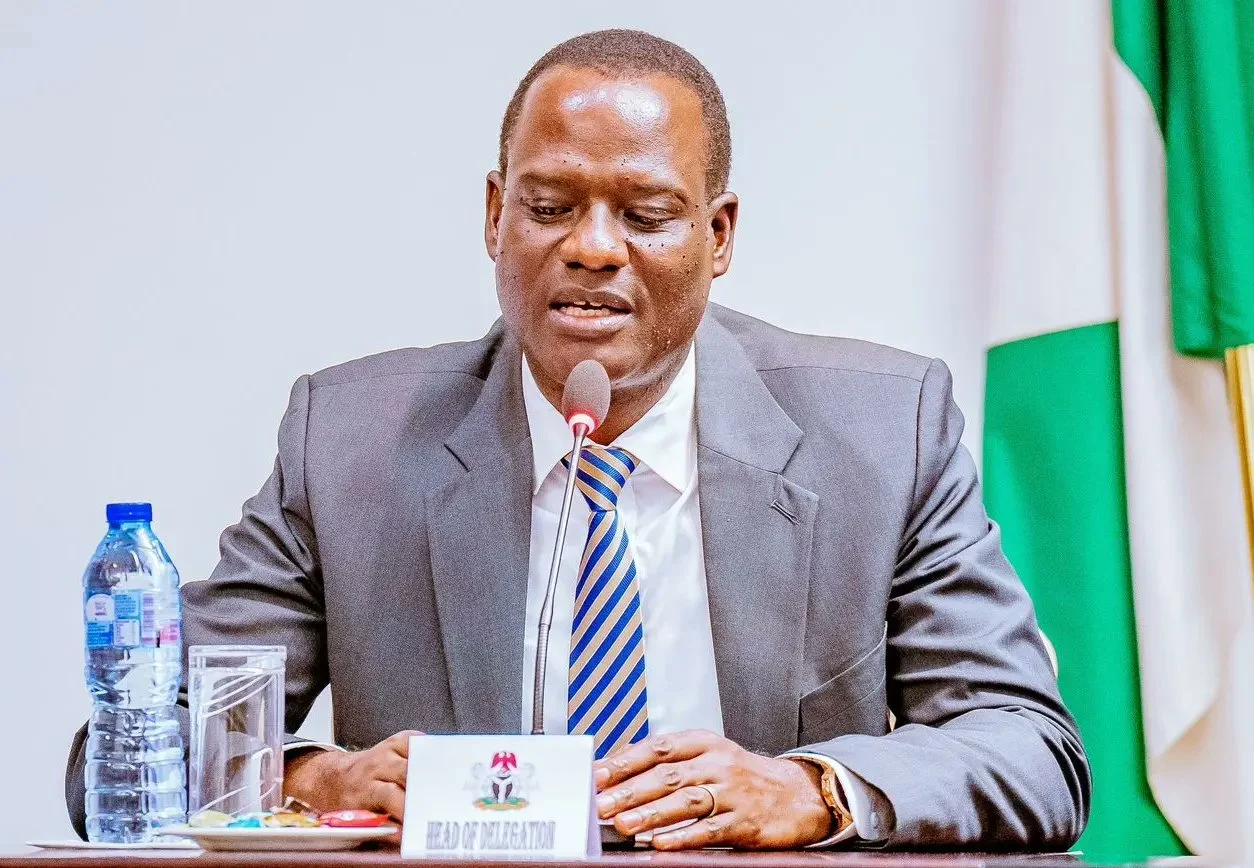


The Group Chief Executive Officer of the Nigerian National Petroleum Company Limited, Bayo Ojulari, has assured Nigerians that the ongoing price competition in the downstream petroleum sector will ultimately favour consumers.
Ojulari said the present tensions in the market are a natural outcome of Nigeria’s shift from near-total reliance on fuel imports to domestic refining capacity.
“Where there is healthy competition, the buyers are the ultimate beneficiaries. And I think for us, we need to keep our minds that the market will stabilise.
“After a while, there’ll be some tension, because we’re going through a major transition,” Ojulari told journalists after briefing President Bola Tinubu in Lagos on Sunday.
The comments were made against the backdrop of an intense price war in the downstream sector, which has seen petrol prices drop sharply from over N1,200 per litre in November 2024 to as low as N739 per litre at some retail outlets in December 2025.
The sharp decline in prices has been driven largely by competition among Dangote Refinery, NNPCL and independent petroleum marketers.
“At the end of the day, I can tell you that Nigerians on the street are going to be the beneficiaries,” Ojulari declared.
Clarifying the role of NNPCL in the deregulated market, Ojulari stressed that the company no longer determines fuel prices or performs regulatory functions under the Petroleum Industry Act.
“The first thing you have to know is that the PIA did something fundamental. Before the PIA in 2021, which rolled in 2022, everything was under NNPC, including some regulations. The PIA divided the roles of regulation from what I will call the business,” he explained.
Ojulari further stated, “The NMDPRA is responsible for all downstream regulation and midstream, as you know, and the NUPRC is responsible for all upstream regulations.
“So it’s very important that Nigerians understand that post-PIA, we as NNPC are not regulators.”
He noted that the Petroleum Industry Act repositioned NNPCL as a profit-driven entity.
According to him, NNPCL has been established to function as “a commercial company, which means a company that needs to compete profitably and be successful profitably.”
Ojulari also disclosed that the company no longer receives allocations from the Federation Account and must now raise funds independently.
NNPCL, he said, now operates “like any other business.”
Nigeria’s downstream petroleum sector has experienced heightened competition since September 2024, following the commencement of local petrol production by Dangote Refinery, Africa’s largest single-train refinery with a capacity of 650,000 barrels per day.
Data from the National Bureau of Statistics showed that the average retail price of Premium Motor Spirit declined by N153 per litre between November 2024 and November 2025, falling from N1,214.17 to N1,061.35 due to improved supply and increased competition.
The price war escalated sharply in December 2025 after Dangote Refinery reduced its ex-depot price from N970 to N699 per litre.
This forced other market players to cut prices in order to remain competitive.
MRS filling stations, Dangote’s retail partner, began selling petrol at N739 per litre nationwide, while NNPC retail outlets reduced prices from N875 to between N825 and N840 per litre, depending on location.
Independent marketers also followed suit, with some selling petrol at prices as low as N865 per litre.
Figures from Petroleumprice.ng showed that Dangote Refinery made more than 20 price adjustments in 2025 alone.
The rapid price cuts have created challenges for marketers who purchased products at higher prices and are now compelled to sell at a loss or risk losing customers.
The Marketers Association of Nigeria confirmed that “price competition now determines customer loyalty.”
Its spokesperson, Chinedu Ukadike, said “any marketer unwilling to adjust prices risks losing patronage and facing mounting bank interest costs.”
Ojulari described NNPCL as “the supplier of last resort,” adding that the company works closely with all key downstream players, including Dangote Refinery, “in which we have an interest,” to ensure consistent product availability.
“For us as NNPC, our focus is to generate more production. As we generate more production, we believe there’ll be more production to feed the refineries as much as possible.
“We also believe the additional production will create more flexibility in terms of ability for downstream players to be able to participate effectively,” he stated.
He acknowledged that the simultaneous operation of large refineries such as Dangote Refinery and NNPCL’s rehabilitated facilities has disrupted the existing market balance.
“To be honest with you, by the time you have a refinery like Dangote in-country, which has not been there before, with NNPC refinery now under a major relook, such a huge refinery in the country, you can expect the market will be impacted right now.
“All we need to do together is to walk through that reality,” Ojulari said.
“Reality is a great thing to have a major refinery in Nigeria, supplying West Africa and other parts of the world.
“The question now is, how do we then ensure that the market forces stabilise so that everyone can be okay,” he added.
Ojulari said NNPCL would allow the Nigerian Midstream and Downstream Petroleum Regulatory Authority to handle competition issues in the sector.
He noted that “we will let the NMDPRA manage the issue of competitiveness,” adding that “competitiveness is not easy, and I think in these early stages, we are seeing a lot of tension with willing buyer, willing market.”
Before the entry of Dangote Refinery, Nigeria’s petroleum sector was marked by near-total dependence on imported fuel, despite the country being Africa’s largest crude oil producer.
Under a heavily subsidised regime, NNPC maintained a virtual monopoly over fuel imports and distribution.
The removal of fuel subsidies by President Tinubu in May 2023 led to petrol prices rising sharply from about N195 per litre to more than N1,030 per litre by October 2024.
This development worsened economic conditions for Nigerians already grappling with inflation exceeding 30 per cent.
Although the Federal Government attempted to restart the Port Harcourt refinery in November 2024, fuel imports remained critical until Dangote Refinery significantly increased output in late 2024 and early 2025.
Ojulari said he briefed President Tinubu on NNPCL’s production performance in 2025, revealing that crude oil output increased from 1.5 million barrels per day last year to over 1.7 million barrels per day currently.
“Some of those are underpinned by very structural changes within the organisation,” he explained.
He added that gas production has also increased from 6.5 billion standard cubic feet per day to more than 7 billion standard cubic feet daily.
The NNPCL chief said the company aims to reach at least 1.8 million barrels per day in 2026, in line with President Tinubu’s target of 2 million barrels per day by 2027 and plans to attract over 30 billion dollars in investment by 2030.
Ojulari further disclosed that NNPCL has completed the welding of the main line of the Ajaokuta-Kaduna-Kano gas pipeline, including the crossing of the River Niger.
“You remember sometimes in summer, we were able to cross the River Niger, which has been a struggle for many years.
“By completing this main line, what that means now is that we can begin to connect, make all the connections to the main line, which we will do in the earlier parts of next year,” he said.
The 614-kilometre AKK gas pipeline is expected to deliver gas to northern Nigeria to support industrialisation, fertiliser production and power generation when commissioned in early 2026.
“We believe that we are in a good state to be able to commence the implementation,” Ojulari stated.